
World's Best Taekwondo Coach Rosendo Alonso Finds New Success in Egypt
World-renowned taekwondo coach Rosendo Alonso, fresh from leading France to Olympic gold, has quickly achieved significant international success with the Egyptian national team, aiming for their first Olympic gold medal.
Rosendo Alonso is back in Tenerife for Christmas, taking time to reconnect. His career as a taekwondo coach has always been about moving, adapting, and aiming high, never letting borders limit him. Now, with a new project in Egypt already showing great results, he's once again considered one of the best in world taekwondo.
Since leaving Tenerife, Rosendo, who won the island's first national youth gold medal in 1995, has traveled extensively, experiencing many countries and cultures, and achieving numerous successes. He started as an athlete but truly made his mark as an internationally renowned coach. His career has taken him to Guatemala, Mexico, South America, France, and now Egypt. This journey explains why Alonso is seen as one of the most influential coaches in taekwondo today.
His time in France was undoubtedly the most successful part of his career. From 2018 to 2025, Alonso guided French taekwondo through an incredibly successful period. This included three Olympic medals, with Althéa Laurin's historic gold at the Paris 2024 Games, four World Championship medals, seventeen Grand Prix medals, and eighteen European medals. This impressive record speaks for itself and helped him earn the title of best coach in the world in 2023.
However, even the most successful periods eventually end. After the Games, changes within the French team led to a feeling of unease. "We weren't very comfortable, and everything has a beginning and an end," he explained. France had been where he achieved a dream – winning the country's first Olympic gold – but it also marked the end of an era. The two Olympic medals, including one gold, changed French taekwondo history, but also closed a chapter for Alonso and his wife, Gülsah Kuscu, which is why he often speaks in the plural.
After two months of rest and reflection in Turkey following the Olympics, the chance to return to Egypt came up. Rosendo knew Egypt well, having worked there from 2015 to 2018 and winning an Olympic bronze medal at Rio 2016. This time, the situation was also good personally: it was close to Turkey, he had existing connections, and there was an ambitious project waiting. He called it "a good opportunity." What he didn't expect was how quickly success would follow.
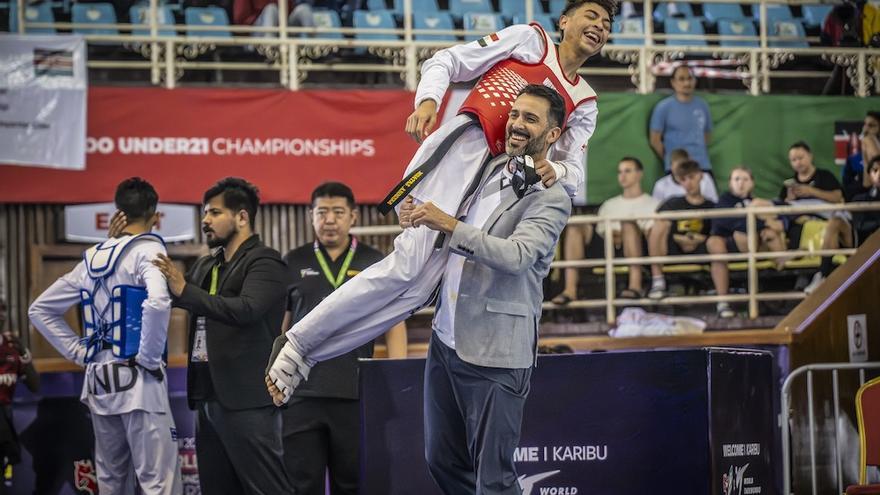
Just weeks after he started, Egypt won a gold and a bronze medal at the Senior World Championships in China. Rosendo, however, downplays his role, explaining, "In three or four weeks, you're not going to make a world champion." Seif Eissa's gold in the men's -87 kg category was Egypt's first world gold in 28 years. Alonso had coached Eissa before during his previous time in Egypt. Still, he credits the federation's earlier work rather than taking full credit. Despite this, he clearly felt satisfied. This feeling grew when, soon after, the U21 World Championships showed it wasn't a fluke. In Kenya, Egypt secured another gold, two bronzes, and finished fourth in the team rankings. There, he admitted to feeling "a little more involved."
The Egypt Rosendo returned to is very different from the one he left almost ten years ago. He describes it as "much more modern." The country's infrastructure has greatly improved, development is clear, and the atmosphere feels "less chaotic than 10 years ago." While he notes no major cultural shifts, the overall environment is now better suited for high-performance training. For someone who values details, planning, and stability, this change is crucial.
If one word defines his career, it's "adaptation." Rosendo avoids strict methods or one-size-fits-all approaches. He explains, "you can't just arrive and apply the same method everywhere." With his wife, he has learned to understand each unique situation, culture, and athlete. "We try to be a bit like chameleons," he says, describing his flexible approach that combines teaching, psychology, and adaptability. For him, his connection with athletes extends beyond the training mat. Factors like family, responsibilities, communication, and surroundings all impact performance. This might be why he proudly states they've never faced problems in any country. Adapting has not only opened doors but also helped them continue learning and experiencing different cultures.
Looking back, Rosendo admits he never expected such a traveling career. He says "everything has gone smoothly." He sees himself as ambitious but also someone who can go with the flow. "Opportunities have come my way, and I've seized them," he explains. He has no regrets about his journey, including successes, mistakes, and lessons learned. Instead, he is "grateful for everything he has been able to do." His plans are clear and calm: to continue coaching until the Los Angeles 2028 Olympics, and most importantly, "to enjoy the moment."
None of this would be possible without his wife. They share their life, work, and the pressures that come with it. "Thanks to being together, we can live this lifestyle," he says. Traveling, competing, and handling responsibilities are easier when they work as a team. He believes that working together has been "much more positive than negative."
He confirms that the Olympics are his main goal, and his ambition is as strong as ever. His aim is "to do something that has never been done before." For Egypt, this means striving for an Olympic gold medal, which they have never won. He explains, "We have good potential with a young group; almost 80% of the athletes are under 21, and that gives hope of achieving good results in the future, because they are athletes with a lot of potential."