
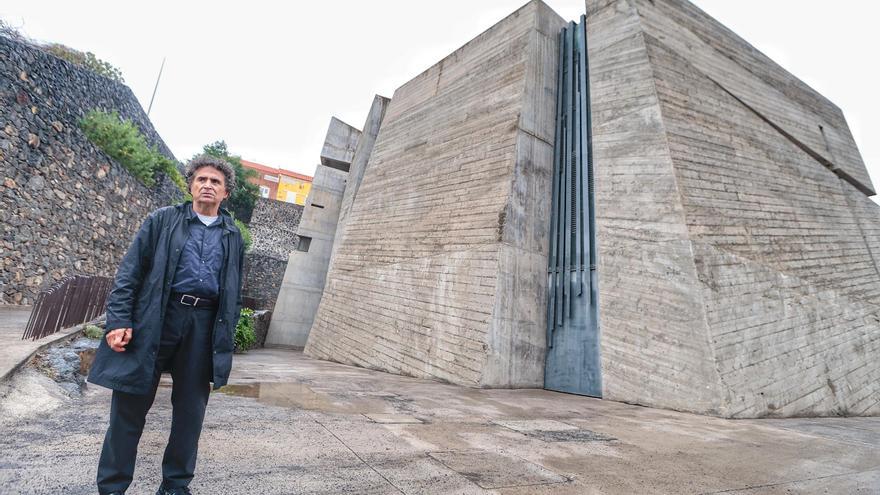
World's Best Church Architect, Fernando Menis, Reflects on 17-Year Labor of Love and Community Connection
Architect Fernando Menis's Church of the Most Holy Redeemer, a project spanning 17.5 years and funded by gradual donations, has been recognized internationally for its innovative design and community integration.
Three retired women, looking every bit the former teachers they once were, finished their yoga class. As they walked past the Church of the Most Holy Redeemer in Las Chumberas, they noticed a buzz of activity. "Something's happening here," one of them whispered to her yoga instructor. Around a dozen young people were gathered outside the building, which had just been named the best in the world at the World Architecture Festival. The boldest of the women approached one of the young men as he finished a phone call.
"Are you Fernando Menis?"
"Yes?"
"The architect of the church?"
"Yes, that's me..."
"Thank you, thank you so much..."
"You've given us a wonderful gift."
"Thank you. Let's hope we can finish it!"
"We saw it on TV yesterday."
"Yes, they told me..."
The brief chat between Fernando Menis, the architect, and the neighbors touched on yoga, plans for a calisthenics area near the church, and the importance of bringing the community together around the project. The church itself sits near vacant homes and a neighborhood undergoing revitalization. The surrounding area is a mix of car dealerships and industrial buildings below, with limited space for more commercial development above.
Menis, whose brother was once president of the Canary Islands and whose wife, Dulce Xerach, he calls his "emotional driving force," mentioned that he'd heard a copy of the church had been built in Korea but wasn't interested in seeing it. He then emotionally described his wife as "the luck of my life." Before explaining his work, he warned that the church "is not easy to understand."
As the women were leaving, they asked for a photo with the architect, much like a child asking a famous footballer for a selfie. Phone numbers were exchanged. Menis, rather than seeming like a renowned architect, came across as a local official kindly addressing residents' concerns. "This needs to be fixed," they commented as their conversation ended.
When asked if the Church of Las Chumberas was his Sagrada Familia, Menis chuckled. "Given the time it's taking me to finish it, yes. I've never taken so long on a project," he admitted, a hint of happiness in his voice. He added, "I always finish what I start. It's been 17 and a half years of a lot of struggle. Almost 18 years of joys, sorrows, hopes..." He explained that the project began when a delegation from the bishopric approached him after he finished another building, the Magma in Adeje. They wanted him to create something similar for the Church of Las Chumberas. Menis, with over 40 years of experience, was surprised but intrigued.
Menis acknowledged that his design isn't always understood. He recalled people asking when he would "dress the walls" or "plaster them," referring to his use of concrete and volcanic stone. He explained that his choice of materials is always influenced by the local region, using more wood in Switzerland and bricks in Poland. "Here, volcanic stone was essential," he stated.
He attributed the project's slow progress to the gradual arrival of donations. "Each person gives what they can afford," he noted, emphasizing that the contributions of ordinary people hold the same value as larger sums. He confirmed that the project has largely followed his original plan, though the choir had to be cut due to budget constraints.
Menis believes the church's location is ideal, perfectly suited for his vision. He shared an anecdote about a woman who questioned why he was building such a beautiful church in Las Chumberas instead of a more central area. His response was firm: "It is where it should be. All my work has a reason; it's not something that happens by chance." He aimed to create a central point, bringing life to an area that lacked it. He also pointed out that some people feel more comfortable confiding in a priest than going to the police, highlighting the social role the church will play as the neighborhood rebuilds.
Although not a devout churchgoer, Menis, who is Christian and Catholic, felt he understood the bishopric's vision. He praised them as "by far, the best client I could have," for giving him the creative freedom he needed. He contrasted this with a proposal to build a Buddhist temple in India in just six months, a project he declined, stating he had no knowledge of Buddhism and wouldn't learn enough in that timeframe. The Church of Las Chumberas, often called "the cave," represents Menis's personal interpretation of Christ's resurrection, focusing on light and open spaces.
Much of the church's natural light comes from a large, unglazed cross facing east, designed to capture the sunrise. The interplay of light and shadow enhances the contemplative atmosphere of the building, which is divided into four sections. Menis described it as "a slice of bread that has been growing as the money arrived." Each section was completed as funding became available, culminating in an altar next to a small chapel housing a blessed virgin. A central corridor features the Via Lucis, depicting the fourteen stations of the Resurrection.
The Church of the Most Holy Redeemer, located in the Las Chumberas neighborhood of San Cristóbal de La Laguna, was designed by architect Fernando Menis. The project, which includes a parish center, covers 1,050 square meters, with 538 square meters built and 512 square meters for urbanization. The structure is reinforced concrete, utilizing concrete and volcanic stone. Construction took 17 and a half years, with a cost of 2,000,000 euros.
Menis, who describes himself as stubborn and a "long-distance runner" in his profession, believes that meticulous architectural planning, the innovative use of light, and careful attention to acoustics are crucial to the building's success. He acknowledges that some finishing touches remain, such as completing the urbanized areas and the priest's wardrobe. The project began under Mayor Ana Oramas and has spanned the terms of four mayors.
The design features independent volumes, allowing for flexibility with funding, and evokes volcanic formations. Different concrete techniques were used to manage acoustics and temperature. Menis is unsure if he would undertake such a long project again at his age, but he enjoyed the process due to the bishopric's support. He jokingly added that he should be paying for the opportunity.
The Church of Las Chumberas has gained international attention and has been used as a filming location, notably by Apple TV for the series "Foundation." Menis confirmed that the income from this filming helped accelerate the construction. He expressed surprise at the building's growing global profile, especially after winning the International Frate Sole Prize for Sacred Architecture. The bishop of Tenerife, Eloy Alberto Santiago, visited the church and was impressed, as were the local residents, according to Menis.