
Virgin of Candelaria: Canary Islands' Patron Saint Celebrated Across Spain
The Virgin of Candelaria, patron saint of the Canary Islands, is widely celebrated across Spain, inspiring numerous Holy Week brotherhoods and local traditions, even as her special visit to Santa Cruz de Tenerife concludes.
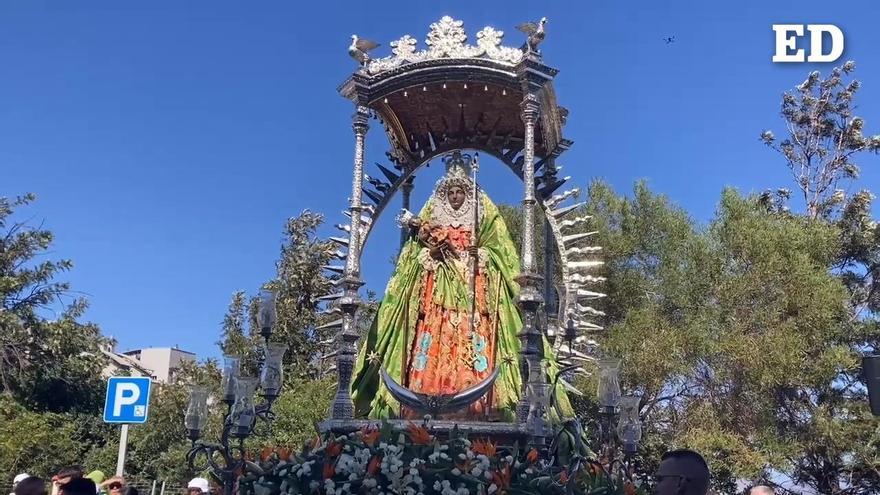
The Virgin of Candelaria, the patron saint of the Canary Islands, is celebrated far beyond the islands. This popular devotion is widespread across Spain, with her image appearing in processions in many cities. She inspires numerous Holy Week brotherhoods, who often name their own statues after her. For people in the Canary Islands, the Virgin, whose visit to Santa Cruz de Tenerife is almost over, represents unity and faith, and her influence reaches well beyond their shores.
Andalusia, in particular, shows great devotion to the Virgin of Candelaria. Many brotherhoods there have named their Virgin statues after her, highlighting her deep significance in Spanish Catholic tradition. In cities such as Seville, Cordoba, and Malaga, the Virgin of Candelaria is carried through the streets under a canopy, with thousands of followers joining her during Holy Week or on her feast day, February 2nd. Several legends also link the Canary Islands to mainland Spain through the Virgin.
"La Morenita," or "The Dark-skinned One," changes her appearance depending on the region where she is celebrated. In the Canary Islands, she is a small, dark-skinned carving, about 90 cm tall, holding her child. On the mainland, she often transforms into a grand "candelero" (mannequin) statue, sometimes over 1.60 meters tall, carried on impressive floats by "costaleros" (bearers).
The village of Colmenar in Malaga has its own Virgin of Candelaria with strong connections to the Canary Islands. Local tradition says that around 1700, nine sailors from the Canary Islands were caught in a fierce storm off the coast of Malaga. In their desperation, they prayed to their patroness, the Virgin of Candelaria, promising to build a chapel on the highest mountain they could see if they survived.
The sailors safely reached land and kept their word, building a chapel in the Colmenar hills, where the Virgin's image is still honored today. In 1884, after a terrible earthquake hit Andalusia, the surviving residents declared the Virgin the Patroness of Colmenar, naming her the town's protector. Today, the Virgin of Candelaria is also the Perpetual Mayoress. During her procession, she carries the town's official staff and pauses outside the homes of the sick, in one of the most moving celebrations in La Axarquía, a region within the province.
The February 2nd celebration is particularly special in Colmenar. The procession of their patroness fills the streets with worshippers, showing that the devotion of those nine Canarian sailors lives on. Additionally, Malaga City also has a Holy Week brotherhood that processes with the Virgin of Candelaria.
Seville's Brotherhood of Candelaria boasts one of the city's most beautiful and uniquely historical images. Founded in 1921 at the church of San Nicolás de Bari, the brotherhood didn't acquire its main statue until three years later. In 1924, sculptor Manuel Galiano Delgado created the current Virgin of Candelaria, basing her features on a real woman. This woman was Marcelina Sánchez Salas, a Sevillian whose beauty was forever captured in the Virgin's face. Historical records state that Marcelina's aunt, a friend of Galiano, gave the sculptor a photo of her 16-year-old niece, asking him to portray her sweetness and calm in the carving. Since then, the Candelaria image has become one of the most cherished and recognizable figures of Seville's Holy Week.
In a 1982 interview for the brotherhood's newsletter, Marcelina recalled being upset with her aunt because she hadn't known about the photograph. She said the sculptor had asked her for a photo many times, but she had always refused. However, she eventually liked the finished statue. She also admitted that the sculptor himself had "courted her" to be his girlfriend, but she turned him down. Marcelina saw the statue's first procession, and people would often stop her, recognizing her face from the brotherhood's sorrowful image. She also mentioned that another painter was inspired by her face and painted her portrait.
Today, the Most Holy Mary of Candelaria of Seville processes every Holy Tuesday from the same church where Marcelina Sánchez Salas's face was immortalized. Each year on February 2nd, her feast day, the brotherhood also holds religious services to mark this important date. Adorned with a greenish-blue canopy embroidered with silver threads by Juan Manuel Rodríguez Ojeda and a large matching mantle, the statue is carried through Seville's streets on a magnificent silver float, bearing the same name as the patron saint of the Canary Islands.
In Cádiz, often called the "Silver Teacup," two miracles linked to the Virgin of Candelaria are said to have happened. The city even has a square named after her because of these events. During the 1596 sacking of Cádiz, English soldiers destroyed churches and convents, including the Candelaria convent. The troops removed the Virgin's statue, intending to burn it, but a local resident managed to save it by hiding it in a nearby well.
Months later, a child playing near the convent accidentally fell into that same well. His father frantically searched for help, and just when he thought all hope was lost, he managed to pull his son out alive. The little boy claimed that a "lady" had held him in her arms. When neighbors checked the well, they were amazed to find the Virgin's statue still there, perfectly intact.
Since then, the story of the Candelaria miracle has become a cherished part of Cádiz's history, inspiring widespread devotion.
Beyond the Candelaria brotherhoods in Seville and Malaga, other Andalusian cities also feature the Virgin of Candelaria as the main image for their brotherhoods. In Jerez de la Frontera and Cordoba, this devotion to Mary is deeply established, drawing thousands of worshippers every Holy Week.
In Jerez, the Brotherhood of Candelaria holds its procession of penance on Holy Monday. In Cordoba, the Brotherhood of El Huerto processes on Palm Sunday, with the Virgin of Candelaria as one of its central figures. Moreover, in various other groups across different Andalusian cities and throughout Spain, the Virgin of Light, another Marian title closely connected to Candelaria, is also highly revered.
As the Virgin of Candelaria returns to her sanctuary this weekend, her visit as the Patroness of the Canary Islands to Santa Cruz de Tenerife comes to an end. Yet, devotion to this Marian figure will continue to thrive across Spain, fueled by the strong faith that originates from the islands.