
Vicácaro: The Enduring Heart of Tenerife's Midlands
Vicácaro, a traditional Tenerife midlands village, preserves a tranquil, self-built way of life shaped by its agricultural history and extreme climate, standing apart from the island's rapid coastal development despite recent improvements and new residents.
As the writer Mario Benedetti once noted, there's more to the south than just the popular image of crowded beaches and sunshine holidays. Take Vicácaro, for example, one of Granadilla de Abona's 13 neighborhoods. Located in the municipality's midlands, yet close to the historic town center, this small village is a traditional island settlement. Its homes were often built by residents themselves, who focused on living off the land. Over time, people from other islands, particularly La Gomera, moved here, and more recently, foreigners have also settled in.
"Here, temperatures can swing from five degrees Celsius in winter to 42 in summer," says local resident José Martín. This statement highlights how much the climate, including the often-freezing wind (as experienced during a clear-sky visit this week), shapes daily life.
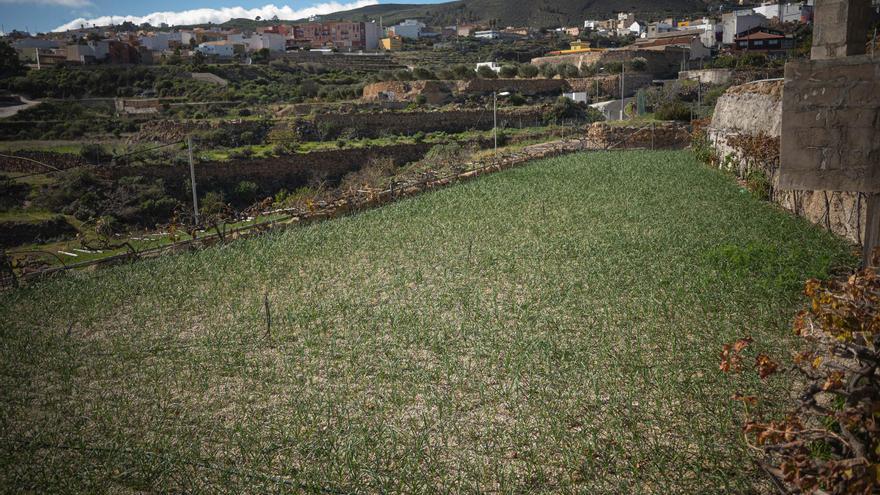
Vicácaro was once known for growing potatoes, though fewer people farm the land now, according to Pepe Martín. It was a place where people grew their own food and practiced 'jable culture' – using a light, yellowish-white volcanic sand. This 'flying' sand, easily moved by the wind, was spread over crops to keep the soil moist and has since become a permanent feature of the landscape.
Looking at the gardens around our host's house confirms that what was once cultivated land is now often barren. Potatoes, onions, garlic, cilantro, parsley, beans, and peas – "Everything we need to make stew," our hosts point out – were grown in three small plots for the family's own consumption. They explain that "farming is very demanding and not very profitable; you can't live off it."
Pepe insists that this is "the best place in the world to live" because of the "tranquility" and "given what's out there." He emphasizes the "quality of life here," citing his mother, Carmen, who is still in excellent health at nearly 92 years old. His wife, Ángeles, agrees.
Both say the population has grown little in the last five years. This is mainly because new construction is difficult since the settlement is on rural land. They appreciate that "many have come, especially foreigners, to buy houses, but people don't want to leave." This slow population growth contrasts sharply with the municipality's rapid expansion, which has 59,000 inhabitants according to official statistics and 72,000 registered with the Town Hall (municipal registers often grow faster than official verifications).
Ángeles and Pepe have been together since 1986. They have two children, a 26-year-old son and a 23-year-old daughter, who still live in the family home. The house, one of six or seven scattered nearby, was built by hand, brick by brick, starting in 1990 after much hard work, and it's still not completely finished. It has two stories and a large living room, typical of self-built homes.
The couple's dream would be to restore an old house near their main dwelling, which they also bought years ago. Dating back to 1867, it's one of many 200-year-old (or older) houses still in the area. Pepe Martín remembers "María Reyes's house" as one of the first, which "stood for nearly a century" overlooking orchards and terraces. Entering the property is like stepping back two centuries, with its red clay floor (no longer manufactured), the typical patio cistern, and traditional roof tiles. Restoring it is challenging, partly due to the need for permits and technical guidance from the Historical Heritage department of the Cabildo de Tenerife.
Vicácaro, sometimes spelled bicácaro, refers to a small native plant. However, residents don't know why the neighborhood was given this name. Perhaps it implies 'tiny,' as this endemic berry is often called in rural areas, reflecting how small this part of Granadilla de Abona (which spans 164 square kilometers) is, despite its closeness to the town center.
Pepe and Ángeles agree that accessibility and services have improved. Pepe recalls that as a child, after heavy rain, he couldn't reach his house because the path would flood. Now, "we have almost everything in that regard." They acknowledge that "we were practically starting from scratch."
Leisure and sports are also available at the social center and the adjacent sports complex, in addition to the nearby hermitage, which serves as the heart of this village within a larger one. It was opened in 2011 when Carmen Nieves Gaspar was mayor.
Vicácaro is bordered by the southern main road and the Usasa and Perico ravines. The latter is named after Perico's inn, which was located in that high area – "the father of Pepe Casanova, the teacher," neighbors add.
Within this area are just over 70 self-built homes, housing about a hundred families and nearly 400 residents. Located 1.5 kilometers from the town center, its highest point is 620 meters. Vicácaro celebrates its festivities in May in honor of the Holy Cross. It forms part of the municipality's midlands, along with other communities like La Higuera, Las Palomas, Las Vegas, Los Blanquitos, Chimiche, and Los Llanos.
Regarding the Perico bridge, another neighbor, Domingo, and councilor Marcos Antonio Rodríguez recall how the municipality's economic focus shifted from the midlands to the coast after the construction of the TF-1 highway. This year marks 50 years since its construction began in 1976. Their conclusion is clear: "Activity moved because people stopped passing through here." He refers to the southern main road. That meant "the death of businesses."
The conversation highlights the parallel shift in the town's livelihood from farming to tourism-related services. From extensive greenhouse cultivation, like at farms such as Los Bonis, to the service sector, which led to a huge increase in population and businesses. This was especially true in San Isidro – a dormitory town that still has room to grow – and El Médano, with its increasing mix of Spanish residents and foreigners. Vicácaro, however, remained more than just emptied; it became "frozen" in terms of its population and way of life.
The midlands also exist, though they are very different from the coastal tourist areas due to the island's challenging terrain. They represent two distinct realities, sometimes contrasting, sometimes complementary, but always present. Much like life itself in the midlands of that 'other' south of Tenerife.
Pepe Martín has lived in Vicácaro for all 58 years of his life. His children are at least the fourth generation in the village. He is currently on sick leave from his job in the Granadilla Town Hall's maintenance service due to health problems. He remembers the hard work of breaking up the 'jable' during summers, extracting the valuable volcanic sand "with pick and shovel" for what became a thriving industry. "We planted everything ourselves," says this motorcycle enthusiast with pride.
Ángeles's smile brightens the room after she kindly welcomes the visitor with a small cup of coffee, much appreciated on a cold morning. Now more relaxed, she shares that she was born 55 years ago in the neighboring San Miguel de Abona, a result of the traditional migration of people from La Gomera to the south of Tenerife.
Six months ago, she left behind decades of work as a cook in hospitality to dedicate herself fully to being a homemaker. She doesn't eat meat, but people say she makes the best goat meat in the entire region.