
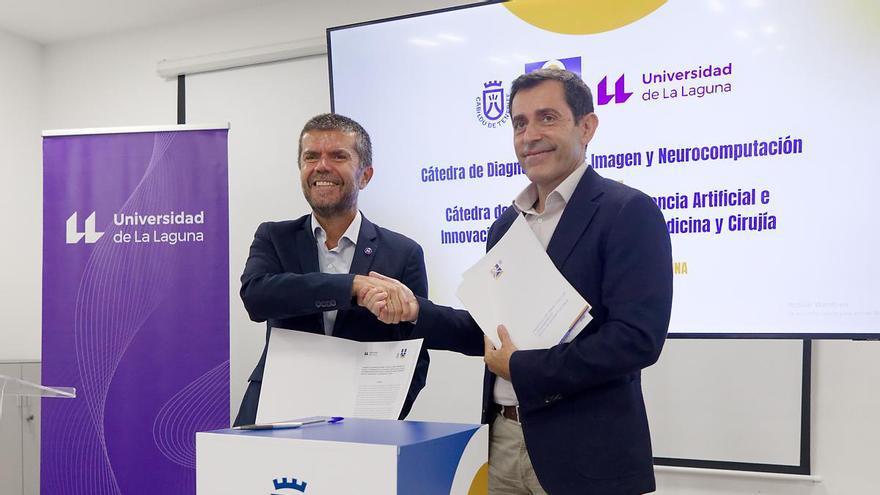
University of La Laguna Launches Two New Chairs to Boost Biomedical Innovation
The University of La Laguna has expanded its public-private research network by launching two new institutional chairs focused on advancing medical imaging, artificial intelligence, and telemedicine in partnership with Imetisa.
The University of La Laguna (ULL) has strengthened its technology transfer network by launching two new institutional chairs, bringing the total number of public-private partnerships on campus to 25. The initiative is supported by an agreement with Imetisa—an organization linked to the Tenerife Island Council and the Canary Islands Health Service—with each chair receiving 75,000 euros in annual funding.
Beyond the financial investment, this partnership provides researchers with access to advanced infrastructure. The Chair of Functional Imaging and Neurocomputation, led by José Luis González, will share nuclear magnetic resonance equipment with the University Hospital of the Canary Islands (HUC). By using this equipment for clinical care in the morning and scientific research in the afternoon, the university aims to maximize public resources while advancing artificial intelligence in healthcare.
Meanwhile, the Chair of Telemedicine, Artificial Intelligence, and Clinical and Teaching Innovation, directed by Guillermo Burillo, builds on previous research to provide greater financial stability. This team focuses on digitizing medical practice, including robotics, telesurgery, and testing new technology in clinical settings. These efforts are essential for overcoming the challenges of providing healthcare across islands, ensuring that local patients have access to the latest medical advancements.
This collaboration highlights the growing synergy between academic research and healthcare management. For the Tenerife Island Council, the project supports a knowledge-based economy, while for the ULL, it marks another milestone in its growth strategy. This expansion is set to continue with the launch of a new Biomedicine degree in the 2026/27 academic year and the modernization of the Faculty of Medicine, further establishing the region as a hub for biomedical innovation.