
Tenerife is preparing for a simulation exercise of a volcanic eruption in Garachico.
Tenerife is conducting a volcano eruption simulation drill to prepare residents for a potential emergency situation, considering the historical consequences of the 1706 eruption.
Manuel Díaz lives in a dangerous place – right next to the town of Garachico, in an area where a volcano could erupt. He says that everyone here knows about it and lives with it.
"In Garachico, everyone remembers the lava," Manuel says about the eruption of 1706, which caused the most damage to the island of Tenerife. "When we hear the word 'volcano,' we get goosebumps."
Therefore, Manuel and other residents of Garachico believe that the authorities did the right thing by choosing their town for the first training exercise simulating a volcanic eruption in the Canary Islands. It will take place this Friday, the 26th.
"Our grandparents told us about the events of 1706," Manuel recalls. "Back then, there was no technology like today, no one warned us. The lava caused a lot of trouble. Its traces are still visible."
Manuel is one of those who attended lectures organized by local authorities to teach people how to act in the event of an eruption.
These lectures and training exercises, which will last from the 22nd to the 26th of this month, are part of the European project EU-Modex. The aim of the project is to test and improve Tenerife's readiness for a volcanic eruption, as the risk of this always exists on the island.
The lectures are held in the San Francisco Monastery and will last until Thursday, September 4. Then they will be held in other places and schools in the city. And after the training evacuation on Friday, the 26th, in the Muelle Viejo area, the training will extend to other 30 towns in Tenerife.
According to Iván Martín, the island's director of emergencies, the main thing is that "almost a million residents of the island know what to do if an emergency is declared."
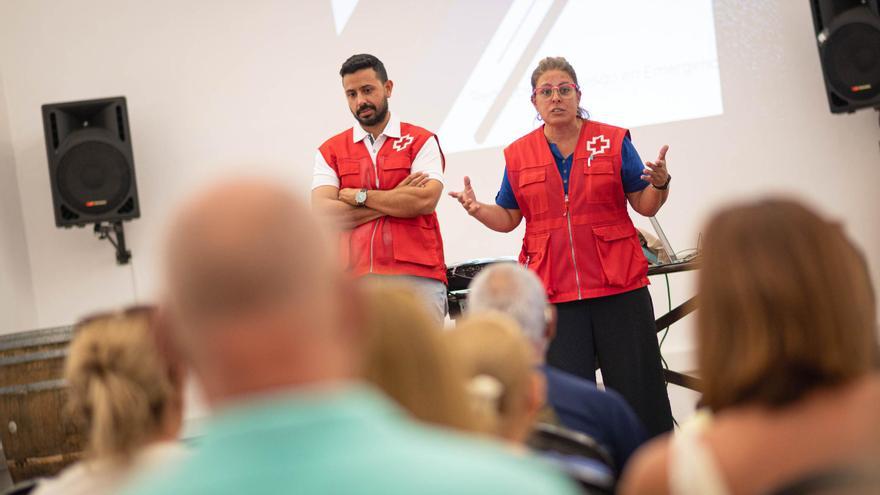
"What should we do with the animals?" a woman asked at a lecture on Tuesday, which was attended by about thirty people. "I won't leave my dogs, no way!"
Dácil León, director of the Red Cross in the province of Tenerife, and Eric Quintero, a technician from the same department, answered this question. They explained how the alert system works, who announces it, and how to act.
Iván Martín emphasized at the beginning of the lecture that "there is no immediate threat of eruption on Tenerife now." He also added that the island has significantly improved the eruption forecasting system and explained why Garachico was chosen for the training.
The lecture participants already know from the stories of relatives about the events of that night from May 4 to 5, 1706. Magdalena González, a resident of the Las Cruces area, says: "My grandparents told me that our ancestors lost everything during that disaster." She thanked them for the "very useful" information provided in these lectures.
Fear gripped everyone that evening 319 years ago, when the small tremors that had been going on for months suddenly became stronger. "The earthquakes were so powerful that they frightened everyone," wrote Friar Domingo José Cazares, a monk who lived in La Laguna, in one of the few documents that have survived about those events.
"Roofs were cracking in the houses, the bells in the churches were ringing as if for a funeral," Cazares said. Many people ran to churches to hide. They felt that the worst was coming.
The tremors continued all night, and an hour before dawn on May 5, 1706, a powerful explosion rang out. Then other explosions rang out.
At an altitude of 1,300 meters, on the slopes near Garachico, 6.5 kilometers from the town, a 950-meter-long crack appeared with more than 12 eruption centers. Lava began to flow from there, not far from Teide.
The eruption of the Trevejo volcano, also known as Arenas Negras or Montaña Negra, had the greatest impact on people and the economy in the history of Tenerife.
Lava flows destroyed fields, houses, public places, and the main port of Tenerife. People did not die, but the damage was enormous.
Margarita Palenzuela, who came to the lecture from Genovés, says that "here we are especially sensitive to news about earthquakes, volcanoes, and the risk of eruption."
Perhaps it is in this town that information about more than a hundred seismic shocks related to volcanic activity that have occurred on the island since 2017 causes the most concern. And it is here that volcanoes have been talked about the most recently, especially after the announcement of the training.
Interestingly, it was here in 2024 that the Spanish film "Under the Volcano" starring William Levy and Maggie Civantos was filmed. It is a romantic comedy about a volcanologist and a pilot who fall in love while an eruption threatens Garachico.
Another resident, José Gutiérrez, thanked the local authorities for organizing the lectures to "fill the gaps in people's knowledge about natural hazards and how to act." "I didn't know how response plans work and what the basic rules are," he says. "Now I understand how important it is for people to be informed. Look what happened in 1706, when the lava destroyed the port and many landmarks."
At the lectures, Dácil León and Eric Quintero explain how important it is to be resilient and prepared for any unforeseen circumstances, especially those that pose a great threat. They emphasize that this requires knowing how to act in emergency situations and remembering two things: listening carefully to information from the authorities and taking warnings seriously.
"Who among you has ever not taken a warning seriously?" asks Dácil León, admitting that she herself once did. The audience nods. Most likely, after this lecture, none of them will do it again.