
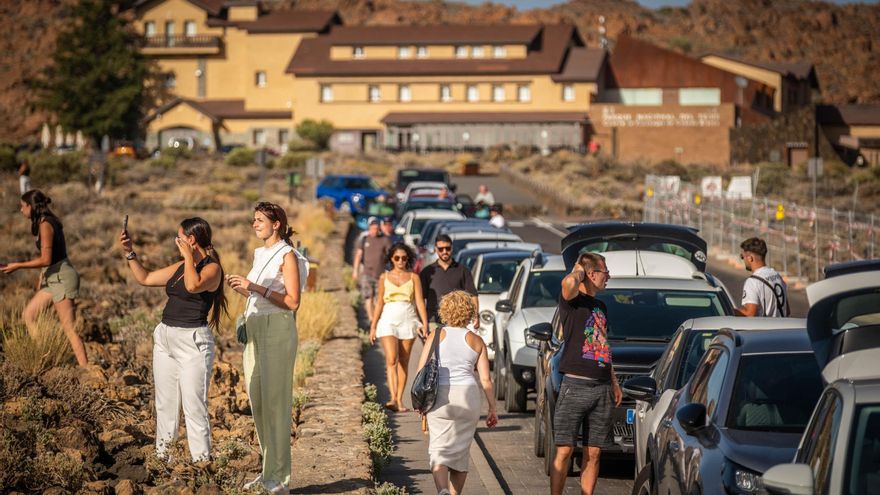
Teide National Park to be closed to private cars: only buses will be allowed.
Teide National Park will ban the entry of private cars, allowing only buses that will run from various parts of Tenerife, in order to protect the park's ecosystem from excessive tourist traffic.
Private cars will no longer be able to enter Teide National Park. Now, only buses will be allowed, running from various parts of Tenerife: from the north, south, and the metropolitan area.
This is the main change stipulated in the new management plan for Teide Park, the most popular reserve in Europe. This plan is scheduled to be approved as early as next Monday, September 29, at an online meeting of the park's board of trustees. This council is responsible for preserving this natural gem, and the Cabildo of Tenerife is one of its key members.
The good news is that there will be no entrance fee to the park, as this is prohibited by law for areas with the highest level of protection in Spain. However, there will be a charge for the bus ride and other services.
The government of the Canary Islands has been working on updating this plan for five years. It defines the rules and protection measures for the highest mountain in Spain (3,715 meters, according to the latest measurements) and its surroundings.
The current plan has been in effect for 23 years, having been approved back in 2002. Since then, new challenges have emerged, such as climate change and the large number of tourists, which negatively affect the park's fragile ecosystem. Therefore, the plan needed updating.
In 2002, Teide Park was visited by 3.4 million people. And in 2024, this figure exceeded 5 million for the first time (5,242,653 to be exact).
This popularity has turned Teide into one of the most attractive places on the planet, but at the same time, it has created a threat to its sensitive ecosystem. That is why the new plan aims to address these problems. It is expected to be approved on September 29.
The previous government of the Canary Islands had already developed a plan that stipulated that Teide could only be reached by bus, closing access to private cars. It was also planned to create three large transfer hubs for buses in El Portillo, Vilaflor, and Chío, where visitors could leave their cars in parking lots and transfer to public transport.
But the current government of the Canary Islands does not support the idea of these transfer hubs near the park, believing that they could damage the landscape. Therefore, the Cabildo of Tenerife was instructed to develop a separate mobility plan.
The Cabildo is also not thrilled with the idea of building large transfer hubs in the proposed locations. Instead, they propose that buses depart from existing stations in the metropolitan area, in the north and south of the island. In this way, only emergency vehicles, as well as those with special permits, such as park employees, the Parador de las Cañadas hotel, restaurants, and other services, will be able to travel on the TF-21 road. A similar system is already in place in the Masca Gorge or Punta de Teno.
The government of the Canary Islands handed over the new park management plan to the Cabildo back in October last year. Since then, both sides have been working on making changes. The Cabildo believed that the plan needed improvement. And now, after 11 months, they have reached a compromise.
After the Teide Park Board of Trustees approves the document on September 29, it must be finally approved by the Ministry of Ecological Transition in order to enter into force.
The Board of Trustees, headed by Rosa Dávila, includes representatives from various institutions and organizations: the Government of Spain, the Government of the Canary Islands, the Cabildo of Tenerife, six municipalities (La Orotava, Guía de Isora, Icod, Fasnia, Granadilla, La Guancha), the University of La Laguna, scientific institutions, security forces, business and social groups.
In parallel, the Cabildo will develop a mobility plan that prohibits the entry of private cars and allows only specially equipped buses to pass.
The Cabildo believes that this is the best way to avoid the chaos in the park, which has been criticized by many people. The plan does not rule out the possibility of building transfer hubs in the future, but not as close to Teide as was proposed in the first draft.
The approval of this plan will help the Cabildo to bring order to Teide. But there is another important step: the transfer of all powers to manage the National Park from the Government of the Canary Islands to the Cabildo.
The Cabildo hopes to resolve this issue in the near future in order to increase the number of park staff and improve control. They are already planning to hire at least ten environmental agents.
The Association of Forest Agents and Environmental Protection Agents of the Canary Islands has repeatedly stated that there are only five rangers on staff at the National Park, which is a ridiculous number given its area (189 square kilometers) and the number of visitors (over five million a year). In July, the Cabildo announced a competition to create a reserve list of employees who will be involved in the protection of the volcano.
Teide was declared a National Park on January 22, 1954, and in 2007 it became a UNESCO World Heritage Site. In 2010, the state transferred the powers to manage the four national parks of the Canary Islands to the Autonomous Community of the Canary Islands.
Subsequently, in 2011, the regional government allowed the cabildos to delegate the management of the parks located on their territory. The Tenerife Cabildo expects to take over the full management of Teide in the near future.