
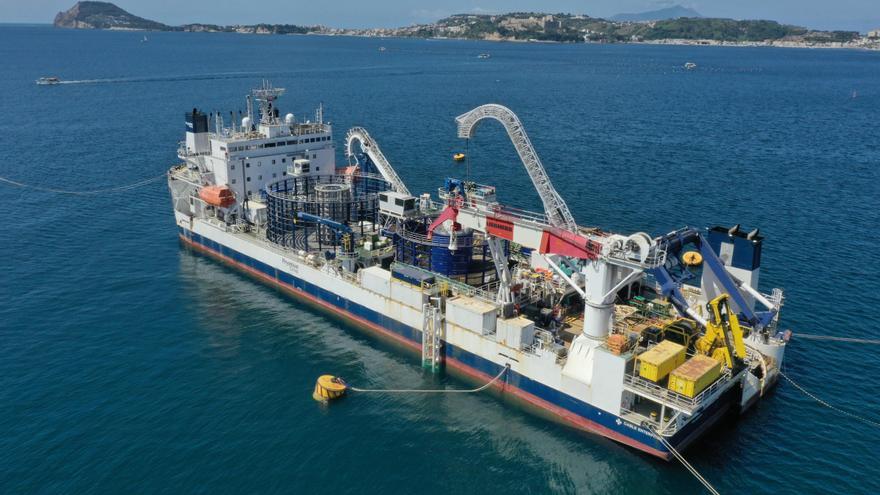
In Spain, the laying of the world's deepest underwater power cable between the islands has been completed.
In Spain, the laying of the world's deepest underwater alternating current cable between the islands of Tenerife and La Gomera has been completed to ensure a stable power supply and the use of renewable energy.
In Spain, Red Eléctrica, the company responsible for the electricity grid, has announced the completion of the underwater cable laying between the islands of Tenerife and La Gomera. The entire infrastructure is expected to be completed by the end of the year.
Work began on August 29. The cable was laid in two lines from the city of San Sebastián on La Gomera to Punta Blanca on Tenerife. The company involved a special vessel, the Cable Enterprise. Thanks to good weather at sea, the work was completed faster than planned.
Preparations are now underway for two stages of cable protection, which will be carried out in the autumn and early winter. In November, the cable will be connected in special chambers and its operation will be checked. Laying the cable was a challenging task.
The underwater part of the cable is about 36 kilometers long and runs at a depth of up to 1145 meters. This makes it the deepest 66 kV AC submarine cable in the world. This required the development of a special cable that could withstand such conditions.
It was also difficult to bring the cable ashore on both islands without harming nature. The volcanic soil there is very diverse, so a method of directional drilling was used. This allowed the cable to be laid underground and brought out to sea at a distance from the shore, without affecting plants and animals.
In addition, there are land sections of the cable on La Gomera and Tenerife that are completely underground. Two new substations have also been built: El Palmar on La Gomera (recently completed) and Chío on Tenerife (operational since the beginning of the year).
The cable route was laid to minimize the impact on nature.
This underwater cable between Tenerife and La Gomera is important for ensuring a stable power supply to La Gomera. It will also allow for the use of more renewable energy and reduce the cost of electricity generation by connecting the energy systems of both islands. In addition, Tenerife will be able to use the surplus of "green" energy produced on La Gomera.