
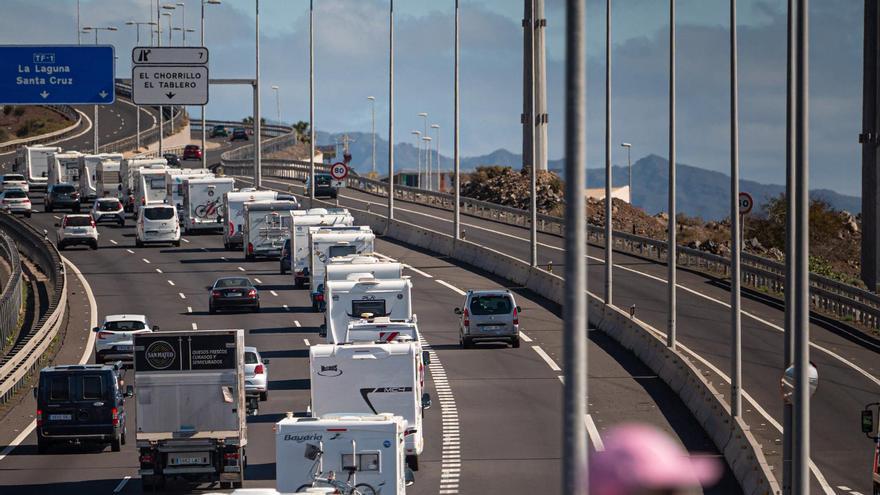
Tenerife: caravanners protest against discrimination and lack of parking regulations
Approximately 350 caravans protested in Tenerife, demanding clear parking rules and an end to discrimination by local authorities.
Approximately 350 caravans traveled through Tenerife from the south to the capital on Saturday, February 22. They demanded "compliance with the law" and permission to park without problems from local authorities. For many people, a motorhome is a lifestyle.
Caravaners from the south of the island complain that they are treated "like criminals." Half a year has passed, but the situation has hardly changed. There are still no clear rules for this community, which includes about 5,000 local enthusiasts and another 10,000 tourists every year.
Juan Martín, head of the Association of Caravans and Campers of the Canary Islands (Acat), says that the conflict has reached a dead end. "There are not enough clear rules," he says. "What is being done is decided at the level of individual cities. And each city hall establishes its own rules without consulting us, or at least the largest association, like ours."
He emphasizes that caravans are just as legal vehicles as any other. They pay taxes and have the right to drive and park. But, of course, not all places are suitable for this due to the size of the caravans.
Juan Martín explains: "According to the traffic rules, if the caravan is parked correctly, does not go beyond the markings and does not exceed the parking time (if it is limited), it does not matter if there is someone inside." It is only forbidden to put things outside the caravan: dry laundry, put up awnings or use supports for leveling (except those needed for safety).
He adds that a medium-sized caravan is unlikely to be able to park in a space designated for passenger cars. Sometimes local authorities even specifically narrow parking areas so that caravaners cannot stop there. "As always, they forbid first, and then think about how to solve the problem," he sums up.
Juan Martín denies accusations that caravaners litter or light fires. "If someone does that, let them be fined, but you can't blame everyone," he says. "You can't discriminate against an entire group of people by assuming that someone will commit an offense."
He emphasizes that certain groups of people cannot be prohibited from using public roads without objective reasons. "We advise our members to respect the rules. Abuses by some lead to restrictions for everyone," he adds.
The situation used to be worse: caravaners were even forbidden to just stop. Now the attitude has softened a bit, but not everywhere. Juan Martín believes that this is due to the fact that local entrepreneurs complain about a decrease in profits because caravaners come to them less often.
Caravanning in Tenerife is becoming increasingly popular, both among locals and tourists. According to two shipping companies operating on the island, 6,000-7,000 caravans arrive every year. There may be about 5,000 registered caravans on the island, plus those who travel independently. "This is the same way of life as any other," Juan Martín sums up. "I choose a motorhome because I want to have the freedom to travel wherever I want, while respecting the laws and traffic rules."
Regarding the local council's plan to create parking and service areas for caravans, he notes that this has already been discussed and even meetings have been held. But it is planned to create ordinary recreation areas, not special places for caravans. He is also surprised why the Cabildo campsite in La Tejita (El Médano) is still closed. The campsite in Punta del Hidalgo (La Laguna) is also closed, but should open soon. Currently, there is only one private campsite for caravans operating on the island - Nauta. "That's the situation we're in," he states.
Juan Martín believes that the future of caravanning in Tenerife does not look very bright, as the authorities are not paying attention to them. "But we are the solution to the problem, not the problem," he emphasizes. "Caravanning is here to stay. Our community continues to grow, and it is a pity that we are all lumped together. This is called stigmatization, discrimination and ignoring."