
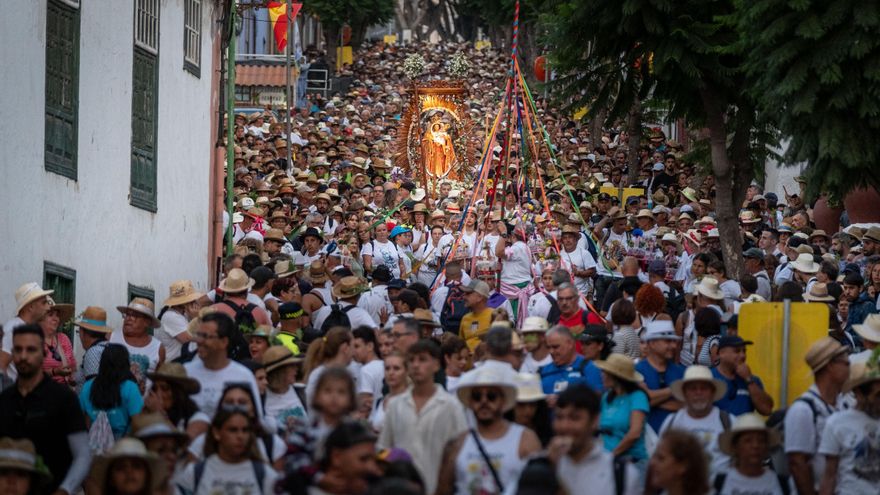
Tenerife grandly celebrated the Bajada de la Virgen del Socorro.
On Tenerife, tens of thousands of people celebrated the Bajada de la Virgen del Socorro, a traditional pilgrimage to the chapel of the Virgin Mary on the coast of Güímar.
Cheers, applause, ovations, and even tears – all of this accompanies the Virgin Mary Socorro as she returns to her chapel on the coast of Güímar. People raise their phones to record it, and hundreds of voices sing a pasodoble, adding emotion to the day. Along the road and near the chapel itself, locals open the doors and windows of their homes to offer food and drinks to those who accompany their patron saint.
Five hours after the doors of the Church of San Pedro opened to begin the Romeria to the sea, the statue of the Virgin Mary took its place in the temple. Tens of thousands of people from all over the island enjoyed this hot day.
This celebration is a symbol of memories, feelings, emotions, and experiences, both past and present. It is important for the entire municipality, the Valle de Güímar region, and all of Tenerife. But most importantly, it is a symbol of peace and meeting with relatives, friends, and acquaintances, whom you sometimes only see at the Bajada de la Virgen.
On this day, everyone is equal. From the richest to the most humble, everyone is happy to meet and chat. Some do it in a garden under a tree, while others do it in a garage converted into a living room.
There are still people who stay overnight in the chapel, in a specially designated place closest to the sea. As local resident José Mesa recalls, this is an old tradition.
Juan de la Cruz, an expert in traditional Canarian clothing, is convinced that the Bajada de la Virgen del Socorro is "the most authentic" romeria in Tenerife.
He explains this by the fact that there is no mandatory dress code here. Everyone dresses as they please. It is a folk festival with its own history and traditions.
Another feature that De la Cruz points out is the spontaneous musical groups and the convenient road, where people behave "organized and know what they are doing."
Also impressive is how the chapel is decorated inside. Previously, this was very common, but now most celebrations use decorations from florists. In El Socorro, they still preserve "folk decorations" made of leaves and other palm elements.
Next to the nougat tent, musicians entertain the public. A man from the group Recordar es vivir sings songs and plays the saxophone. He is accompanied by three guitars and an accordion. Later, a woman with a timple joins them. Songs such as Vete a lavar morena, pasodobles, and isa lift the spirits of everyone around.
Elsewhere, reggaeton, merengue, or salsa can be heard. The El Socorro kiosk was packed, and Latin American music added energy to the chapel surroundings.
Not far from the musicians, entrepreneur Modesto Campos and his son are waiting to be served something to eat. His father, Agustín Campos, and uncle, Pedro Modesto, were mayordomos of the Virgin Mary Socorro in the past. And Modesto himself also held this position.
He experiences this holiday every year "with great enthusiasm." He explains that he "opens his house to treat all the romeros, so that they can at least have a glass of wine or eat a croquette or a chicken leg." In his opinion, "the holiday is becoming more and more popular, and more and more people come every time; it has deep roots in the valley."
On the other side of the street, Maria Rosa's house is also full of people, relatives and friends. Some of them only meet at this holiday. She recalls that many people always come to the coastal town every September 7, regardless of the day of the week.
According to this local resident, on such a day "verbenas are not needed, neither day nor night." She explains that this is not a tradition. She says that this is "a holiday of peace, not fights, and everything goes very calmly."
But it is not always easy to remain calm. Before the start of the Bajada, an incident occurred in the Church of San Pedro. According to witnesses, a man climbed onto the altar, stopped for a moment, and said that this holiday was for Chaxiraxi (the goddess of the Guanches, meaning she who carries the King of the World or the Mother of the Sun), so there was no point in holding a Christian mass. After that, everything continued as usual.