
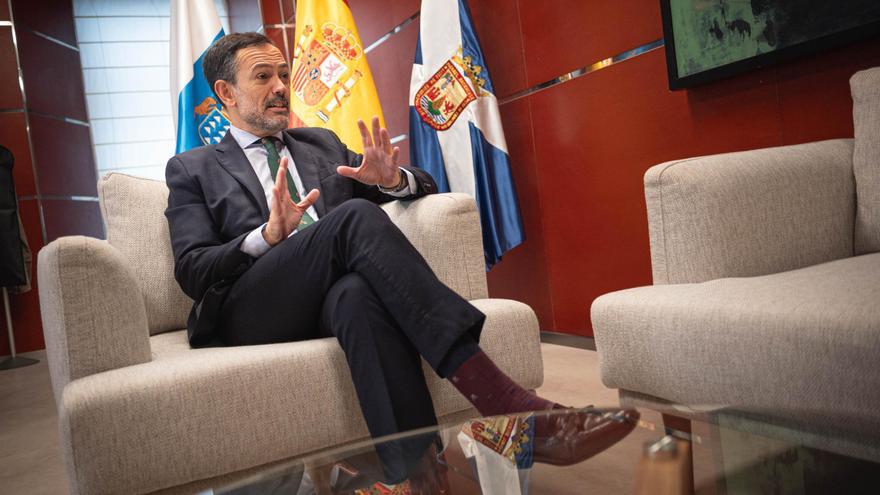
Tenerife VP Afonso: Government Delivers, PP Ready to Win Elections
Lope Afonso assumes the second half of the Tenerife island government's term, formed by a CC-PP agreement, with responsibility and a stated aim to grow the Popular Party, declaring he is "not afraid" of winning elections.
Lope Afonso is taking on the second half of the Tenerife island government's term "with responsibility." This government was formed by an agreement between the CC and PP parties in the Cabildo de Tenerife. He is dedicated to growing the Popular Party and is "not afraid" of the challenge of "winning elections."
We're past the halfway point of this term, and I believe the agreement has been largely fulfilled. There's still a lot to do, but in terms of management, results, and public trust, we've delivered on our promises: a strong, hardworking government focused on Tenerife. We're committed to boosting the island again and improving the lives of its citizens through an economy that thrives with an active Cabildo. I've worked to keep the government on track, acting as a link to ensure major issues move forward through constant and honest discussions with the president. I believe this has helped bring stability to the institution, especially after the instability of the previous period. The Cabildo is structured around its president, Rosa Dávila, so she is the main focus. My goal isn't to be more or less visible, or to take over the president's role. As vice-president and leader of the areas managed by the Popular Party, I aim to maintain a central position, consistent with the goals we set out in our agreement.
I've already achieved a significant level of public presence. How much I'm seen by the public will depend on what citizens think. I want them to connect with this serious and responsible government. Unlike the polarized national scene, we advocate for a sensible, open, and dialogue-driven approach that gets results. In short, we stand for common sense and good judgment. We are a different kind of project. As president, I make sure the Popular Party's presence is felt wherever we govern, with clear management principles: common sense and good judgment in our plans, reaching out to most of society without favoritism, and efficient financial management, which is crucial for everything else to work well. This means organized management and effective budget spending, contributing to a dynamic economy that creates jobs, and proper management of public services. If I'm lucky enough to be nominated again as a candidate for the Cabildo presidency, I'll ensure this strong management record is recognized. But right now, I'm focused on finishing this year's planned work and, most importantly, ensuring the people of Tenerife are reasonably satisfied with their government. I'm confident we can convey this approach to politics when we ask for voters' trust. The Popular Party has the potential to grow on the island and the challenge of winning elections.
I don't like to use the word "impossible" because reality often proves it wrong. We've had moments of working with the Socialist Party to form governments in municipalities, and in many cases, it has worked well. There's no suspicion or favoritism. From there, the situation, shared goals, and political will must be present. Right now, we are happy with our work alongside Coalición Canaria in the Cabildo and in the main institutions of the Archipelago.
It's growing with the highest amount ever, but also because it has a different purpose. It's not just about providing more money, but doing so in a specialized way that is closer to the needs of families and groups, people with disabilities or dependencies, and especially victims of gender violence, children, and teenagers. We are also very mindful of the current issue of homelessness. So, we cover all areas where the Cabildo de Tenerife can take direct action and intervene.
For the 2025 budget year, which is now ending, there wasn't enough time to build any new housing. The major agreements for this term in the Cabildo began in late 2023 and became solid in 2024. Typically, a housing project takes 18 to 36 months to build. However, if we compare what is currently being built and will be ready in the coming months with what we inherited, there's no comparison. In the plenary session last Wednesday, I called our inheritance a "blank slate," because that's what the PSOE's policy amounted to. They forced us to start from scratch. That said, we're not boasting. We know we're facing a complex problem, and even though the Cabildo is more involved than ever, it's happening in a context of high demand, meaning everything we provide will still not be enough. More than a thousand housing units are already committed during this term, either solely by us or with other administrations. If we add specific projects in municipalities like Santa Cruz, the total would exceed 1,200. They will become available as construction deadlines are met. If the PSOE has another solution, they should present it.
I absolutely deny that. Between those already started, newly created, and those planned for the 2026 budget, there will be more than 2,000 new social and health care resources in Tenerife during this four-year term. Barely fifty were put in place in the past. Not to mention what was invested in our own resources: starting from 90,000 euros over four years in existing centers, compared to four million in just two years. And with an investment of 380 million euros in 2026 across the entire area. This amount is part of the 417 million we announced for social policies, with the IASS as the central point.
Rarely have so many measures been launched so quickly for construction projects, both to expand the road system and to encourage public transport, meaning buses. There's also an unprecedented effort to make public transport free, with the aim of offering an alternative to using private cars. This free service sometimes leads to peak demand on some routes, causing them to become overcrowded. That's why we're buying new buses to expand the fleet and hiring more staff, mainly drivers. The goal is to establish a viable alternative so people can leave their cars at home and adopt a different habit. This doesn't mean we're ignoring the work needed to improve the congestion we still experience – and I say this personally. Projects to add third lanes in the north and south are getting closer, but innovative planned measures haven't been implemented yet. These include removing vehicles from highways with cranes after accidents and the smart traffic light system, both of which depend on the General Directorate of Traffic, which is part of the Spanish Government, and they haven't responded. We have a set of measures that we hope will ease traffic in the short and medium term, such as the agreement with the University of La Laguna for staggered class entry or on-demand transport in some municipalities. We are closer to seeing results. For example, the opening of the Padre Anchieta pedestrian walkway, which will address the bottleneck on the TF-5, is just around the corner.
Tourism works and provides the biggest economic boost, benefiting other sectors and creating a lot of jobs, making Tenerife the island with the lowest unemployment rate. But tourism also needs to be more balanced, responsible, and sustainable over time. That's why we also try to help visitors better understand the value of the destination beyond just mass sun and beach tourism. The strategies we've put in place have encouraged tourists to leave their hotels and explore the island, spending money wherever they go, whether in towns with historical heritage or in natural areas, thanks to our rich biodiversity. The island lacks enough infrastructure for mass tourism, and tourist taxes aim to improve the visitor experience by funding services and providing more resources for conserving valuable natural areas like Teide. There won't be a significant increase in tourist numbers; the trend of seven million tourists from last year will continue. The budget for tourism in 2026 starts at 45 million euros, slightly more than 4% of the total. The goal is to find a balance between different areas and the interests of residents. To do this, we need to match the destination's vision with the type of visitors we attract. This is also why we are diversifying our markets, beyond the traditional British, Spanish, and German tourists, in that order. We want visitors who spend more and are more willing to understand and appreciate the destination. That's why we've focused on the North American market with strategic airlines to encourage their interest in Tenerife.
It's a key part of the budget. We're improving connections with North America through agreements with airlines that bring significant traffic from Canada. The direct flight to New York was put aside because the airline's interests were focused on other destinations, and we didn't want to rely on just one. Instead, we're channeling arrivals through agreements with several airlines. The goal of attracting more North American, American, and Canadian clients is being met.
40% of visitors already enjoy local food. Connecting gastronomy with tourism is a successful approach, which is why we've focused on promoting restaurants and eateries at major events. This strengthens our primary sector, thanks to the quality and variety of our products. We also can't forget the huge potential of our wines, and that professions related to hospitality also benefit. A significant part of consumption involves traditional food and "guachinches" (local eateries), which visitors often highlight in their experience. As for industry, we've created a specific focus area with unprecedented investment aimed at renovating industrial estates. We've completed twelve in two years, compared to only one in four years during the previous term. I also recognize the crucial role of innovation, looking towards strategic future sectors, with key elements like the Science and Technology Park. And the Insular Directorate of Strategic Projects, which drives initiatives like energy diversification through green hydrogen as a transition energy for the Granadilla Industrial Estate, a commitment of the PP.
We welcome a new regulation to help bring order to a successful subsector that has high market demand. However, for it to be competitive and add value, it makes sense to require quality standards. I believe the law doesn't harm anyone or limit the ability of small owners to earn extra income.
I hope it will be soon, because it's a long-standing debt to the Island. We have the resources, capability, and knowledge at the Museum of Nature and Archaeology (MUNA) to manage its stay here with all guarantees. The Ministry's refusal has, until now, prevented its return. They removed it from exhibition at the National Archaeological Museum to put it in storage, and now they are exhibiting it again. What is appropriate is for it to be exhibited here, in Tenerife.
It was an opportunity that slipped away. We did everything we could for an ideal event to return to the Island in 2026, promoting it through values like our natural spaces, especially Teide. One of the three participants, the Cabildo de Gran Canaria, decided not to proceed. The cost (seven million euros) is too much for us to handle alone. We haven't given up on bringing major events to the Island and are prepared to continue doing so with proactive management. A Tenerife Arena? We plan to develop it in the coming years. We are currently studying suitable locations on public land.