
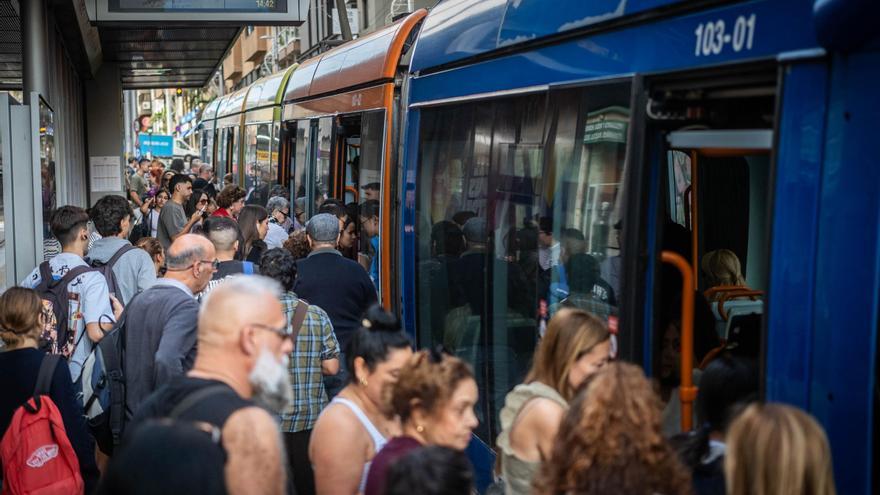
Tenerife Tram Strike Nears Two Years, Workers Extend Action Over 35-Hour Week
Tenerife's nearly two-year tram strike continues to cause disruption after workers rejected a new proposal and extended strike hours, maintaining their demand for a 35-hour work week aligned with other island government employees.
A tram strike in Tenerife is nearing its two-year mark, largely because Metropolitano staff want to work a 35-hour week, just like employees of the Tenerife Cabildo (the island's government). Unions are urging the Cabildo to act proactively to ensure peace, but the company isn't budging. Last week, Metropolitano offered a proposal to end the strikes, but workers not only rejected it last Friday but also voted to extend strike hours, causing more disruption for passengers.
For instance, at 2:31 PM at the Weyler tram stop, a long line of people waited for a tram heading to La Laguna. A display board showed the next tram would arrive in five minutes, and the one after in 20. This is a direct result of the worsening dispute, which will hit its two-year anniversary in February. Not everyone sees it the same way. Manuel González commented, "I don't notice anything different from other days," though he added, "we've been dealing with this for over a year now. There are queues, journeys are cramped, and you have to let people off before you can get on."
Sabina Megolla, in her twenties, shared a negative experience from her day, blaming overcrowding. "I got on at the University Hospital stop around midday; it was really hard to squeeze in, and I ended up standing in the aisle between the seats." At the next stop, El Cardonal, she said, "I told a gentleman to sit down, and I found a spot on the other side." The tram continued its journey, becoming "full to the brim at every stop." Before reaching Zurita bridge, she recalled, "a woman of about 50 got on; she was on her phone, sat in my spot, and started bothering and insulting me." Sabina responded, but thankfully, the argument didn't get worse. She believes "this happens every day" because "some people get on just to cause trouble," linking it to issues like "mental health and begging," which can sometimes occur together.
Sandra Díaz, who regularly takes the tram from a Santa Cruz suburb to her job downtown, said, "I've had much worse days." She recounted her journey home at 2:40 PM: "Two trams passed; the first was completely packed. Four minutes later, another came with fewer people. The display panel then showed the third tram would be 12 minutes away. It was a bit chaotic, but still better than my usual experience."
Carmen Febles, another daily commuter, uses the tram from Avenida Príncipes de España (Ofra) to the Weyler stop for her office on San Clemente street. She is highly critical: "I get on at eight in the morning with my face pressed against the glass, and I get off the same way." She added, "Today I was twenty minutes late, and usually it's ten. The tram stops four or five times on the way down, not counting traffic lights." She stressed that "a journey that used to take 12 minutes now takes 20, and I think it's deliberate."
Juan Carlos Gómez, easily identified by the instrument on his shoulder, works at the Music Conservatory and travels daily by tram from Weyler. Having only lived on the island for a year, his main complaint as a user is the tram's frequency. He said, "What's announced on the panel isn't true." He explained, "They say six minutes, but then 14 minutes pass, and the next tram arrives just a minute later. So, you get two trams almost back-to-back."
Willy Arias, a Latin American who has only been in Tenerife for two weeks, thinks the tram service is "great," especially coming from Ibiza, where there are no trams. He noted that it's beneficial for residents because it's free. He uses it for work, often carrying his documents, as he's in the process of applying for residency.
Fran Padrón, president of Metropolitano's Works Council, representing the UGT and USO unions (who won this year's elections, replacing CCOO as the majority union), began by saying, "Of course, I apologize to users." However, he argued, "we are defending our social rights and working conditions." He stressed, "We are not asking for money, not at all," but simply "that the company finally honor the agreements made in June 2023 to end the strike." He added that "strike periods will be extended by assembly mandate until they become 24-hour strikes." It's worth noting that even during strikes, minimum services can be as high as 80%.
Both Padrón and Juan Miguel Suárez (from CCOO) urged the Tenerife Cabildo to show "foresight" and resolve this deeply rooted problem, rather than just "falsely closing it" to "restore social peace." Suárez highlighted "difficult situations, with disciplinary actions taken against colleagues, especially drivers." To break the deadlock, they are requesting an urgent meeting with the island president, Rosa Dávila, and the mayors of Santa Cruz and La Laguna, as residents of the Metropolitan Area are "the most affected." Yesterday, the Cabildo passed the matter to the company for assessment, and Metropolitano de Tenerife declined to comment.
Fran Padrón (UGT) and Juan Miguel Suárez, an advisor for CCOO, both confirmed that "the strike hasn't been suspended even for fifteen minutes." While "most health and safety issues, like replacing silica dust, are practically resolved, with other minor details left for collective bargaining," the core of the strike remains the disagreement over reducing the work week from 37.5 hours to 35, matching the Cabildo's standard. Workers proposed allowing 15 minutes of 'grace time' at the start and end of each shift. The Cabildo initially seemed open to this but ultimately only agreed to a total of 15 minutes.