
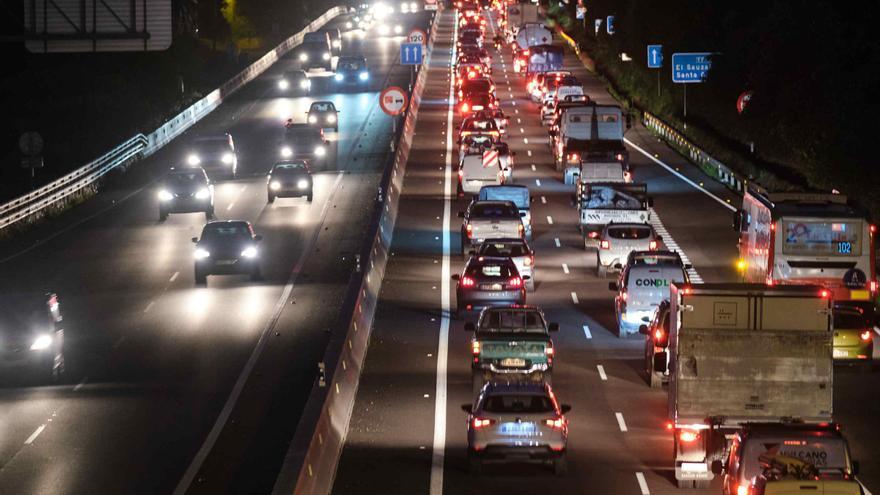
Tenerife to Illuminate Major Highways TF-5 and TF-1 Starting 2026
Tenerife's Roads Department will begin a three-year project in 2026 to install lighting along the TF-5 and TF-1 highways, aiming for full road network illumination by 2030.
Tenerife's Roads Department plans to install lighting along the island's two main highways, the TF-5 and TF-1, starting in 2026. This three-year project is expected to be finished by 2028, with the goal of having the entire road network lit by 2030. The initial budget for this project is €549,268, with €209,567 allocated to the TF-5 (North) and €339,701 to the TF-1 (South).
Dámaso Arteaga, the island councilor for Roads, described this initiative as the most significant and exciting project his department is undertaking. He stated it fulfills a promise made by President Rosa Dávila in July.
Work will commence at the highway interchanges. The design phase for the northern interchange will take ten months, and for the southern interchange, twelve months. The overall long-term cost for these improvements is estimated at €40.9 million. The aim is to ensure continuous lighting from interchanges and roundabouts, in line with current regulations.
The project will be carried out in six sections, three for each highway.
-
TF-5 (North):
- Zone 1: Kilometers 19.3 to 32.4 (Tacoronte, La Orotava, Puerto de la Cruz) - estimated €5.8 million.
- Zone 2: Kilometers 39.7 to 49.5 (Los Realejos, San Juan de la Rambla, La Guancha) - €4.5 million.
- Zone 3: Divided into three sub-zones, costing a total of €4 million.
- Sub-zone A: Kilometers 49.8 to 51 (Santo Domingo tunnel to kilometer 51).
- Sub-zone B: Kilometers 50.9 to 56.6 (to Icod de los Vinos).
- Sub-zone C: Kilometers 57.9 to 62.2 (La Vega to Buen Paso).
-
TF-1 (South):
- Zone 4: Divided into two sections, costing €8.5 million.
- Section A: Metropolitan Area, Candelaria, and Arafo (kilometers 20.2 to 25.2).
- Section B: Between Arafo and Güímar (kilometers 25.4 to 37).
- Zone 5: Güímar, Fasnia, and Granadilla de Abona (kilometers 37 to 54.6) - €8.8 million.
- Zone 6: Adeje, Guía de Isora, and Santiago del Teide (kilometers 80.4 to 98.9) - €9.3 million.
- Zone 4: Divided into two sections, costing €8.5 million.
The decision to undertake this project now, after not being addressed previously, is attributed by Cabildo sources to "political will." Technically, current regulations, which consider the Canary Islands Sky Law, are flexible. Highway lighting is generally justified when roads pass through urban areas on both sides or when traffic intensity exceeds 80,000 vehicles per day. Currently, lighting is only present on the Santa Cruz-La Laguna section of the TF-5 and the Los Cristianos-Torviscas section of the TF-1, where these conditions are met.
Councilor Arteaga also highlighted the 2026 budget forecast, which includes over €88 million for road maintenance, an increase of approximately €200,000 from the previous year. This figure does not include a €8.5 million loan arranged in 2024 and budgeted for 2025.
Beyond highway lighting, the department's plans include twenty projects to improve roundabouts and slopes, a new road information service with enhanced resources and cameras, and a €16 million road infrastructure rehabilitation plan for 2026-2028.
Notable roads slated for rehabilitation include the TF-180 (Santa Cruz-Laguna) at Vuelta de los Pájaros, the TF-1 between Santa Cruz and Güímar, the TF-21 (La Orotava), the TF-42 (Garachico-Buenavista de Norte), the TF-421 (Garachico-El Tanque), and the TF-65 (Polígono de Las Chafiras intersection).
Arteaga mentioned that some projects, like the TF-21 leading to Teide via La Orotava, have been ongoing for some time and are expected to continue until 2028. He noted that many projects initiated in 2024 and continuing into 2025 are nearing completion, with new projects planned to finish between 2027 and 2028. He cited the TF-180, a six-kilometer stretch, as an example of a short but costly section, with an estimated cost of €10 million, while the TF-21 is estimated at €40 million.
Regarding the TF-42 between Garachico and Buenavista, plans are in place for a complete rehabilitation, including improvements to intersections, which may require land expropriation. The project is currently in the design phase.
Arteaga emphasized that the department is addressing long-standing challenges, including several actions in San Miguel de Abona and Arona. He also highlighted the ongoing rehabilitation of the Southern highway's pavement, a project costing over €30 million, which he believes is already benefiting users. Work is also planned for the Güímar to Santa Cruz section, with a project to be tendered in 2026.
The councilor also pointed to the importance of interchange improvements, such as the one connecting the TF-29 with the TF-1 in Santa Cruz, near the Santa Lastenia cemetery, an area experiencing increasing traffic. He also mentioned plans for a pedestrian walkway in the vicinity, requested by residents of the Buenos Aires neighborhood, to connect both sides of the road, approximately 50 meters wide, while considering slopes and accessibility regulations.
Arteaga clarified that the Cabildo's responsibility is primarily road maintenance, and they collaborate with municipal, regional, and national authorities. For instance, they have proposed a traffic congestion management system for the Guamasa, Tacoronte, and El Sauzal area to the DGT (Directorate-General for Traffic).
Discussions are ongoing for an intelligent traffic light system, with the Cabildo having presented a proposal that is awaiting a response. They plan to tender this system in 2026 and will contribute their new Road Information Center, expected to be tendered next year, which will allow real-time monitoring of Tenerife's roads.
The closure of TF-5 interchanges at Guamasa, tested previously, is currently being reconsidered due to plans for a third lane between Guamasa and Los Rodeos, which will alter the area. Alternative routes, such as the TF-152 (which will have its pavement rehabilitated) and the TF-247, will be addressed later, as it is deemed less cost-effective to invest in them now.