
Tenerife Supercomputers to Become Spain's Elite After Multi-Million Euro Upgrade
Tenerife's Cabildo is investing up to 10 million euros to upgrade its Teide and Anaga supercomputers, making them one of Spain's most powerful and a cornerstone of the island's strategy to become a science and technology hub.
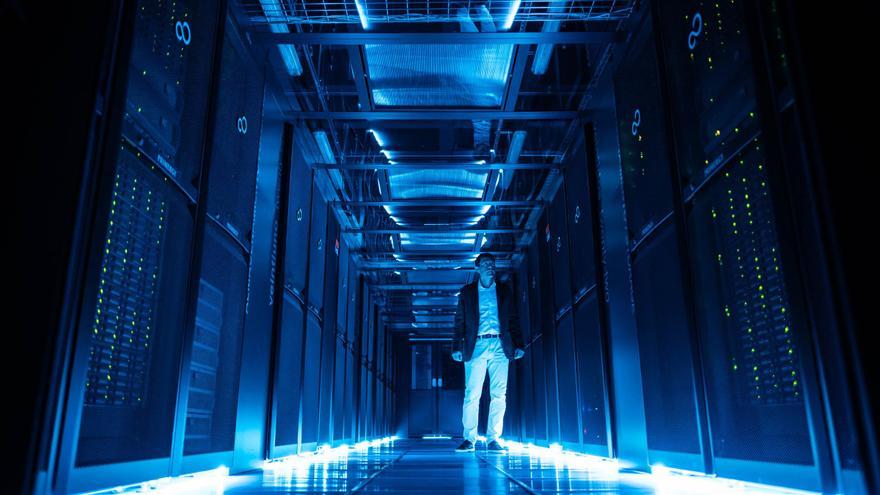
The constant hum of the air conditioners creates a vibration you can feel deep inside. Along the 10-meter corridor, neon lights flash, their glow bouncing off the walls of the rectangular space. Stepping into the Teide and Anaga supercomputer facility feels like entering another world, like walking through the rooms of a spaceship.
Blue lights illuminate the metal frames holding the processors, which are packed with green, yellow, and gray cables. The lighting slowly fades to darkness, broken only by a scattering of flickering orange, blue, and green dots. Then, after a few seconds, the neon blue returns, a cycle that has continued without interruption for 12 years.
Tenerife's local government, the Cabildo, is about to complete a multi-million dollar investment. This money will boost the power of the Canary Islands' two biggest computers, Teide and Anaga. These supercomputers, which together take up 80 square meters in the D-Alix datacenter at the Technological and Renewable Energies Institute (ITER) in Granadilla de Abona, will become one of Spain's top three most powerful and join the European elite. If the full investment goes through, their data processing power will increase 30-fold, reaching 10 petaflops – that's like having 18,000 average computers working as one.
Juan José Martínez, who heads the Innovation department for the island's government, is preparing to open bids for the Teide and Anaga upgrade. The first stage will cost four million euros. However, if the chosen company helps create more economic activity, three additional stages will be approved, bringing the total investment up to 10 million. Martínez explains, "This approach encourages the winning company to help bring in new projects and growth related to these supercomputers' increased power."
Martínez shares this information as he enters the building where these massive machines are kept – the most advanced and important tech facility in the Canary Islands. In fact, as ITER director Carlos Suárez points out during the tour with Martínez, the D-Alix datacenter is listed under the Ministry of Defense's National Critical Infrastructure Plan. This means it's considered a strategic asset, like airports, ports, hospitals, or telecom centers, that the Army would prioritize in an armed conflict because of its vital importance to the country.
At the core of D-Alix sit the two supercomputers, behind an automatic glass door that opens only with a fingerprint. "We needed to expand them because they're getting old," explains the island's Innovation councillor. "This investment is a 'driving project' that will spur further development."
He then gives other examples to explain what a 'driving project' means: "We're also working on geothermal energy and the 'Canarias' satellite network. Geothermal energy will draw in energy companies, and the satellites will attract the aerospace industry."
"In fact, four aerospace companies have already established themselves in Tenerife because we're creating an environment for the island to become a hub for science, technology, and telecommunications," Martínez explains. "Teide and Anaga are key to this, offering companies that choose Tenerife access to a top-tier data processing center."
Carlos Suárez sums up their importance and potential: "They're essentially many computers working as one, allowing them to handle complex computing tasks that smaller machines couldn't manage. For instance, during the COVID pandemic, ITER's Genomics department was one of the few places in Spain that could analyze virus strains – and that was thanks to these supercomputers. Their power was also used to render animated films like Tadeo Jones, creating images and videos from raw data."
"Without these supercomputers, Tenerife wouldn't be a major player in scientific and digital work," Juan José Martínez adds. He also notes that the Teide and Anaga upgrade will actually make them take up even less space in the ITER datacenter. This is because new technology has created more powerful, yet smaller, processors. With the extra room, they'll be able to store over 100,000 high-quality (4K) movies.
Last Friday, the 24th, marked exactly 12 years since the Teide supercomputer first started running. Anaga, which began operating later on June 22, 2022, was actually an expansion of Teide, named after the island's prominent volcano.
Today, these supercomputers are worth over ten million euros. The upcoming upgrade, which will soon be put out for bids, will coincide with another important milestone: the 35th anniversary of the Technological and Renewable Energies Institute.
The main anniversary events will take place this Thursday, October 30, at the Institute's large complex. Located on the Granadilla coast, the complex focuses on clean energy, research, telecommunications, volcanism, technology, and computing.
Founded in October 1990 by Tenerife's Cabildo, ITER has been a leader in innovation and sustainable development from the start. It all began on October 24 of that year with the opening of its first renewable energy project: an experimental wind platform.
Today, ITER is home to many facilities: a robotics unit, a genomics area (which studies human genetic material or DNA), connections to underwater fiber optic cables, and a lab for photovoltaic cells. It also features a bioclimatic housing development – though its management is currently being handed over to private companies after being unused for over five years – a wind tunnel, a renewable energy walking path, and several solar and wind farms that produce over 20% of Tenerife's clean energy. The newest addition, installed in April, is an antenna from Astra, the communication satellite brand run by Luxembourg-based SES.
Among all these facilities and projects, one building stands out: the D-Alix datacenter. This reinforced industrial building, with its rectangular shape, was designed like a 'bunker within a bunker' and is where the supercomputers are located.
Inside this data fortress, which is whitewashed both inside and out, a screen on the wall immediately grabs your attention. At the top, it proudly displays: "Uninterrupted operation." Below that, six numbers show – as of this Monday when the report was written – 14 years, 7 months, 1 day, 2 hours, 17 minutes, and 16 seconds.
This digital clock means more than just showing how long it's been since the datacenter opened on March 26, 2011. According to Juan José Martínez and Carlos Suárez, its real importance is that "it's undeniable proof that it hasn't stopped working for even a second, having survived storms, power outages, and disconnections."
"This reliability has been crucial in building maximum trust among both public and private operators," they explain. "It proves that D-Alix has a power supply system that has so far been unbeatable against any challenge."
This explains why the 2,000-square-meter datacenter serves major companies and organizations like Telefónica, Disa, Hospiten, the Tax Consortium, Hiperdino, the Canary Islands Institute of Astrophysics (IAC), and the Cabildo itself. This proven strength has made it the largest data processing hub in the Canary Islands and one of the biggest in Spain.
Beyond Teide and Anaga, the facility also contains electro-mechanical systems that ensure a constant power supply and climate control. These include generators, fuel tanks, water cooling units, and batteries. They are essential because all systems must continuously stay at a temperature between 17 and 21 degrees Celsius.
There are also rooms for data storage centers, used by the companies and organizations mentioned earlier. Plus, D-Alix has direct connections to three underwater fiber optic cables, giving it global digital reach.
One of these cables stretches over 9,000 kilometers along the seabed, connecting northern France to South Africa, running down the entire West African coast. Another links the datacenter to Rota (in Cádiz province, 1,500 kilometers away) and then on to Europe. The third connects to La Palma (240 kilometers) to support the facilities of the IAC on that island.
Finally, there's the central control room, staffed by at least one person 24 hours a day. Mónica Marrero is often at the helm, carefully watching the screens filled with numbers and letters that most people wouldn't understand.
Only one piece of information on the screens is easy for a non-expert to grasp: "Wind power 0.0." This means there's no wind, so ITER's wind turbines aren't generating electricity at that time. Nearby, the Teide and Anaga supercomputers continue their constant hum. These powerful machines are built to withstand anything, even hurricanes.