
Tenerife Study: Holiday Rentals Drive Gentrification, Displacing Locals
A study in Tenerife reveals that gentrification, driven by a surge in holiday rentals, is displacing long-term residents from traditional coastal communities like Punta Brava and San Andrés, leading to increased housing costs, loss of community, and widespread emotional distress.
A study by the Rayuela Association, in partnership with the University of La Laguna (ULL) and its Foundation (Fgull), and funded by the Canary Islands Government, confirms that long-term residents are gradually being pushed out of the island's traditional areas. This is due to a relatively new trend called gentrification – a process where wealthier newcomers replace long-time residents. The project, titled 'Social Infrastructures: People's Palaces in Tenerife,' shows how holiday rentals affect the lives of people in two neighborhoods with similar characteristics: Punta Brava in Puerto de la Cruz, and San Andrés in Santa Cruz.
At least 90% of the more than 150 people surveyed in both communities said they have noticed significant increases in housing and service prices. They also reported frequent problems with their commutes or finding parking, causing frustration. In this environment, residents expressed a widespread feeling that local authorities are ignoring their needs and that public areas are getting worse.
These are urban coastal centers with a history shaped by the repression following the 1936 coup, the Civil War, and the Franco dictatorship. They still feel more like villages than mere neighborhoods but have faced difficulties over the last decade.
Punta Brava has 1,400 registered inhabitants, while San Andrés has 3,800, according to 2024 data. These numbers might seem small compared to the 210,000 residents of Tenerife's capital and the 30,000 in the tourist city, but the high number of holiday rentals there makes them important case studies. The study found that up to 20% of their homes are holiday rentals. Across Tenerife, 24,000 of the Canary Islands' 57,000 holiday rentals are located there.
Beyond the statistics, there are real social issues. Another main goal of the project is to understand how community relationships affect people's emotional well-being. To do this, the research focused on identifying the emotional, social, and urban needs of the population, and assessing how gentrification has impacted these two areas on the island. Punta Brava and San Andrés are areas with a strong history of community development, but also a high presence of holiday rentals.
The research results show clear links between a sense of belonging and community spirit, and the emotional well-being of residents. The study also points to gentrification and the impact of tourism as factors contributing to the overall unhappiness in both communities. Residents in both areas say they have noticed a lot of new building and development in recent years, and people are worried.
Among the most common requests are more green and leisure areas, especially for young people and families, improvements in cleanliness, transport, and the upkeep of the towns, as well as the reopening of public meeting spaces and fewer tourists crowding their areas. These requests highlight the need to improve community facilities that help people live together better and enjoy a higher quality of life.
In addition to collecting data and perceptions, 'People's Palaces' also encouraged residents to share their individual worries, turning them into a shared voice. This shared feeling of unease and unhappiness stemmed from rising housing costs and the loss of community spaces. This reinforcement of shared identity was strengthened through activities like a series of community podcasts set to be released this month.
This process has highlighted the strong connection both communities have, reflected in repeated phrases like "this neighborhood is my whole life." A sense of belonging is crucial for preserving the cultural identity and community spirit of the area.
Iraida Pérez and Irene Ruano work for the Rayuela Association and are spokespeople for the organization, which was founded in 2009 with a clear goal: to help improve the lives of people living in Tenerife. They achieve this through various projects and actions focusing on areas like employment, health, and community involvement.
One such project is 'People's Palaces,' which focuses on Punta Brava and San Andrés in Tenerife. The main idea is that the high number of holiday rentals and intense tourist pressure have pushed out local residents in these two locations.
Both emphasize that "we talk about emotional well-being because we understand that it's not about mental health or individual discomfort, but a range of problems that impact the whole community. It's not just about feeling bad, but also about unstable jobs or having to travel two hours to work and facing long queues. It's also about coming home and not having neighbors to talk to, share with, or ask for help."
For example, they explain, "both in San Andrés and Punta Brava, there was a local support network for everyday needs," such as "leaving my daughter with the neighbor for five minutes" to quickly buy sugar from the supermarket. That support has ended or is now mostly limited to immediate family.
These places were chosen because "they are coastal" and because of "the significant and increasing presence of holiday housing, which has pushed out long-term residents." Furthermore, the feeling of a united, traditional village that once existed has faded. In fact, the percentage of holiday housing in San Andrés is higher than in the south of the island, despite the south being a major tourist area. San Andrés was the first place settled in Santa Cruz, always unique. Punta Brava, within a tourist city like Puerto de la Cruz, was a distinct, village-like area.
The study concludes that residents in both centers have had to move to free up homes for holiday rentals. For instance, in San Andrés, many people had to move to Añaza, La Gallega, and Ofra to make space for newcomers. This creates unhappiness among those who remain, not because they reject outsiders, but because they feel isolated. Wealthy people can afford the few homes available at very high prices, meaning local people can't afford them. This is, by definition, the process of gentrification. And a similar process called 'touristification' happens when this is driven by tourism.
Iraida and Irene summarize a project that began last February and is ongoing and has the potential to continue. It started with a survey to gauge residents' well-being using specific measures. The ULL, through its Foundation, designed this survey to identify factors linked to feelings of well-being or unhappiness. 90% of the population reported a significant impact of tourism in some places.
The study provides a foundation for the project's next steps. For example, it showed how much meeting spaces where people could talk helped. Activities were aimed at creating opportunities for dialogue and connection; in short, to get to know each other. These are two places where a strong sense of identity has historically been important but has slowly faded.
A few days ago, the San Andrés Institute hosted an activity with young students where they discussed their local area and identity. The young people strongly supported these ideas. Among the conclusions was that humans need a sense of belonging and to feel they have a purpose.
Another common factor is fishing, as both centers once relied on fishing as their main industry. This is no longer the case, but the connection to fishing remains strong, even though few people work in it now.
Finally, it's worth noting the social communication workshops where people shared their feelings of unhappiness. In these, people who still live in Punta Brava and San Andrés today, or who had to leave, gathered. All agreed on the feeling of "I had to leave" and the desire of "I would like to return." The conclusion is that they face a sense of loss, like a 'migratory grief,' that they need to deal with. From there, conversations about common issues started, regardless of whether they still live there or have left. Rayuela also runs initiatives like a mobile library in Punta Brava with books requested by the people.
Why 'People's Palaces'? It's a concept used in sociology by the Swede Erik Linnenberg about social spaces where people gather for a primary purpose, and then, as a secondary benefit, community and socialization naturally happen. The clearest example is libraries, where other activities take place and where class barriers can also be broken. The community needs to create its own palace, its natural meeting spot, like when mothers talk outside school, its meeting place. Like the staircases in San Andrés. With the gentrification process, that has been lost. Community organizers are needed to help bring these places back.
Some of the new residents joined the organized participatory walks, which aimed to share the history and culture of both neighborhoods. For example, "I want to highlight that people didn't ask the city council for permission to open the funeral home. If there were three deaths, any neighbor would open it." That is something very characteristic of old San Andrés "that we hope to recover with 'People's Palaces,' like old Punta Brava," because an important part of the project also has to do with shared history and memories. In this regard, they recall that the young people of San Andrés feel that Las Teresitas beach is something foreign that is being taken away from them, despite being in their town.
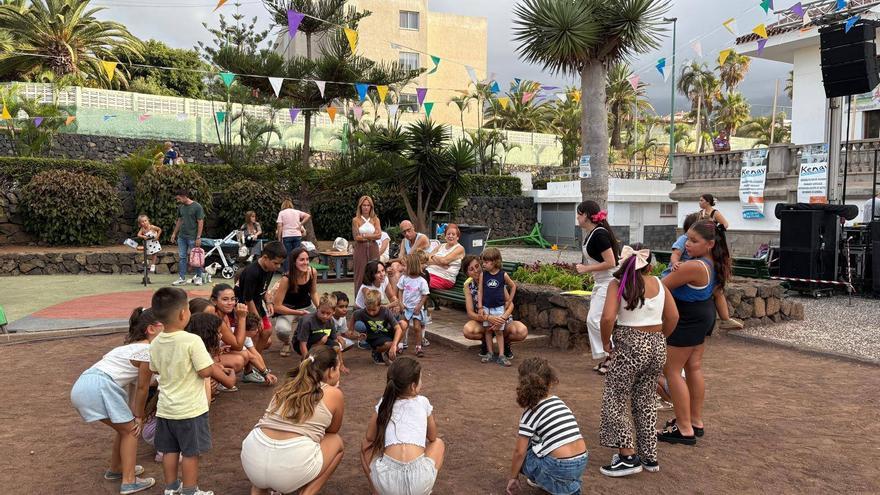
The people behind 'People's Palaces' consider it not a project with a beginning and an end, but a social model that can be used elsewhere. For now, they will continue in Punta Brava and San Andrés because "we believe that nine months is not enough time to make a real difference." This unique approach to social work aims to tackle unhappiness head-on to build community. Or rather, to help Punta Brava and San Andrés rediscover their community spirit through fun activities. With whistling or Zumba workshops, radio podcasts, walks, or waste collection on the beaches, but all together because loneliness affects people of all ages.
Gentrification is an urban process where run-down neighborhoods are improved, attracting wealthier people. This raises housing and business prices, pushing out original residents, changing the area's social and cultural identity, and reshaping its economy. A striking example: the fishing neighborhood of Santa Cruz now has over 70 tourist homes, whereas just ten years ago it had none. 'People's Palaces' proposes a new social project aimed at creating healthier, more pleasant, and more engaging neighborhoods. Now, after the fieldwork, a guide of best practices is being created with the General Foundation of the University of La Laguna to roll it out in other towns.