
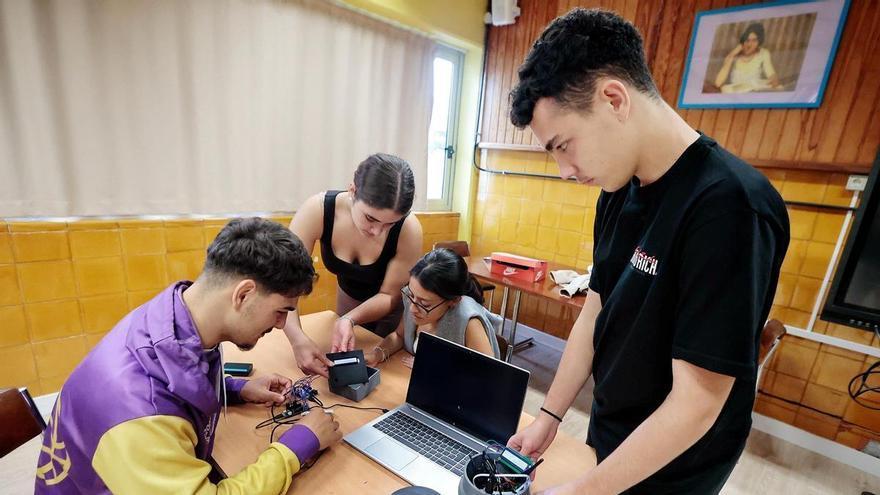
Tenerife Students Reach Semifinals of National Efigy Technological Contest
Two student projects from IES Profesor Martín Miranda in Tenerife have been named semifinalists in the national 8th Efigy Technological Contest for their innovative solutions to forest fire detection and water quality monitoring.
Students at IES Profesor Martín Miranda in San Cristóbal de La Laguna, Tenerife, are once again proving that the classroom is a powerful place for social change. The school has become a national leader in technological innovation, with two of its student projects named among the 12 semifinalists in the 8th Efigy Technological Contest. This prestigious competition evaluates the work of over 3,000 secondary school students across Spain.
The success of these projects lies in their practical, real-world applications. The students developed "AgroFlare," an autonomous system designed to detect forest fires early by monitoring environmental conditions, and "EcoWave," a tool that tracks water quality and identifies microplastics along the coast. These two projects are the only entries from the Canary Islands to reach this stage of the competition, and they stand out for addressing environmental issues that are vital to the archipelago.
Research is a core part of life at the La Laguna institute. Under the guidance of teacher Roberto Díaz, the school’s technology program uses a hands-on approach that focuses on computational thinking and solving real-world problems. This method has led to consistent success in national competitions, including last year’s award-winning "Algactive" project, which automated microalgae cultivation.
The ongoing achievements of IES Profesor Martín Miranda demonstrate the power of integrating programming and robotics into public education, even when schools face tight budgets. By creating functional prototypes—from forest surveillance systems to smart urban lighting—these students are successfully moving beyond academic theory to build technology that improves sustainability and public safety. Their track record proves that early technical training is a key driver of scientific innovation in schools today.