
Tenerife's Titsa Secures €40M for 95 New Buses, Boosting Green Transport and Jobs
Titsa has secured an additional 12 million euros, bringing its total investment to nearly 40 million for 95 new buses, including double-decker and electric models, to modernize its fleet and expand services across Tenerife.
Titsa, the public transport company, has received an extra twelve million euros. This money comes from the island council's (Cabildo) final budget adjustment for 2025. This boost means Titsa can buy 25 more buses, bringing the total number of new buses planned for next year to 95, adding to the 70 already ordered. Around fifteen of these new buses will be used to improve services in Teide National Park. According to Eulalia García, the island's Mobility Councillor, Titsa has had 37 million euros this year to buy buses that will arrive in 2026. Another three million euros will be added to next year's budget for this purpose.
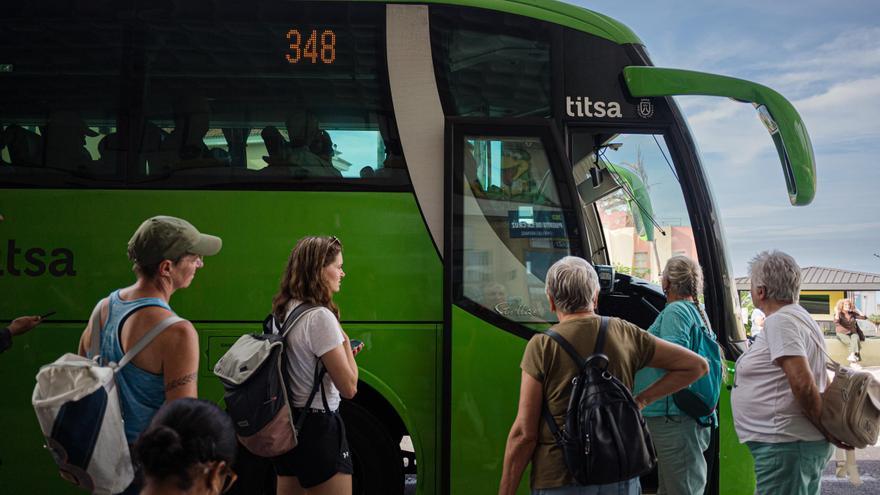
The full Cabildo council in Tenerife approved this agreement, meaning almost 40 million euros has now been set aside to pay for nearly 100 new vehicles. Many of these will be double-decker and hybrid buses. This will help expand the currently limited two daily services to and from Teide National Park, which operate on lines 348 (Puerto de la Cruz) and 342 (Costa Adeje).
Specifically, the 12,009,251 euros will be used for payments to Titsa and to fund three key projects. First, 3,161,589 euros will cover the remaining payment for buying new buses. Second, 1,447,662 euros will go towards electrifying the Los Rodeos Garage. Finally, 7,400,000 euros is for this year's payment for the purchase of 25 buses. These new vehicles will help update the bus fleet by replacing older models. They will also expand services to meet growing demand and extend the transport network on various routes, including those serving Teide National Park.
In mid-October, the Cabildo announced that Tenerife was making a big move towards greener transport with the purchase of 70 buses for routes between towns. These will join the island's fleet in the second half of 2026. Now, an additional 25 buses are being added to this order. A key part of the plan is almost twenty double-decker buses, which will run on long-distance routes with few stops. They are designed to ease traffic jams on the island's northern and southern motorways. These buses will carry twice as many passengers, increasing capacity from 65 to 93 seats, leading to more efficient journeys and a more comfortable service.
Titsa will also get its first eight electric buses for inter-town routes, able to travel up to 310 kilometres daily. These will run on lines 051 and 057, connecting La Laguna, Tacoronte, Valle de Guerra, and Tegueste. They will be used to test how electric vehicles perform on medium-distance routes. With these new additions, Titsa's total fleet will reach 692 vehicles, making it the most modern and newest in Spain, according to the island government.
Public transport on the island continues to expand, with passenger numbers rising from 47 million in 2023 to an expected 86.7 million by the end of this year. This growth is mainly due to free travel and better services. By the 12th of this month, Titsa and Metrotenerife had already carried over 86 million passengers together, firmly establishing the island's public transport system as the top choice over private cars.
Rosa Dávila, President of the Cabildo de Tenerife, said this investment "marks a new milestone for the island's sustainable transport." She noted that combining electric and double-decker buses "will provide a more efficient service tailored to what people need." She called it a "green revolution" with zero-emission vehicles, less noise, and less environmental impact, which will strengthen connections across Tenerife.
The contract for these vehicles was split into nine parts and awarded to companies including Scania Hispania, Iveco España, and Whole and Retailer, S.A., who will supply most of the double-decker buses. Furthermore, expanding the fleet has also created 350 new jobs, including 300 for drivers.