
Tenerife's Taucho: A 95-Year-Old's Secret to a Long Life
Nearly 95-year-old Leandra Martín González, who credits "living well" for her longevity, offers a poignant look at Taucho, an ancient, charming Tenerife village grappling with a shift from its agricultural past to a tourism-focused present.
Leandra Martín González, nearly 95, laughs as she shares her secret to a long life: "living well." Though she no longer calls Taucho home, she spent much of her life there, on a balcony with stunning views of the Atlantic Ocean. It's a place that truly captures the essence of southern Tenerife.
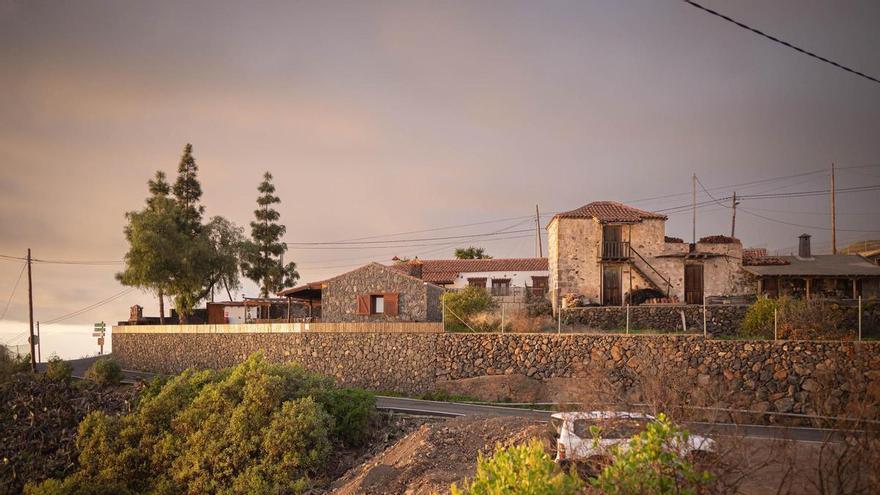
This village, nestled in the mid-altitudes of Adeje, feels a world away from the busy tourist resorts just a few kilometers down on the coast. It maintains its unique charm with well-preserved traditional Canarian buildings, narrow winding streets, old, crumbling granaries, and dried prickly pear leaves – all signs of its deep Canarian heritage.
Leandra answers questions easily, her mind remarkably clear. While her hearing isn't what it used to be, she gets by. Her thick, short hair is straight and whiter than cotton. She's dressed warmly, as the mid-altitude areas of southern Tenerife can be surprisingly chilly. She remembers that in winters past, her family would move for three months to Los Menores, just below Taucho, to escape the cold. She was born there on March 1st. She was fortunate to attend school until she was 16 without having to work, which meant she had a happy childhood.
Still, she recalls a time when everyone worked in agriculture, "growing wheat, barley, and other grains; plowing the land all day with animals – cows, goats, horses, and donkeys. We called them 'beasts' because back then there were no cars for work, and no roads either." She pauses, looking at one of her daughters, and asks, "Are there any 'beasts' left in Taucho now?"
Today, this Adeje village has around 200 registered residents. However, Leandra's daughters remember the 1970s when the hamlet became almost deserted, with fewer than 10 people living there. Leandra herself confirms this, as does Román Álvarez Ramos. "Brother, come help me, you remember more than I do," Leandra asks him. His affectionate nickname brings laughter, and he dutifully sits beside her. He, too, has grey hair, and his thoughtful, wise nature becomes clear as soon as he speaks.
Román sits to her right. Though not a professional historian, he deeply loves the history and culture of the Canary Islands, especially his hometown. He shares a wealth of information about the founding of the hamlet where he grew up and from which he left twice – once for Venezuela and once for England. But he always came back. "I enjoy this," he explains. "I think everything I know comes from my grandmother's stories." He vividly connects the family lines of the early settlers, showing where each family built their homes, granaries, and farmlands.
The earliest records of life in Taucho date back to 1496, the same year that towns like San Cristóbal de La Laguna and Garachico were founded. This Adeje hamlet is considered one of Tenerife's oldest mid-altitude settlements, and its architecture clearly shows its age. Buildings are constructed using local materials like stone, pine heartwood, and two-sloped roofs covered with tiles. Most walls are made of masonry with mud mortar, and window and door frames are crafted from pine heartwood. It seems that a sense of responsibility is also a key ingredient here, as while some properties show signs of age, most homes are carefully maintained and well-preserved.
Over time, agriculture gave way to tourism, and now holiday rentals are becoming common in Taucho. Just as Leandra wondered about the "beasts" of her youth, she now observes that the people living there "are not from here. I walk down the street and I'm sure I don't know anyone." Her neighbor agrees. He, too, no longer lives in Taucho because of work. Commuting from the village was too difficult, so he, like most young people, moved away. "Young people leave because they don't want to work in agriculture," he explains. "Some still plant crops here, but nowhere near as much as before."
The road leading to this mid-altitude village in the south is well-paved but very winding. When asked about it, one of Leandra's daughters quickly says, "32," referring to the number of curves, a fact that resonates with everyone. "Before, there was no road at all," Leandra exclaims, as if transported back 80 years. "Then they built a track, and we bought a jeep to get up here. People also used donkeys and mules." Román adds that he remembers his teacher arriving in Taucho on a mule when he was five years old. He estimates the track was built in 1963, with asphalt arriving about ten years later.
Román recalls that in the past, people would gather every weekend in two or three private halls for traditional Canarian parties, complete with music and dancing. "That's gone now," he says, gesturing as if playing a guitar. "But it was a wonderful time when everyone came together to have fun." He also mentions the local festivals for the Virgen del Socorro and Santa Margarita.
Taucho has no supermarket today, though Leandra fondly remembers, "before there were two small shops where we bought sugar and coffee." There has never been a doctor in the village. "We always had to go to Adeje," Román explains. "If there was an emergency back then, I imagine it meant going down the track or path on a donkey or a mule." There is, however, a bar named after the village, which seems to be a hub of activity, attracting both tourists and local residents.
As the sun sets, it bathes the streets of the Adeje hamlet in a golden light. The sun dips gently over the magnificent sea visible from the village, while to the east, a pine forest stretches out. Perhaps Leandra Martín González's enduring zest for life is simply Taucho itself, a place where authenticity truly feels eternal.