
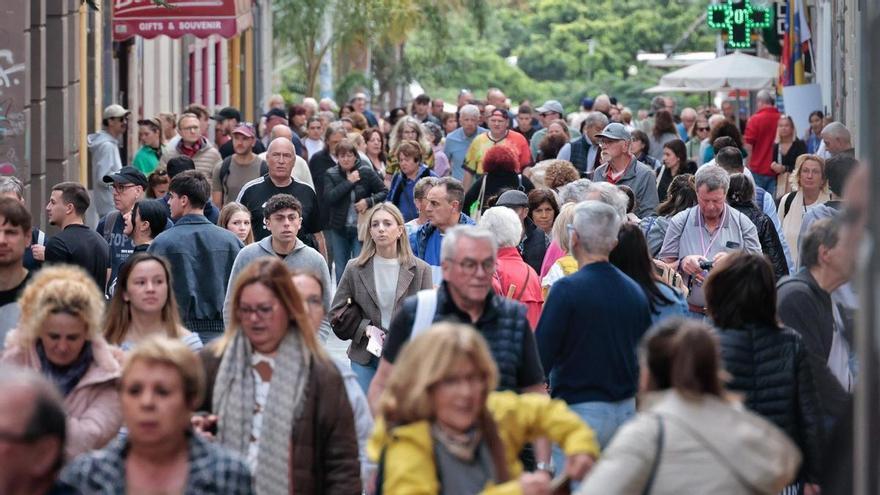
Tenerife's Population Surges 35% in Quarter-Century
Tenerife's population has increased by over 35% since 2000, reaching 961,745 residents by 2025, creating significant challenges for housing, traffic, and public services.
Tenerife's population is growing significantly. You don't need official reports to see it – just look at the traffic jams, lack of parking, housing problems, long waits for healthcare, crowded beaches even on slightly warm days, busy hiking trails in Anaga, and the bustling towns of Santa Cruz and La Laguna. All these signs point to a major demographic shift.
Official figures from the National Institute of Statistics (INE) confirm this trend. In the first 25 years of the 21st century, Tenerife's population increased by 252,380 people, a rise of 35.58%.
Every year, the INE releases official population numbers for Spanish towns, based on updated local registers. These figures are from January 1st of the previous year and help us understand population changes. For example, on January 1, 2025, Tenerife had 961,745 residents, which is 6,682 more than on the same date in 2024 – a 0.7% increase. However, the full scale of growth becomes clear when looking back to January 1, 2000.
In summary: Tenerife's population grew from 709,365 in 2000 to 961,745 in 2025, an increase of 252,380 people, or 35.58%. This means the population grew by more than a third in 25 years. To put it another way, Tenerife added as many people as if a city larger than Santa Cruz (which currently has 211,957 residents) had appeared.
There are three main points of interest: the South is booming, the North is growing slowly or even shrinking, and the Metropolitan Area is seeing growth in its surrounding towns rather than in Santa Cruz itself.
Professors José León García and Alejandro Armas from the University of La Laguna's Geography and History Department confirm this significant growth. They also highlight that the overall increase is even larger when you consider the "floating population" of tourists (over 18 million in the Canary Islands in 2025). Armas explains, "It's true that they come for limited periods, but they are people who contribute to the saturation of certain types of services or infrastructures that those of us who live here daily use."
Tourism is driving very high growth in the South. Adeje leads with a 257% increase, adding 36,014 people. San Miguel follows with 227% (16,645 people), and Granadilla with 189% (38,429 people). However, in terms of sheer numbers, Arona saw the largest increase, adding 49,377 residents. But because Arona already had a larger population, its percentage increase was smaller (128%). García explains that the first tourist areas were in the North (like Puerto de la Cruz and Bajamar), but tourism later expanded to the South. He believes this tourist development is central to the population changes. He notes that some visitors become residents, but more importantly, tourist hubs attract people seeking work and opportunities, often immigrants.
In contrast, the North is experiencing population declines. Garachico saw the biggest drop (-10%, or -552 inhabitants), followed by Buenavista (-8%, -455), El Tanque (-7%, -213), and Los Silos (-5%, -293) during the period analyzed. However, Garachico's mayor, José Heriberto González, disputes these figures. He claims the 2000 population of 5,492 was inflated by people registered but living abroad, particularly in Venezuela and Cuba. He states that after a census review, the municipality was left with its true population and has even seen slight real increases and stabilization in recent years.
Similarly, Santa Cruz's population has decreased by 1.48%, partly due to a "ghost register" that artificially boosted its numbers for years. Other factors also limit the capital's growth. José León García points out that Santa Cruz's expansion is restricted by the nearby Anaga Rural Park. This leads to growth in neighboring areas like La Laguna (up 27%, adding 34,565 people) and Candelaria (up 118%, adding 15,279 people), as people choose these areas instead. Alejandro Armas adds that the Metropolitan Area's population growth started long ago, driven by people moving from rural Canary Island areas to the capitals. He says that growth in these areas is now "much less dynamic" compared to tourist zones.
In Adeje, the mayor, José Miguel Rodríguez Fraga, believes they are managing the situation well. He clarifies that while Adeje has grown proportionally the most, it hasn't in absolute terms. He describes Adeje as a "municipality of opportunities," which has attracted people. He emphasizes that population growth has been matched by economic growth, leading to improvements in employment and opportunities. "People like living in Adeje; we know it because they tell us," he says. The mayor notes that growth has been gradual, not a sudden "boom." He acknowledges healthcare shortages but believes public spaces, leisure, sports, social, and cultural facilities have "evolved" to meet needs.
Among other official figures, the North's La Orotava saw a modest increase (10%, 4,166 more residents), and Puerto de la Cruz had contained growth (24%, 6,149). El Sauzal, known for its high average income, grew by 25%, adding 1,902 people. The largest percentage growth in the North was in Santa Úrsula (46%, 4,900 people). Other areas like Arafo, Fasnia, La Guancha, Icod, La Matanza, and Los Realejos showed moderate growth. Even remote Vilaflor saw an 18% increase (296 people).
What does all this mean for Tenerife as a whole? The island faces a demographic challenge. There are clear imbalances, with some areas experiencing depopulation while tourist zones attract immigrants from many countries seeking economic prosperity. More people also mean a greater demand for services. Emeritus Professor of Geography José León García clearly states that "growth is significant" and the Island "is showing signs of saturation," adding that "the necessary services have not been updated."
Current indicators suggest this trend won't reverse soon. A recent meeting of the Juan Miguel Sanjuán Chair's Board of Trustees at the University of La Laguna revealed that projections indicate continued population growth in the Canary Islands in the coming decades. This is mainly due to international migration, driven by economic factors and the Archipelago's lasting appeal as a place to live, as reported by the Efe agency. According to INE data, by 2039, the Canary Islands will reach 2.5 million inhabitants, with one-third of them born in other countries.