
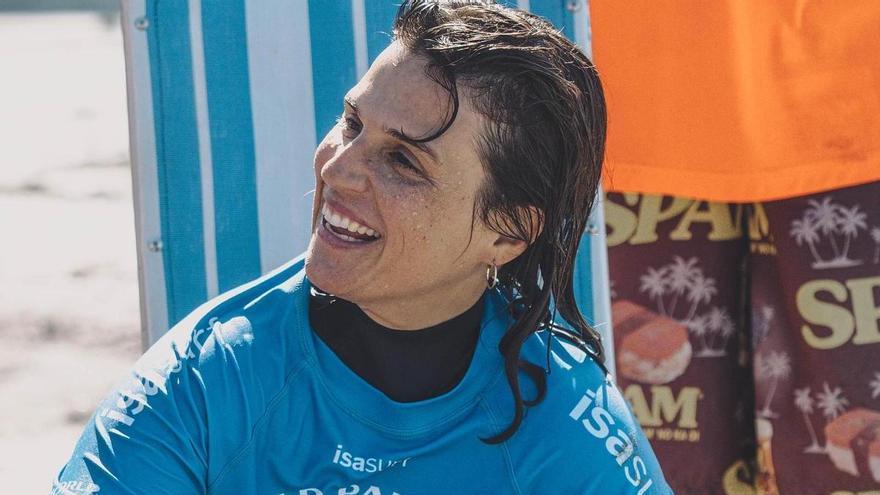
Tenerife's Paloma Oñate Claims Silver at World Para Surfing Championship
Tenerife's Paloma Oñate secured a silver medal at the ISA World Para Surfing Championship, becoming a world leader in adaptive surfing.
Tenerife has a new star athlete. Local surfer Paloma Oñate has become a world leader in adaptive surfing, earning the runner-up title at the ISA World Para Surfing Championship in Oceanside, California. Her silver medal in the Prone 1 category highlights her significant progress and puts the Canary Islands on the map in this growing sport.
The International Surfing Association organized the event, bringing together the world's best para surfers. Oñate competed in a category where athletes must perform all maneuvers while lying down, paddling and catching waves without assistance. The skill level in this division is exceptionally high. Oñate demonstrated her talent with strong scores in the qualifying rounds, earning 7.66 and 9.60. In the final, she scored 11.16 points, placing her second to American Sarah Bettencourt, who won gold with 16.43.
Support from the Fundación También – Almar Consulting team and the Capacitas scholarship, backed by Fundación Disa, made Oñate's participation possible. This initiative helps athletes with disabilities from the Canary Islands compete internationally. Oñate stated that without this support, her trip to California "would have been impossible."
Oñate's achievement is the result of dedicated preparation and a deliberate adjustment to her personal and professional life. Although she grew up in Santa Cruz de Tenerife, she has lived in Madrid since she was 18 for her studies and career. This location has proven to be a strategic base for accessing prime surfing spots in Spain and Portugal. "Even though there are no waves in Madrid, it's a good place to travel from," she explained.
She described the runner-up title as the most important accomplishment of her career, "the most I could have hoped for." This silver medal confirms the progress she had been feeling for a long time. "I've seen myself improve over the years, and seeing that reflected in competition makes me very happy," she added.
Oñate trains in various locations, including Cantabria, the Basque Country, Portugal, and the Canary Islands. This approach allows her to seek out quality waves and receive essential technical guidance for her sport. Her recent training has involved spending time in northern Spain, where she has benefited from a supportive network of people and professionals, which has been crucial to her success.
She emphasized the importance of personal connections in adaptive surfing. After struggling to make progress in Tenerife during her younger years, she found the key to her sporting development in Cantabria. She met Pedro Gutiérrez, who worked with her daily for a week, an experience that "lit the spark."
"Every surf session involves a lot of people." Oñate's time in the water requires the coordinated effort of several individuals to help her safely enter the sea and get onto her board, depending on the conditions. This highlights the significant role of the Fundación También – Almar Consulting team, with whom she has completed a substantial portion of her training.
Now, as the world runner-up, Oñate is focused on continuing her training with specific goals. She plans to return to Cantabria in December for its prime surfing season and will train in Tenerife over Christmas.
A key priority for her is refining her technique. She believes there is still much room for improvement, stating, "Even though I've evolved, there's still a lot to explore." Her aim is to make her training sessions "much more technical."
Her ultimate goal is to become world champion, though she acknowledges this will require "making many concessions." She also expressed concern about accessibility to water sports for people with disabilities. She noted that outside of the summer months, essential facilities like ramps and chairs are removed, limiting athletes' independence. Oñate believes that the goal should be for individuals to have the freedom to "do what they want," rather than simply being included.