
Tenerife's Masca Village Overwhelmed by Tourist Deluge
Tenerife's picturesque Masca village, home to only 80 residents, struggles with overwhelming daily tourism that strains its limited infrastructure and services, despite being vital to its economy.
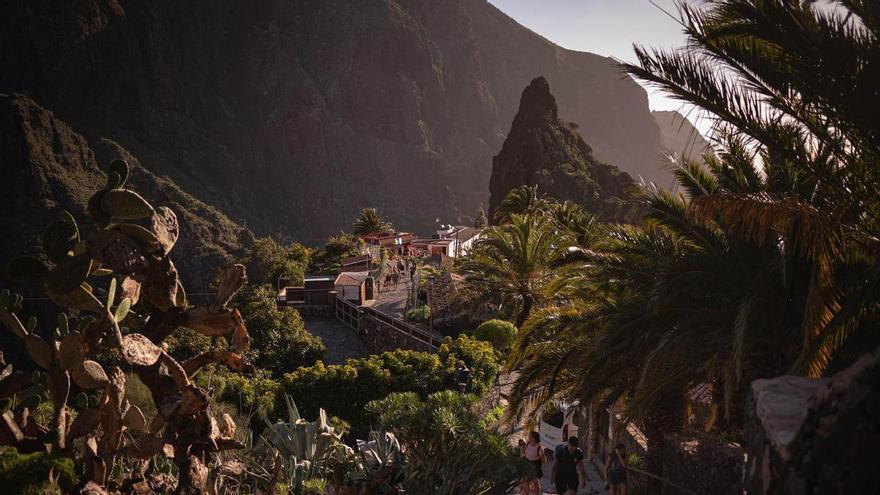
Masca village is built on incredibly steep and high cliffs, so tall they make your neck ache just looking up. It almost seems to float. It's amazing to see life thrive here, nestled among deep ravines and hills topped with old Canarian homes. From a narrow opening on the path to the beach, like looking through a tiny window, you can spot the island of La Gomera. Stone and lush greenery dominate the view, and gazing out into the vast emptiness creates a peaceful, dizzying feeling. This wonderful sensation, however, quickly fades because of the huge number of tourists who visit Masca every day in Buenavista del Norte.
Only 80 people live in Masca, Tenerife's most famous village, yet thousands of visitors arrive daily. It's astonishing: Masca is the second most visited spot on the island, right after Teide National Park. This creates a strange situation. All these visitors bring their cars, driving on a typical local road that's extremely winding, with very sharp turns and a high risk of hitting the rocks.
If you visit Tenerife, Masca is definitely a must-see. However, how people access it has become a long-running debate in the local news. In recent years, some changes have been made: access to the ravine trail was restricted because it was so dangerous, and visitors are now required to use public transport to get there. The island also introduced its first ecotax. Many Masca residents, though, feel this tax is "useless because the money isn't reinvested here." Despite these efforts, there's still a big problem with access, not just to the ravine but to the village itself.
The thousands of tourists visiting Masca can choose from about a dozen places to eat, drink, and shop. Bars, restaurants, and souvenir shops are dotted around the cobbled streets. So, the service industry keeps the village going. In fact, it's rare to hear Spanish spoken when you walk through Masca.
As evening approaches, only a few bars stay open. Life in Masca seems to wind down around 5:00 PM, when most businesses close. Tourists are then left to simply enjoy the last sunlight and the stunning scenery – which is still quite something. It's a shame that in such a special place, you can only truly experience its essence once the crowds leave.
Perhaps being a village so hyped by the media, and often portrayed negatively, has made its friendly locals a bit grumpy. They often prefer to remain anonymous when speaking out, and the first thing a long-time resident might say is, "We are abandoned here." This highlights a clear contradiction.
One Masca resident complains that the streetlights flicker like Christmas lights. He's also unhappy with the cleanliness, saying, "They only clean three times a week, considering how many people come through here." Security is another complicated issue. "Local police don't come, and there's only one person to stop tourists from parking wherever they please," he explains. He also criticizes the rude behavior of some visitors. "They simply don't respect private property," he adds angrily.
His complaints continue. "Our doctor is in El Palmar, and there's no supermarket," he states, then shares a recent urgent health scare he experienced. It's striking how easily he calculates his driving time and how little he seems to care about Masca's distance from other parts of Tenerife. Yet, if you flip the perspective, all those places are equally far from Masca. For instance, "How far Santa Cruz is from Masca!"
The resident recalls a time before tourism, when more people lived in Masca. "Tourism started here around 1985, when the road was improved, because before that, people came by mule," he explains. When asked about past economic activities, he estimates there were "about four herds of goats," indicating that herding, along with farming and basket weaving, were key to the local economy back then.
Despite these issues, he insists, "life is good here. Once everyone leaves, it's very peaceful." Only one small shop remains in Masca, located in El Turrón, one of the village's most iconic ridges. This is also where the last district mayor of Buenavista del Norte used to live. Stepping into the shop, named after its neighborhood, feels like a deep dive into nostalgia. Childhood memories flood back, and just when you expect an elderly Canarian woman to appear behind the counter, you're greeted by a young woman with a dark complexion. She has chosen to continue her family's business, becoming the third generation to own the establishment.
Inside, an industrial coffee machine sits alongside ketchup bottles, cleaning supplies, a display fridge beneath the counter, and a small shelf on the right filled with souvenirs made from palm leaves. The shop has several tables where some tourists are enjoying cured meats. It represents a form of local resilience.
Before you reach El Turrón, just a few bends in the road away, you'll find the Cruz de Hilda viewpoint. Here, a cozy cafe offers panoramic views of Masca, serving as a welcoming stop if you're coming from Buenavista del Norte, or a final goodbye if you're heading towards Santiago del Teide. The cafe is run by a couple from Las Lagunetas (where Miñona lives) who themselves live in Las Portelas (where Rosa is deeply rooted). A tourist points to a traditional "barraquito" coffee and asks, "What is that?" He orders another, then heads to the spacious balcony-terrace, where the sheer scale of the landscape is truly breathtaking.
Masca leads a surprising double life, almost as if the village has two distinct personalities. As the sun sets, most tourists leave, and bars and restaurants close. The village then settles into a state of serenity and calm for the night, waiting for the next day when tourism will once again bring its overwhelming crowds.