
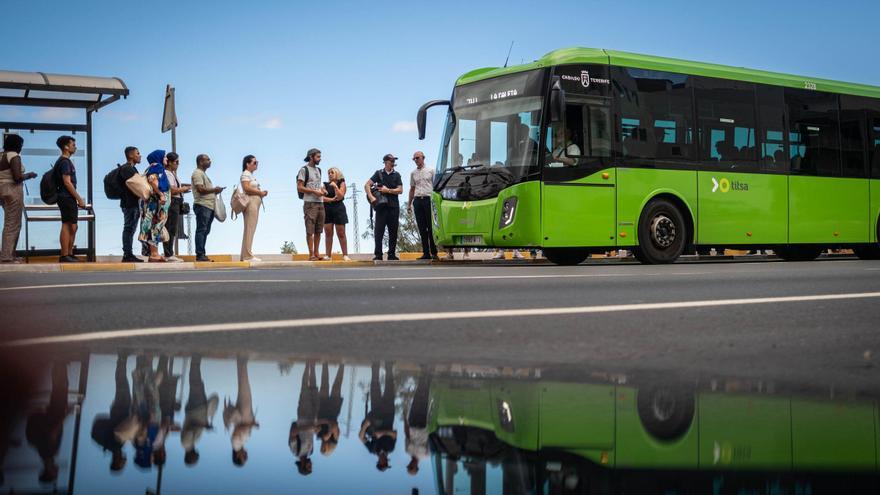
Tenerife's Line 467: The Island's "United Nations on Wheels"
Tenerife's Line 467, dubbed a "United Nations on wheels" for its diverse passengers, is the island's second busiest bus route, carrying over four million people annually and significantly easing traffic congestion in the south.
To truly grasp the unique character of the residential towns in southern Tenerife in just an hour, simply take the bus from Costa del Silencio to La Caleta. On this "United Nations on wheels," you'll see a vibrant mix of people: a T-shirt of the Argentine football team with Messi's number 10, another from Senegal, one for CD Tenerife, a hijab, a keyring with a Ganesha figure, an NBA Los Angeles Lakers tracksuit, headphones playing reggaeton, a phone with a Russian song as a ringtone, or island maps left on a seat by a forgetful tourist.
Bus line 467, despite its relatively short 24-kilometer route between just two municipalities (Arona and Adeje), is not only one of Tenerife's busiest lines but also the one that carries the most diverse range of nationalities.
In this small, multicultural space, you can hear English, German, Spanish, Arabic, Wolof, Polish, Norwegian, and Hindi spoken any day, any time. Though they might not understand each other's languages on this daily journey, everyone coexists, united by a common goal: getting through the day.
The bus gets crowded even during off-peak times, early in the morning and as night approaches. Javier Hernández, who moved from Orotava to the south of the island and has worked in tourism for over 30 years, explains this. "People are constantly getting on and off," he says while waiting at the first stop in Costa del Silencio.
Because it runs through the island's main tourist areas, home to thousands of residents and workers like Javier Hernández, line 467 has become the second most used out of the more than 200 lines operated by Titsa, the island's public transport company.
Last year, over four million people used it to travel along a route that passes through Las Galletas, El Fraile, Los Cristianos, Playa de Las Américas, San Eugenio, Fañabé, and La Caleta.
The first three towns alone have more than 20,000 residents. Buses run from Costa del Silencio from 5:30 AM to 2:30 AM, with services every 10 to 20 minutes during busy times.
Only line 014, from Santa Cruz to La Laguna via La Cuesta, carries more passengers, with 4.8 million in 2024. The next eight busiest lines are far behind, with over a million fewer users each: 015 (2.8 million), 934 (2.5), 111 (1.7), 101, 122, 232 (1.6), 108, and 51 (1.5 million).
More than 80 million passengers used Tenerife's 3,800 stops last year, setting new records since free public transport was introduced on January 1, 2023. By last May, an estimated 42 million car journeys had shifted to public transport, thanks to a more than 30% increase in bus and tram use.
Javier Hernández, a cook at the adults-only Tigotán hotel in Playa de Las Américas, is one of many who has stopped using his private car for line 467.
He even decided to do so when the monthly pass cost 19 euros. "The bus stop is close to my house and drops me off just two minutes from the hotel," he explains. He adds, "Why would I take the car if it's free now and the bus also runs very frequently and offers good service?"
Javier, a Tenerife local, mentions that early mornings can be uncomfortable. Even though the buses are articulated (double-length), "sometimes you have to stand because so many people get on." However, most journeys are short, and he believes "the advantages far outweigh the disadvantages." He also points out that it's not just tourism workers who use the bus. "There are also employees from other sectors, tourists, students..."
Neda El Arafi is an example of a student who uses this diverse bus line daily. At 18, this young woman, born in Tenerife to Moroccan parents from Tangier, is studying a vocational course in Computer Science and Communications at IES Las Galletas.
She confirms that in addition to hotel, apartment, and restaurant workers, many students and even tourists travel on line 467. "The truth is that the bus service is very good," she emphasizes.
Her high school and neighborhood, El Fraile, are just as diverse, with residents from 80 countries. "Every day you see people from everywhere, but coexistence is generally positive," she remarks. She adds, "We all come from families who arrived here to contribute and find a better life. I feel very good here; I'm just another Tenerife local."
This 38-stop route highlights the crucial role of public transport for getting around Tenerife, an island where it's increasingly difficult to travel by private car due to the large number of inhabitants (960,000), many visitors (6.3 million last year), and the high number of cars (almost one per resident).
Eulalia García, the Tenerife Island Council's Mobility Councillor, states, "Imagine if these four million people who use line 467, of whom 30% are tourists, had chosen the car instead of the bus... Traffic would be even worse."
García also sees this route as a prime example of the successful fleet upgrade the council carried out in 2023. "If you notice, all the vehicles on that line are new. They are part of the new buses we've added to replace older ones or expand our fleet. Now we have modern and more comfortable articulated buses than before. This means more passengers can fit, and they travel in greater comfort." She emphasizes, "It's not enough to just offer free service; you also have to provide quality service."
Public transport has been a key part of the measures launched by the Island Council to ease traffic congestion. The councillor mentions the purchase of 247 buses, "many of which replaced rented vehicles or supplemented older ones." More than 300 new staff, mostly drivers, have also joined Titsa.
Eulalia García also highlights the success of the shuttle buses from the North and South to the University of La Laguna, as well as the quicker response to strengthen busy lines like 467. "As soon as we identify a route that needs more service, we act as quickly as possible."
Traveling on line 467 is also a journey of contrasts, especially for those with the time and interest to look out the wide windows. From the abandoned Ten-Bel, a 1970s dream development now dubbed Tenerife's 'Chernobyl,' one passes to the gleaming luxury hotels of Costa Adeje. From the bustling and chaotic Los Cristianos, one passes to the calm, spiritual area around the La Encarnación hermitage and San Sebastián church, near La Enramada beach. From once-fertile tomato and banana plantations, now neglected land, to the thriving Golden Mile on Las Américas avenue in Arona.
However, there are points along the route that urgently need improvement. One notable example is the El Fraile stop, which has benches and other upgrades, but is surrounded by a degraded environment, full of rubbish.
Colombian Daniela Escobar works in cleaning services for holiday rental homes. "When you have to stand, I have to hold on tight not to fall. Some drivers go a bit fast," she says with a laugh.
She is another person who switched from sharing a car with colleagues to taking the bus, especially since it became free. "It's much more practical and is always reliable," she assures, while taking a moment to buy a refreshing drink at the La Victoria minimarket, behind the stop, to cool down.
Fifteen minutes later, at the El Fraile stop, another Colombian, Cristian Ladino, watches videos on his mobile phone under the bus shelter, wearing headphones. He works in hotel maintenance. Arona and Adeje alone account for more than half of the tourists who arrive on the island each year, around 3.5 million in 2024.
"I always travel by bus; it's usually on time," says Ladino. Around him, some passengers stand up, others wait. A car drives by, blasting J. Balvin's "Si te vas." Bus 467 arrives. "Now baby, I put life on stop..." The journey continues.