
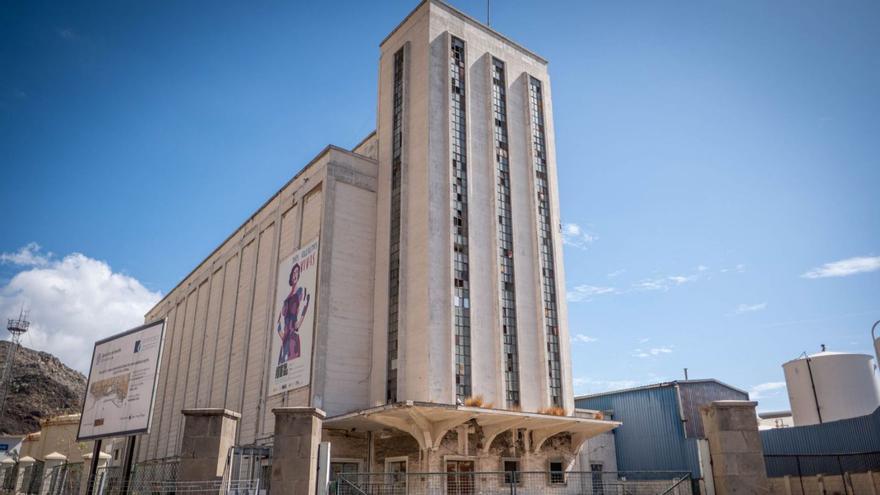
Tenerife's Last Port Silo Faces Demolition, Sparks Heritage Debate
The Port Authority's plan to demolish the unique 60-year-old Type P silo in Santa Cruz de Tenerife, a nationally significant piece of industrial heritage, faces opposition from architects advocating for its preservation and public debate.
In post-war Spain, when the government controlled resources and intervened in the market, the National Silo and Granary Network Project began. This initiative, started in 1944, aimed to build a large, strategically placed network of silos and granaries across Spain.
These buildings were designed to collect and store grain harvests. They also served as distribution hubs for cities and ports, and as reserves during times of low production, helping to stabilize the market.
By 1984, a total of 672 silos and 277 granaries had been built. After this date, Spain joined the EEC (now the EU), leading to calls for less government control over the economy. This effectively ended the purpose of these "rural skyscrapers."
Santa Cruz de Tenerife is home to one such silo, built in 1965 and now 60 years old. Located in the Port of Santa Cruz, it's one of only two "Type P" (Port) silos ever constructed in Spain. The other, in Malaga, was torn down in 2006.
The impressive Tenerife silo, over 30 meters tall, has a striking presence due to its size and prominent location facing the road to San Andrés and Anaga. This building has always captured people's attention, becoming deeply ingrained in the local imagination, much like a "forgotten cathedral."
On October 15, 2025, the local press reported the Port Authority's plan to demolish this nationally unique building, with a budget of 1.5 million euros. The Port Authority argues it's an outdated structure with no practical use, and that its condition has significantly deteriorated.
This news calls for a closer look at the reasons for demolition and a discussion of alternatives. A public debate is essential to decide the future of this and other historical landmarks.
In this case, we are talking about publicly owned land, a public investment (1.5 million euros), and public bodies responsible for protecting worthy assets. Therefore, this debate must be open to the public.
First, the claim about the silo's poor structural condition needs scrutiny. A review of the demolition project itself reveals no mention of structural problems or that the building is in a state of ruin.
Second, the argument that the building cannot be reused is unfounded. Many similar silos worldwide have been successfully converted for various purposes, including cultural centers, offices, and homes.
A recent example is the transformation of a 1930 silo in Kristiansand, Norway, into a cultural venue, which won the CSCAE Architecture Prize 2025. Other successful conversions include: the SZHK Biennale in Shenzhen, China (2013); the Zwarte in Deventer, Netherlands, now a restaurant (2015); the Almagro Silo in Ciudad Real, restored as a cultural center (2017); the Automatic Mills of Pardubice in the Czech Republic (2023); the Kunstsilo art gallery, also in Kristiansand, Norway; and the MOP Foundation in A Coruña (2024).
The historical value of the Type P silo, which makes it worthy of being cataloged as industrial heritage, is undeniable. It is a unique building in Spain, a witness to an industrial past and a social reality that should not be forgotten, making it worthy of National Heritage status.
These criteria have been considered in the Draft Protection Catalog of Santa Cruz de Tenerife, which includes the port silo under Alternative 3 with an Environmental protection level. This would protect its overall shape, height, roofs, facades, defining walls, and surrounding open areas. This shows the building's recognized historical and industrial importance, and the City Council's aim to protect it.
The conversion and reuse of industrial heritage is not a new phenomenon. Changes in production systems and advances in technology have often led to abandoned or ruined industrial spaces. Recognizing their value as a historical record of social and cultural shifts, many factories worldwide have been renovated and repurposed.
Furthermore, heritage protection laws, enacted at both state and regional levels, specifically address Industrial Heritage. These laws define it as movable or immovable assets that represent technological or engineering achievements, valued for their technological, architectural, or scientific significance.
Restoring industrial silos means acknowledging their inherent worth. Their real potential lies in giving them a new life, adapting them for modern uses like offices, shops, or museums.
Considering all these points, it's clear that the silo meets all the criteria to be recognized as National Heritage.
The Sustainable Development Goals (SDGs), adopted on September 25, 2015, by world leaders, represent a global pact to which we must all be committed to building a more just, equitable, and sustainable world.
Within this framework, heritage protection holds a prominent place. In all its objectives, ratified by countries and by the Spanish State, it stresses the importance of protecting cultural heritage. This helps build a sense of belonging and identity, strengthens social bonds, and creates a more resilient society that better understands its history and its role in the world.
Heritage conservation needs to rethink its purpose and role if it is to maintain its rightful place.
Administrations must take decisive action on this issue – which is entirely within their responsibility – to meet national and international goals.
All stakeholders share the responsibility for preserving heritage. Public administrations, in particular, should be even more vigilant than citizens when it comes to their own heritage. It is unacceptable for a building with clear historical value to be on the brink of demolition, promoted and overseen by the very public body meant to protect it.
We must reflect on whether it makes sense to spend public money on demolishing a part of our industrial heritage, or if those funds should instead be used for its preservation and repurposing for the public good.
As professionals, it is our duty to demand that the relevant public administrations act urgently. They must halt the demolition of the Type P silo in Santa Cruz as a precautionary measure and open a public debate about its future. The Official College of Architects calls on other professionals to join this petition.