
Tenerife's "General Escape": Unpacking the Legend of San Diego's Unofficial Student Holiday
Tenerife's "San Diego escape" tradition, an unofficial student holiday on November 13th, has evolved from skipping exams to organized barbecues and a revived historical pilgrimage, celebrating its unique origins and cultural significance.
Many students in Tenerife know the phrase "general escape" very well. Every year on November 13th, a saint named San Diego seems to give thousands of young people on the island an unofficial day off. But where did this tradition actually start?
For over a hundred years, students from different schools on the island would skip classes on this day. They often didn't even know the exact reason why, just that many teachers seemed to accept or allow it.
A little over ten years ago, a high school in La Laguna decided to bring back the original spirit of this tradition and explain its history. This was at IES San Benito, and soon IES Canarias Cabrera Pinto joined in. Since then, both schools have celebrated the "San Diego escape" every November as an event that's both fun and historical.
Around the feast day of San Diego, La Laguna used to have several events, including a pilgrimage on November 13th. But, as in any story, there was a bit of a conflict: a professor.
This teacher, Diego Jiménez de Cisneros y Hervás, didn't want his students to go to the pilgrimage. He had his own tradition: holding an exam on his saint's day.
The school principal, Adolfo Cabrera Pinto, stepped in as the "hero." Students went to him to ask for his help. While he respected the professor's authority and didn't cancel the exam, he did give a hint that would become famous: "General escape."
Without wasting any time, the students took his advice, skipped the exam, and went to the San Diego festival. To show their defiance, they brought pumpkins as an offering, a symbol of the bad grades they expected to get.
Like any good story with heroes and villains, there's also a legend connected to this tradition. Although its exact origin is unclear, the belief has spread that on November 13th, students can do a ritual to help them pass their subjects.
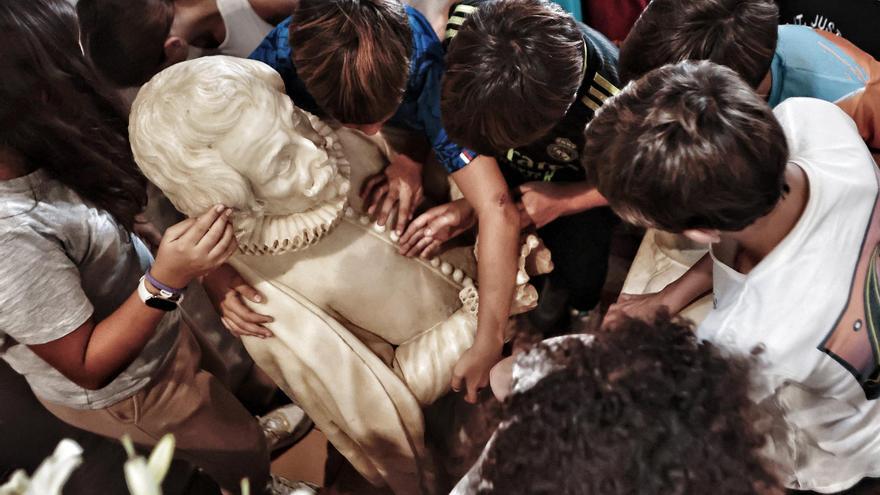
The ritual involves going on the pilgrimage to the hermitage. Afterwards, young people count the buttons on the statue of Juan de Ayala, who founded the convent of San Diego in La Laguna.
Some buttons are hidden, so it's not an easy task. Legend says that whoever finds them all will pass. Of course, it's probably still a good idea to study!
Over the years, the "San Diego escape" spread from the schools in La Laguna to the rest of Tenerife. However, when the saint's celebrations changed and the pilgrimage was no longer held on its original date, the tradition started to change.
Students continued to "escape," with varying degrees of approval from teachers. But in the 1990s, possibly due to more pressure to attend classes, some of the celebration turned into vandalism, like throwing raw eggs at buses, both school and public ones.
Widespread criticism caused the practice to lose popularity, though it remained in the memories of thousands of young people who had enjoyed it for years.
As those generations grew up, a new way of celebrating the escape emerged: not going to class and instead organizing barbecues in the mountainous areas of Tenerife. This trend also spread to the University of La Laguna (ULL), where recreational spots were packed every November.
The phenomenon grew so much that the days off were extended to avoid overcrowding the leisure areas, leading to entire weeks without students in some departments.
Seeing this shift, the team at IES San Benito decided to bring back the historical and cultural meaning of the "San Diego escape." As a school activity, they organized the pilgrimage to the hermitage again, including the traditional search for buttons on Juan de Ayala's statue.
With this, the escape regained its symbolic, educational, and festive character, bringing back one of Tenerife's most unique student traditions.