
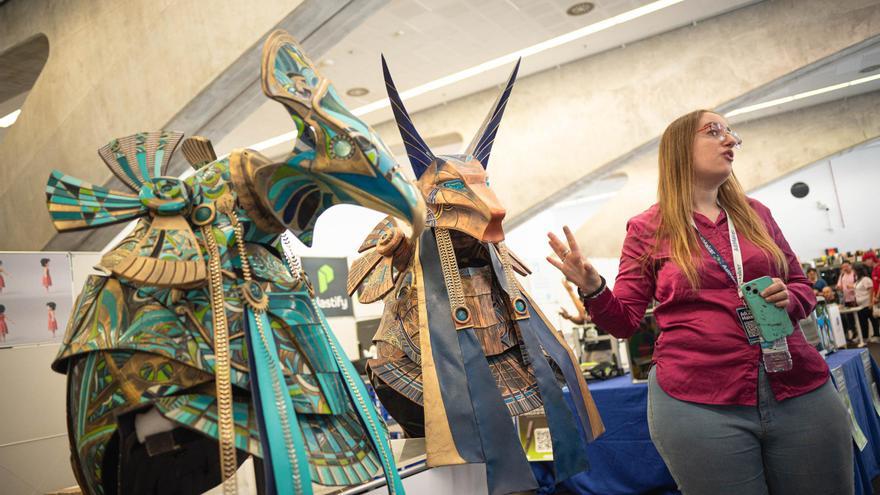
Tenerife's Animaker25 Fair Champions 3D Printing, Local Innovation
Tenerife's Animaker25 fair returns, showcasing 3D printing innovations and fostering local industry to reduce reliance on foreign markets.
The "made in Tenerife" fair, Animaker25, is back for its second year, aiming to connect creative minds with industry and business. For three days, the Santa Cruz Trade Fair Center will host the event, covering 3,000 square meters.
This year, Animaker25 features over 40 brands in the 3D printing world. They're offering their services to help young people and anyone interested create anything they can imagine – from prosthetics and headphones to phone cases. The goal is to reduce reliance on the Chinese market, proving that "we already have that here."
The fair was opened by Lope Afonso, Vice President of the Cabildo, and Manuel Fernández, the Island Councilor for Industry. They see it as an industrial revolution for the island, bringing together business, jobs, and a move towards a more diverse economy, less dependent on tourism.
Following its successful debut in 2024, the 3D printing fair returns with a "more complete and structured proposal" under the theme "Printing the Future: global innovation, sustainability, and intelligent production from the Canary Islands." It also emphasizes "a firm commitment to environmental and social responsibility," highlighting the importance of recycled products and reuse.
The event is designed for everyone, from the general public to industry professionals and students. It's a chance to explore the latest advancements in additive manufacturing, which is the process of building a 3D object layer by layer from a digital design.
At the Natural Fibers of the Canary Islands stand, Alba Reyes explains how banana plant stems, usually considered waste, can be transformed into useful objects or materials, like fiber for other industries. It's almost like magic.
Many schools already have 3D printers, allowing students to bring their creations to life. Students like Gabriela Morales, Bryan Rodríguez, and Daniela García, part of a group of 25 Graphic Arts students from IES Virgen de la Candelaria, are excited about the possibilities. These 17-20 year olds believe they can "design and market our own ideas." They also feel that events like this "help connect creators with people."
Lope Afonso praised 3D printing as "a useful technology because it's efficient, fast, and sustainable." He even had a button on his jacket replaced by a 3D-printed one at the fair. He values the event as a meeting place for the technology sector, fostering talent and knowledge sharing.
This year's fair has doubled the number of professionals attending, showcasing a technology that's already used in fields like medicine, art, and architecture. Rubén Miralles, the fair's director, sees it as an "industrial revolution" and a source of skilled job opportunities.
Manuel Fernández highlighted the "circular economy" aspect, where plastic is turned into filament, which then fuels 3D printers to create new objects. You can even find three-dimensional concrete for building houses.
The fair is divided into different zones for different audiences. There's an area for companies showcasing technological solutions, new materials, and advanced machinery. Another area is dedicated to makers and DIY enthusiasts, where inventors, digital artisans, and hobbyists present their 3D-printed projects, prototypes, and products. There are also workshops, presentations, and training sessions. Admission is free, and the fair is open today from 11:00 a.m. to 8:00 p.m. and tomorrow from 11:00 a.m. to 6:00 p.m.
Albi Martín, a teacher, is at the fair showing people how to become a maker. For him, 3D printing commissions and teaching classes are "my way of life," but he knows that "for many it's a hobby, a simple pastime." He believes that being a maker – someone who builds their own things – is a growing trend because "we need to regain the right to manufacture." He remembers when there were workshops in every neighborhood, "with carpenters, repair shops, and so on." He believes that "today we're trying to recover that, it's a fight against mass-produced items, the desire to manufacture and develop our own projects through objects." He points out that local industry is "disappearing, and we get used to everything coming from China." Albi disagrees: "Well no, you can build here." He describes a process where things are "designed, printed, manufactured, and sold locally." He concludes: "Less AliExpress and more filament and 3D machines."