
Tenerife Reservoirs Over Half Full After Rains, Easing Drought Concerns
Recent rainfall has boosted Tenerife's reservoir levels to over 56% capacity, easing immediate drought concerns for agriculture, but officials caution that reserves remain significantly below annual demand, necessitating continued water management and emergency measures.
Recent rainfall has significantly boosted water reserves in Tenerife's reservoirs, easing concerns about drought and ensuring enough water for agriculture next summer. This improvement is largely due to successive storms in late autumn and early winter, followed by a wet spring, alongside ongoing water purification and desalination efforts. Reservoirs like Valle Molina (Tegueste), San Antonio (La Matanza), and El Saltadero (Granadilla) are now in good shape. On average, the island's reservoirs are over 56% full, holding more than 2.7 million cubic meters of water.
Despite the positive outlook, Valentín González, the Cabildo de Tenerife's Minister for the Primary Sector, urges caution. He highlights that while the island's reservoirs have a total capacity of five million cubic meters, this amount would need to be nearly five times higher and completely full to meet the annual water needs of all 11,258 agricultural users, from large farms to small producers. For instance, over 23.25 million cubic meters were supplied in 2024, with a similar demand expected for 2025.
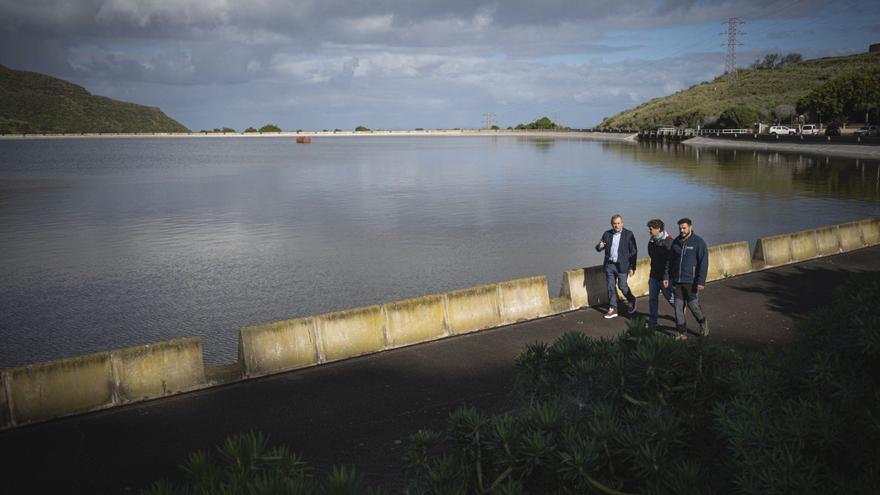
The tour began at Valle Molina, where agricultural engineer Benigno Quintero and operator Rubén Gutiérrez were present. Later, Felipe Pacheco at San Antonio and Juan Guinovart at El Saltadero demonstrated that the 40-strong staff is Balten's (the Cabildo's water company) greatest asset. These experienced employees expertly explain technical details like water levels and pipe networks. They are the ones who typically receive desperate calls from farmers during water shortages, a common problem in recent years. So, seeing the reservoirs full brings them great joy.
Benigno Quintero noted that on a calm day, the water surface acts like a mirror, reflecting the snow-capped Teide, as seen in La Matanza. He added that the reservoirs support a rich ecosystem of plants and animals, drawing interest from scientists. As if on cue, a lone duck appeared, a white speck on the clear blue water. Benigno and Rubén work in Zone 5, one of six water management zones on the island. Zone 6, covering the entire southern slope, is particularly large.
Zone 5 includes areas like lower El Sauzal, La Laguna (especially Tejina and Valle de Guerra), and Tegueste, covering about 2,800 meters. The staff mentioned that it's unusual for the reservoir to be this full at this time of year, as recent years saw more water leaving than entering. Quintero explained that winter started earlier than usual, in December, and brought significant rainfall. Valle Molina receives water from several sources: the Northeast wastewater treatment plant (after advanced purification and pumping), the Santos and Los Rodeos ravines, and some local wells.
The workers pointed out that using regenerated water isn't new; they've been doing it for six or seven years, and it provides a steady supply. Water treated at the Valle de Guerra facility comes from Tacoronte, La Laguna, and other eastern parts of the island, undergoing further purification through electrodialysis.
Benigno Quintero added that farmers initially hesitated to use regenerated water due to concerns about its origin, but now they actively request it. This water is delivered through a pipe network to 2,300 direct subscribers of Valle Molina, supplying farms and orchards of all sizes. Like household water, it's delivered with proper pressure and metered, with users paying for what they consume. A dedicated team also handles essential maintenance, as pipes and other equipment can often break.
Minister Valentín González joined the tour, acknowledging the positive impact of storms Claudia, Emilia, and Francis and their rainfall. However, he remained cautious. He noted that in just a few days around January 1st, reservoir levels rose by 4%, adding about 100,000 cubic meters and reaching 56% capacity.
Comparing December 1st to January 1st, reservoir levels jumped from 34% to 52%, an increase of 897,774 cubic meters. The year-on-year comparison is also positive: current levels of 2.6 million cubic meters are 14% higher than the 1.9 million recorded on the same date last year, an increase of 670,052 cubic meters. González described this as "a significant relief," also leading to lower demand from farmers. Reservoirs in the South are slightly fuller (59%) than those in the North (54%), which is typical due to the greater use of regenerated water on the drier, leeward side of the island.
While touring Valle Molina, Valentín González pointed out that not all reservoirs are as full; for example, Montaña de Taco in Buenavista del Norte is at 35% and La Cruz Santa in Los Realejos at 24%. He stressed the need to monitor weather patterns but added that "if these winter rains continue, we will have significant reserves for summer." In past years, a lack of rain meant reservoirs were often only 10% to 20% full. Now, the combination of rainwater and regenerated water provides much-needed water security.
A question arose during the tour: why doesn't Tenerife have large dams like Gran Canaria? The answer is the island's "orography" or terrain. Except for places like Trevejos in Vilaflor, which has inlets to collect abundant rainwater and also uses regenerated water, most areas lack direct collection points. Benigno Quintero explained that Tenerife's volcanic terrain is very porous, meaning water quickly filters through the ground.
The tour moved from Tegueste to La Matanza, home to the San Antonio reservoir. This reservoir is smaller (500 meters in diameter compared to Valle Molina's thousand) and features floating photovoltaic panels, with the impressive snow-capped Teide visible behind it. Felipe Pacheco, the manager for several years, showcased the reservoir's renewable energy model, using solar power as a test for other reservoirs. Like his colleagues, Felipe expressed pride in working for Balten. San Antonio, located in Zone 4, supplies five municipalities. The tour then headed south to El Saltadero in Granadilla to inspect six water facilities. Juan Guinovart, with 31 years at the company and 27 as manager, guided the visit. Walking the 720-meter perimeter, he recalled when the reservoir was covered and expressed his satisfaction at seeing it full, thanks in part to desalinated water.
Valentín González reminded everyone that Tenerife is still under a water emergency, first declared in May 2024 and recently extended until February 28th. A "Drought Table" meeting is planned before that date to decide, with all parties involved, whether to lift the emergency. González highlighted that in the previous hydrological year (October 1, 2024, to September 30, 2025), rainfall was severely delayed until March and April, creating "a very complicated and delicate situation." This year, storms arrived earlier, leading to a more positive water outlook and increased reserves.
The Minister confirmed that all 75 measures, including new water infrastructure projects, initiated under the water emergency plan have either been completed or are currently underway.
In summary, Tenerife's reservoirs are now just over half full. While recent rains have greatly boosted water reserves, the total capacity of five million cubic meters is still far short of the 25 million cubic meters farmers need each year – five times more. This is why caution remains essential. Although rainwater is the best solution for drought, the island hopes for continued rainfall.
The Cabildo de Tenerife invested 350,000 euros in the first phase of Balten's decarbonization plan, starting with a pilot project at the San Antonio reservoir. This pioneering initiative in the Canary Islands involves installing floating photovoltaic panels to combine efficiency with water management. The goals are to boost the facilities' self-consumption of energy, save power, and reduce pollution. It's estimated this will prevent 124 tons of CO2 emissions, equivalent to planting about 6,200 trees. This project also improves water management efficiency, which is crucial given the island's water emergency. The solar panels, installed on the water surface at a 15-degree angle, are bifacial, meaning they capture energy directly from the sun and from reflections off the water. This system will gradually be rolled out to other reservoirs, including the Valle de San Lorenzo reservoir, currently under construction in the south. There, 50% of the water surface will be covered, generating almost one megawatt of power. This energy can meet the needs of the San Lorenzo treated water desalination plant and also be shared with the Montaña Reverón regional wastewater treatment plant, which is expected to open in the first half of this year.