
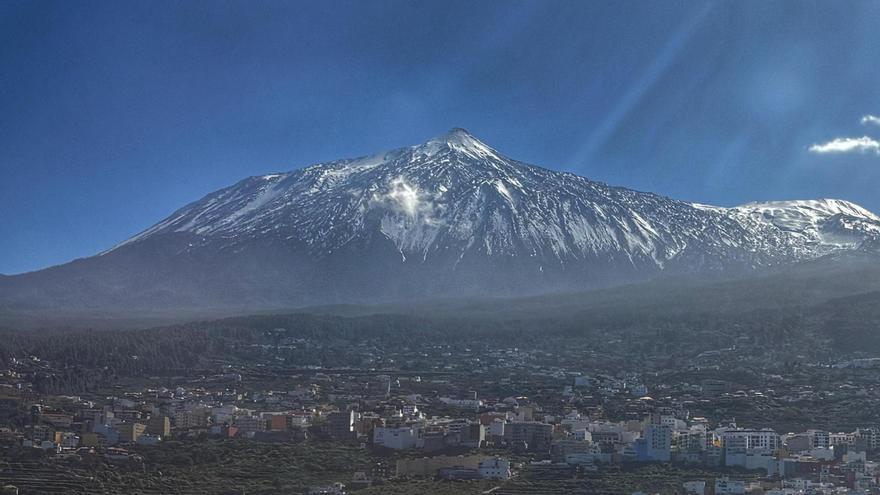
Tenerife Records New Minor Earthquake Swarm, Volcanic Risk Low
Tenerife recorded a new swarm of 14 small earthquakes near Teide National Park between December 29-30, 2025, with the strongest measuring magnitude 1, but volcanologists confirm no immediate risk of eruption.
Tenerife recorded a new swarm of small earthquakes over just three hours. This was confirmed on Tuesday, December 30, 2025, by the Volcanological Institute of the Canary Islands (Involcan) via its social media channels.
Involcan's seismic network, which monitors volcanic activity alongside the National Geographic Institute (IGN), recorded this swarm between 10:30 PM on December 29, 2025, and 1:14 AM on December 30. A total of 14 tremors were detected, and 11 of these were precisely located. The strongest measured magnitude 1 on the Richter scale. None were reported felt by the population.
The earthquakes were centered southwest of the Las Cañadas caldera, within Teide National Park, a protected area. They occurred mostly at depths of 8 to 16 kilometers. This region and its surroundings have experienced similar earthquake series since 2016.
Involcan noted that the signals from these quakes showed a predominance of low frequencies, a behavior similar to that observed in seismic swarms recorded in previous months and years, including one on November 7, 2025.
Scientists stress that this recent activity does not change the likelihood of a volcanic eruption in the short or medium term, which remains low. While experts are staying vigilant, there is no immediate risk of an eruption in Tenerife, according to Luca D’Auria, Involcan’s Director of Volcanic Surveillance.
Mr. D’Auria, a researcher from the National Institute of Geophysics and Volcanology of Naples who joined Involcan in November 2016, has outlined the probabilities, based on historical studies, of a volcano becoming active on the island: 1% in the next 12 months, 4.9% in the next five years, 9.5% in the next decade, 39.3% in 50 years, and 63.2% in a century.
Tenerife's south coast has also seen seismovolcanic activity in recent months. While this activity has decreased, minor quakes have been occurring since the IGN reported them last October.
A series of earthquakes off Tenerife's south coast kept volcanologists on alert, as reported by EL DÍA on October 19. The activity began on Thursday, October 16, with quakes located offshore, very close to the municipalities of Fasnia, Arico, and San Miguel de Abona.
By midday on Sunday, October 19, 30 earthquakes had been recorded in this area, with one felt by the population. The National Geographic Institute (IGN), which oversees volcanic monitoring in the Canary Islands, listed these 30 quakes. However, more tremors in this series were not recorded due to their low magnitude.
The largest quake in this series, a magnitude 3.4, occurred on Saturday, October 18, at 8:17 PM. It was felt by residents in areas of La Orotava, La Laguna, and Los Realejos. Its epicenter was located 29 kilometers below sea level. Only two other quakes in this group exceeded magnitude 2: one at 2.6, barely three hours after the one felt by the population, and another at 2.3 recorded last Friday, the 17th.
The island of El Hierro has also experienced significant seismic activity recently. The IGN located a total of eight earthquakes southwest of the island of El Hierro in the early hours of Monday, December 29. These movements were concentrated between just after midnight and 6:30 AM.
The largest of these tremors, recorded at 1:56 AM in El Pinar at a depth of 36 kilometers, had a magnitude of 3.8. Despite this, the population of El Hierro did not report feeling this earthquake.