
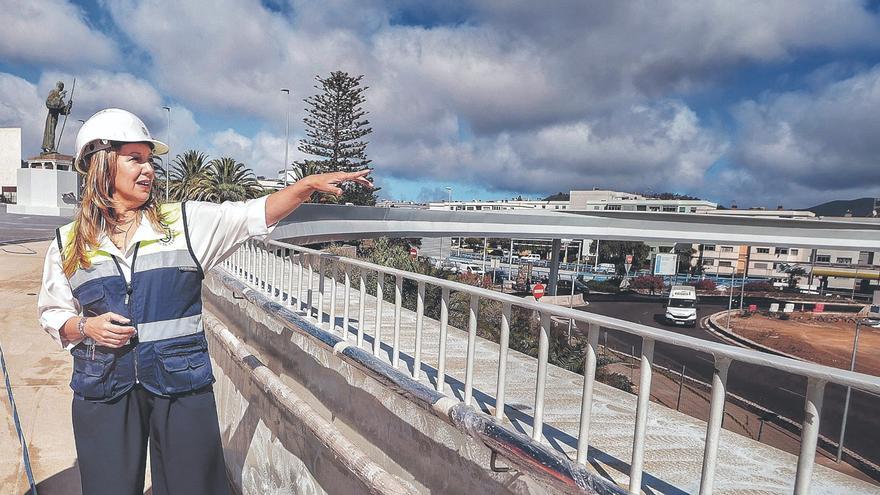
Tenerife President Dávila Unveils Record Budget, Tackles Housing, Traffic, and Teide Tourism
Tenerife's Cabildo President Rosa Dávila unveiled a record €1.278 billion budget for 2026, focusing on social services, housing, and infrastructure improvements while addressing traffic congestion and environmental protection in Teide National Park.
Rosa Dávila, the 54-year-old president of the Cabildo of Tenerife and an economics graduate, is proud of presenting the third-largest budget for a local government in Spain for 2026, totaling 1.278 billion euros. In this interview, she discusses the upcoming year's finances, traffic congestion, a new plan to protect Teide, and other current issues.
This budget is ambitious, ranking third in Spain for local administrations, behind only Madrid and Barcelona. It's over 10% larger than before, with a significant focus on social services.
The Canary Islands Government is making a substantial effort in elder care and has reduced waiting times for assessments. However, Tenerife faces a disadvantage. While the previous Canary Islands Government (2015-2019) allocated funds for a socio-health infrastructure plan, the subsequent socialist government only managed to implement 10% of it. During that same period, welfare policies at the Cabildo, also led by socialists, stalled. Out of 18,000 people needing care, not all require full-time assistance.
We are working hard to improve care and create more facilities. In just two years, we've added 630 spots, compared to none in the previous term. We're also shifting towards a model that keeps people in their own homes and communities, with over nine million euros invested in home care projects.
The high cost of living, low wages, and difficulty finding affordable housing – issues affecting not just the Canary Islands but the whole country – are impacting the local economy. We've addressed this in the budget by increasing funding for these key areas and cutting operational costs by 10%. Our personnel expenses are lower than in many other local governments, yet we've maintained high efficiency. This means 1.040 billion euros are directly benefiting Tenerife's economy. If the Cabildo were to become inactive, as it was under the previous socialist government, Tenerife's economy would suffer. We have revitalized it, making Tenerife the economic powerhouse of the Canary Islands.
Naturally, I am concerned about high poverty rates, as any government should be. That's why we've launched an emergency plan for the homeless and increased funding for social services.
I've noticed it, and anyone walking around can see it.
Many local councils struggle to help homeless individuals with mental health issues because current laws require their consent, which they often don't give. This needs to be re-evaluated.
The goal isn't just shelters; it's about creating a network of homes that provide proper care.
Recently, I met a young woman who found her first job through the Cabildo's 'Práctica' project. She told me she earns just over a thousand euros but is being asked to pay 600 euros for a room. This is unacceptable. The Cabildo has never prioritized housing as much as it is now.
For the first time, this Cabildo has a housing policy. There was none when we took office. The previous Canary Islands Government, led by Ángel Víctor Torres, failed to deliver any housing, not even on La Palma or Tenerife. We are actively providing land, financial resources, and proposing renovation projects, even exploring industrial construction methods.
Yes, it became a meme, but I understand its significance. In the first three months of our term, over 20 measures were implemented, and they are now starting to show results. The key is to have the courage to tackle this long-standing problem and to introduce a comprehensive set of solutions, which we have done. We must recognize that we have one of the highest rates of car ownership globally, leading to traffic issues similar to those in major cities like Mexico City or Los Angeles. This is a challenge for society as a whole.
We've introduced staggered access to the University of La Laguna, a first for the institution, along with shuttle buses for students, improved highway access, and agreements with companies to remove heavy vehicles. We're also offering free public transport, expanding the Titsa bus fleet, implementing modern traffic control systems, and negotiating an express towing service with the DGT to quickly clear accident sites.
The Canary Islands Government, working with the Cabildo, has just approved a third lane on the Southern Highway from Oroteanda to Las Américas. Efforts are also underway for the Northern Highway, with a descending third lane planned between Guamasa and Los Rodeos, where 119,000 vehicles pass daily. In parallel, the Cabildo is improving critical junctions and building direct access lanes. These changes are already making a difference; for instance, the direct lane to San Isidro has reduced travel time by 30%. We are also working on the junction for the Güímar Industrial Estate, Las Chafiras, and the large pedestrian roundabout at Padre Anchieta.
The situation has improved significantly. Finally, decisive action is being taken. The previous Canary Islands Government stalled railway projects. While socialists from Gran Canaria supported this transport mode, their counterparts here shelved it. We have now revived it, and a protocol has been signed with the state, securing funding.
Absolutely, and I've discussed this with the president of Gran Canaria. That's why we've invested so heavily in public transport, not just through free travel. We've allocated 134 million euros to Titsa over two years, enabling us to acquire 254 new buses. Titsa now boasts the most modern fleet in Spain, with an average vehicle age of just three years. Double-decker buses will also be introduced next year. Over 120,000 people have switched from using their cars to buses.
We have excellent collaboration with the Cabildo of Gran Canaria and other island administrations.
Having previously worked for the Canary Islands Government, I understand that the region thrives when all its islands are functioning well. I have no interest in inter-island rivalries. My priority is to advocate for Tenerife, but I am always open to collaborating with other islands when beneficial. We are currently working with the Canary Islands Government and the cabildos of Gran Canaria and Fuerteventura on establishing aerospace sector centers. We also collaborated with La Palma on the National Volcanology Center. I maintain good relationships with the presidents of the cabildos, particularly with Antonio Morales of Gran Canaria.
This is the first time access to the Teide peak has been properly managed. We've limited the number of visitors, installed an emergency phone, provided guidance, are renovating the hostel, and have introduced an eco-tax. This has helped reduce overcrowding.
Tourists, who make up over 80% of visitors, will pay an eco-tax to travel by bus within Teide National Park. This is in addition to the existing tax for ascending the peak. Residents of Tenerife will receive priority. This is part of a comprehensive plan to manage mobility in Teide and alleviate overcrowding. Just as tourists pay to visit natural landmarks elsewhere, they will do so here. Both national and international tourists will be required to park their cars outside the park and use buses, similar to the model in Timanfaya National Park. Access will be further restricted during peak hours, from 9:00 AM to 1:00 PM.
We have taken a firm stance against quad bike companies that operate illegally in Teide and other areas, lacking proper registration, insurance, and vehicle inspections, causing significant environmental damage.
These are not initiatives of the current island government.
Yes.
There's a strong passion for motorsports in the Canary Islands. Enthusiasts risk their lives due to the lack of a dedicated circuit, and some travel to Gran Canaria to use a facility that isn't ideal. A proper circuit is a much-needed infrastructure.
We are working on transforming our tourism model to focus on quality and environmental sustainability. We aim to attract tourists who value and respect nature and sustainability.
My party, Coalición Canaria, has also advocated for a residency law and restrictions on foreign property purchases. I agree with this. Europe needs to recognize that certain territories, especially those facing significant population pressure, require specific regulations.
Any president in that situation should at least face a vote of confidence.
Torres misled the investigation committee and opened the door to corruption in the Canary Islands. He is in no position to demand apologies; he should be the one apologizing to the citizens.