
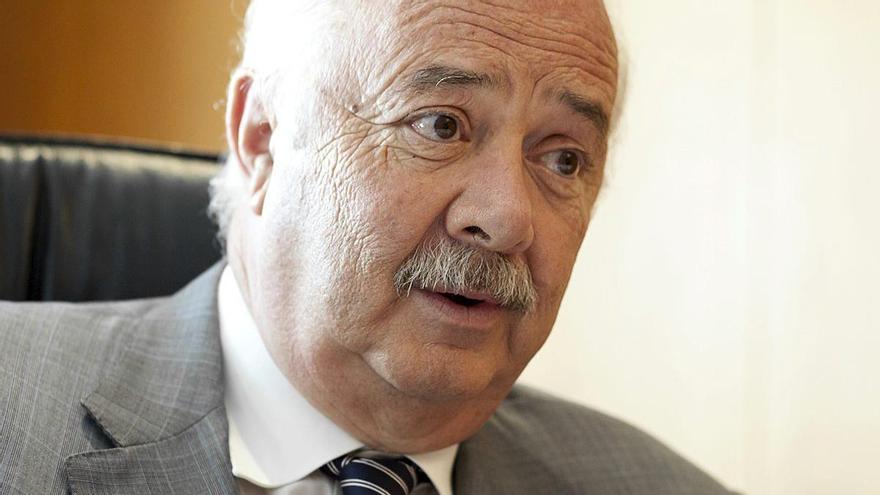
Tenerife Mourns Influential Ex-President Ricardo Melchior
Ricardo Melchior Navarro, a former four-term president of Tenerife's Cabildo and senator, and an influential Canary Islands politician known for championing renewable energy and regional development, has died.
Tenerife learned on Saturday of the passing of Ricardo Melchior Navarro (1947-2023). He was a former president of the island's government (Cabildo) for four terms and also served as a senator for Tenerife. Over the past three decades, he became one of the most influential political figures in the Canary Islands. Like Adán Martín, he was known for his broad vision of how the entire archipelago should develop, even though his direct work focused mainly on Tenerife.
Melchior, an industrial engineer, studied at the University of Navarra and later at RWTH Aachen University in Germany. Among his close friends, he was known as 'the German.' Before he turned 30, a career in politics wasn't on his radar. His first significant role in Tenerife was as director of CAPSA, the company that managed the Port of Tenerife. This experience at the port prepared him for a new professional challenge, one he championed throughout his political life: using renewable energy to fight the emerging threat of climate change. Unelco hired him to lead their New Energies (renewables) department, and his focus on this area grew stronger. He often said, "We live in a privileged place to take advantage of what renewables offer us," whenever asked about the archipelago's future direction. Around this time, ATI began to approach Melchior and other private sector experts. They wanted them to lead the first major nationalist project within the Cabildo, after the socialist José Segura's government fell. Adán Martín became the central figure of this group, which included other notable individuals like Paulino Rivero, José Carlos Francisco, and Melchior himself. Melchior quickly became a trusted advisor and began to build his political standing.
During his first term as Vice-President of the Cabildo de Tenerife (1987-1991), Melchior served as Councillor for Planning and Economic Development. For his second term (1991-1995), he shifted to lead Agriculture and Economic Development. Before his party chose him to head the island's electoral list, he was Vice-President and Councillor for Agriculture and Water (1995-1999). Then, significant changes occurred. Adán Martín moved to a regional role as president, and Melchior competently took the helm. The 150,000 votes he received in the election confirmed his position as the strong leader of CC in Tenerife. With his deep understanding of the primary sector, his initial decisions greatly benefited livestock farmers and agriculturalists. However, he understood that the most crucial discussions involved renewables, mobility, and new technologies. Tourism was already a fundamental part of Tenerife's economy, and while he didn't neglect this "golden goose," his focus was on specific, strategic changes. He was already planning initiatives that he would implement during his second term, which began in 2003. Just a year later, he was elected senator for Tenerife in the VIII Legislature.
Melchior's re-election victory in Tenerife was decisive; he won over 170,000 votes for his second term. Within his party, a group of five was formed to represent the islands in the Senate (the Upper House). This quintet, consisting of Alfredo Belda Quintero, Félix Ayala Fonte, José Luis Perestelo, José Mendoza Cabrera, and Melchior himself, advocated for improvements in key areas. These included industry, tourism, commerce, the environment, and scientific research and technological development. They were essentially laying the groundwork for what we now see as a reality closely linked to the progress of Artificial Intelligence (AI).
Following the news of Ricardo Melchior's death, nearly everyone highlighted his transformative and innovative approach. Many even compared him to a Mercedes Benz, praising his unwavering reliability in implementing policies. In his final four years at the Cabildo, his focus shifted entirely to mobility. Melchior was a strong advocate not only for the tram system but also for the proposed Southern Train. He often expressed regret in interviews, saying, "It should have been planned many years ago; we are already late." He felt like a visionary whose warnings hadn't been fully heeded. This was partly because the funds he requested from Madrid for guided transport in the islands (a regional concern for him) never materialized, and partly because day-to-day demands often overshadowed long-term planning.
Melchior believed the Canary Islands should be a competitive region, not just a tourist destination. This vision helped bridge the historical divide between the island governments (Cabildos) of Tenerife and Gran Canaria, which often had more disagreements than collaborations. This idea gained further traction in November 2016 during President Bill Clinton's visit to Tenerife. Clinton's speech emphasized the regional importance of the Canary Islands, stating, "the Canary Islands are the place the world needs to reach Africa." This highlighted the ongoing need for better connectivity. During his visit, Clinton and Melchior also discussed the progress of wind energy on the island's southern side. In a meeting before a golf game, they stressed that "The Canary Islands are a territory that should make much greater use of this energy source." While the winner of their golf match remains unknown, the islands were, for a few days, on the agenda of White House officials. At the Auditorio de Tenerife, they openly discussed ending extreme poverty, reducing global warming, and encouraging good governance in leading democracies. Melchior also shared his strong views on contemporary politics, stating, "If Trump wins, it would be terrible," before Americans went to the polls to elect the conservative president, though with less ease than in previous elections.
Renewable energy, therefore, remained a constant priority for Melchior. In 2002, his contributions were recognized with an honorary doctorate in Science from the National University of Ireland, awarded at a ceremony in the auditorium of University College Cork.