
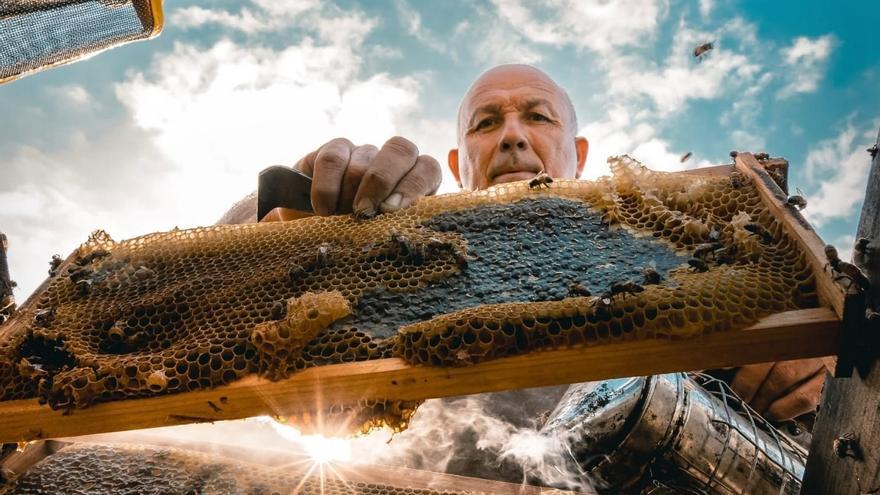
Tenerife Honey Harvest Doubles Post-Fire
Tenerife's honey production has more than doubled this year to 71,196 kilos, signaling a significant recovery after the 2023 forest fire and drought, despite ongoing challenges and environmental disputes in Teide National Park.
Tenerife's honey production has significantly increased this year, more than doubling the amount harvested after the 2023 forest fire. With a month left in the current season, production has reached 71,196 kilos, up from 43,224 kilos last year. The island's 680 registered beekeepers ensure the high quality of this 'sweet gold'. However, this year's quantity is still far from the ten-year record of 194,392 kilos set in 2016, before the pandemic.
The beekeeping industry is showing signs of recovery after two difficult years, marked by the fire and a seven-year drought. While things are looking up, the sector still faces losses and challenges from health and environmental issues. This year's harvest offers some much-needed relief for beekeepers, who manage a total of 16,000 beehives.
Valentín González, the Cabildo's Councilor for the Primary Sector, called this "a good year for beekeeping in Tenerife." He attributed this success to "favorable weather conditions and the hard work and dedication of beekeepers." The honey's "optimal" quality was recently highlighted at the 29th Tenerife Honey Competition, where it won awards. González Évora added that the Cabildo de Tenerife plans to keep supporting the beekeeping sector, notably through the Casa de la Miel (House of Honey), which he described as a unique facility in Spain.
Florencio Gutiérrez, originally from El Hierro but a resident of La Laguna for 40 years, has spent most of that time tending to his bees and beehives in the Teide National Pre-Park. This Saturday, he will be honored with the Gran Celdilla de Oro award for the best honey with Protected Designation of Origin (PDO) at the 2025 Regional Competition, held at the Casa de la Miel. His winning entry was a tedera honey, sold under the brand El Productor. This isn't his first win; his home is filled with awards from previous years.
Gutiérrez remembers "the blow" of the fire two years ago, which destroyed not only beehives but also parts of the bees' natural habitat. He noted that "thanks to the Cabildo and the Primary Sector council, we've been able to keep going, despite the ongoing drought." He also expressed frustration, stating that "some environmental and scientific groups seem to be picking a fight with beekeepers in Teide National Park, where we have lived side-by-side for centuries and want to continue doing so."
He explained, "They claim our bees compete with a wild bee that lives... somewhere." He questioned, "Who is more ecological than us?" adding, "We know when to take our bees to the park and when not to, and we won't go if there's no flowering." He warned, "Today they ban us from the park, and tomorrow it will be the pre-park."
Gutiérrez pointed out that "the regional Ecological Transition department is giving 314,000 euros to experts studying how climate change affects pollinators." He stressed, "They're holding their first talk in La Graciosa because there's an endemic bee there, a close relative of those in Teide." He argued, "Now, they're saying our bees are making the broom dry up. It's not climate change, or lack of rain, or lack of snow." He also mentioned that Teide's new Master Plan for Use and Management (PRUG) sets a limit of 2,600 beehives and requires a reduction of 600 over five years. Gutiérrez concluded, "Do you know where I'm going to put the beehives? In Roque de Garachico, if the town council lets me."
Tenerife's honey production is known for its artisanal methods and its strong connection to the island's unique plants, like Teide broom. Beekeepers have historically moved their hives to the National Park to access flowers such as tajinaste, broom, and malpica. This practice, documented since the island's early history, remains crucial for producing highly prized high-altitude honeys, especially those with the Tenerife Protected Designation of Origin (PDO). Managing permits is vital for the sector. This year, the availability of Teide broom has been significantly reduced after the recent fire.
Florencio Gutiérrez received the Gran Celdilla de Oro for the best Canary Islands honey with the Miel de Tenerife Designation of Origin at the 29th Regional Honey Competition, organized by the Cabildo's Primary Sector council. The other top prize, the Gran Celdilla de Oro for the best honey without PDO, was awarded to Benigno Díaz for a fennel honey from El Sauzal.
Valentín González, the councilor for the sector, praised "the excellent quality of the honeys in this year's competition." He stressed the need to "recognize the immense effort of beekeepers, who have produced outstanding quality products despite challenging conditions, including the lasting effects of the summer 2023 fire and the ongoing drought."
The competition featured 52 honeys from Tenerife, La Palma, El Hierro, La Gomera, Gran Canaria, and Lanzarote. Categories included mild, medium, and intense multifloral, as well as agave, tajinaste, tedera, honeydew, and various single-flower honeys. A jury tasted and judged the honeys, considering both their flavor and presentation.
Additional Celdilla de Oro awards went to the brands 'Oromiel', 'El Productor', and 'Mieles Tagoja'. Celdilla de Plata awards were given to 'Mieles Tagoja', 'El Productor', 'Villa Clara', 'Ladera de la Reina', 'Colmenar La Violeta', 'Miel Henry y Viti', 'Flores Herreñas', 'Mieles El Julan', 'Mieles Tagoja', and 'Destiladera Mieles de La Palma'.