
Tenerife Hires Private Security for Teide Park Amid Debate
Tenerife's island government has hired private security to boost surveillance and control at Teide National Park, sparking debate over the management of protected natural areas.
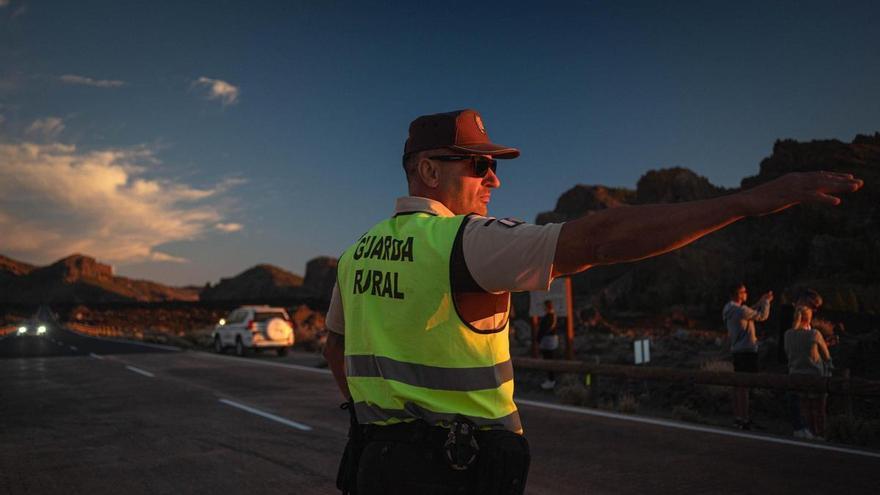
Tenerife's island government has decided to bring in private security to boost surveillance and control at Teide National Park. This move has sparked a debate about how protected natural areas are managed. Starting April 1st, eleven rural guards will begin working at the famous park. Their role is to support the existing environmental agents in an area that welcomes five million visitors each year.
This new security system is being set up through a service contract, which is currently open for bids. The island government council approved the contract's terms and conditions, dated November 2025. Any company awarded the contract must be authorized by Spain's Ministry of Interior. The plan details where the guards will be stationed: one guard will be at La Rambleta, and two at the summit of Montaña Blanca. Four other guards will patrol the park's 190 square kilometers during the afternoon shift, from 4 PM to midnight, using two off-road vehicles. Two more guards will handle night surveillance, from midnight to 9 AM, with one vehicle. Additionally, two extra roving guards will work during these same night hours, but only between April 1st and September 30th.
The estimated cost for this security service is 3,766,421 euros over three years, with an option to extend it for two more. This figure is based on a rate of 31.5 euros per guard-hour, totaling 111,717 service hours. The annual budget is planned as follows: 875,858 euros for 2026, 1,255,140 euros for both 2027 and 2028, and 379,282 euros for 2029.
Blanca Pérez, Tenerife Island Council's Minister for the Natural Environment, has defended the plan. She noted that these professionals aren't entirely new to the park; they started working there last November through a revised agreement with Gesplan. This coincided with the first rules put in place for accessing the summit. Pérez clarified that these guards are not police officers and therefore cannot issue fines. Instead, they support environmental agents and work under the supervision of official security forces. Their main job will be to check documents and permits, even at night, and to alert the Island Council's agents or the Civil Guard if rules are broken. The minister believes their presence has stopped "botellones" – outdoor drinking gatherings – in the park, arguing that before they arrived, large parts of the park were left unsupervised after 3 PM.
The Island Council says this measure is necessary because of staff shortages, particularly in the evenings and at night. They argue that the current number of environmental agents cannot meet all the park's needs, even with recent changes in responsibilities and planned staff increases. This month, the number of environmental agents in Teide will go up from two to seven, with a goal of having thirteen by the end of the year.
However, trade unions have criticized the decision. Antonio Mengual, a CGT representative on the Tenerife Island Council, voiced his concern, calling it a "bet on private over public" services. Mengual believes that a National Park, by its very nature, should only be monitored and protected by public officials who have legal authority, such as environmental agents or police. He suggested that the money set aside for private security could instead be used to hire more public agents. He compared the situation to imagining private guards being used in city parks, like García Sanabria Park.
On the other hand, José Ángel Castro, who leads the agents in Teide and has thirty years of experience, has welcomed the addition of rural guards during what he calls a "moment of transition." Castro pointed out that these guards are covering crucial services, such as night surveillance and controlling access to the stratovolcano, which previously couldn't be managed due to a lack of staff. This allows environmental agents to focus on other duties. He described the service as "necessary" and believes that, in the long run, these measures, though perhaps unpopular now, could prove to be the right choice.