
Tenerife Grandson Embraces Rural Life in Las Portelas
Daniel León León chose to return to Las Portelas, a tranquil, tradition-rich village in Tenerife's Teno Rural Park, drawn by family roots and a desire for peace away from tourist areas, despite the challenges of rural life.
From Rosa Martín Díaz's large window, you can see almost the entire neighborhood. The village of Las Portelas is split into two parts, a detail that really matters to Rosa's grandson, Daniel León León. "There's Upper Las Portelas and Lower Las Portelas," explains Daniel, a young man from Buenavista. He chose to settle here, drawn by the peace and his family roots, leaving behind the busy tourist areas of southern Tenerife. "One day I went to the South with my mother to run some errands, and I just thought, 'No way. I don't want that life'," he adds, sharing a laugh with his grandmother and mother, Delia León Martín.
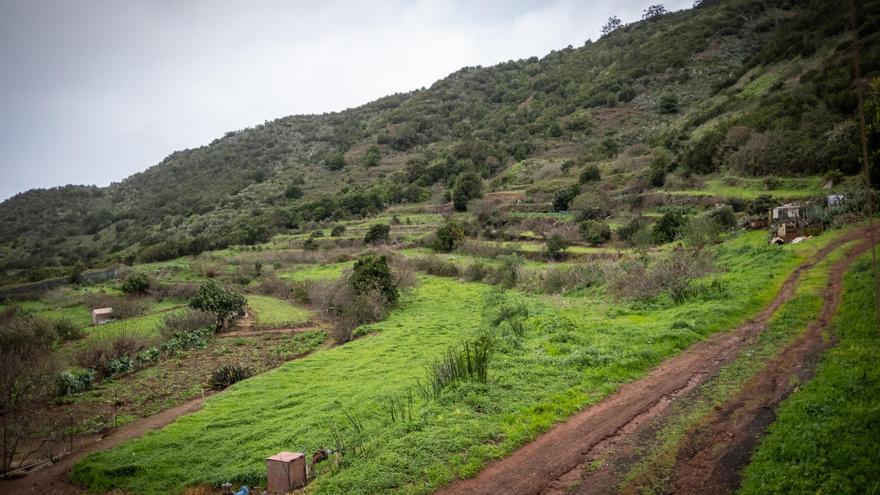
In Las Portelas, nestled in the heart of Teno Rural Park, time seems to slow down. This winter's heavy rains have painted the village a vibrant green. Inside Rosa's house, behind a glass-enclosed balcony, sits a small sofa. It's a cozy spot, perfect for sitting, chatting, and enjoying a coffee. At 88, Rosa settles into a comfortable armchair, crossing her legs with surprising ease. She's small in stature, but her smile makes her seem grand. She looks fondly at her grandson, confessing, "I raised him as if he were my own son." Their family resemblance is clear: all three share light-colored eyes, a shade they call 'Las Portelas green'.
The León Martín family is deeply rooted in tradition. In Buenavista del Norte, they are known as the heart of Las Portelas. Rosa's husband was Alberto, better known as 'El Rubio' (The Blonde). He passed away three years ago, and tears still fill her eyes when she remembers him. "He was very well-known and loved by everyone," she says proudly. A mural on the village walls keeps 'El Rubio's' memory alive. He was honored in 2025, partly for always letting the community use his garden to celebrate potato planting at the start of each year.
Las Portelas is a popular spot for hikers. Throughout the morning, several groups of foreign hikers can be seen climbing the steep main street, heading towards the Bolico area. There, they'll find a hostel, a true oasis perfect for a few days' stay amidst the laurel forest. The area offers two circular hiking routes, one short and one long, which also connect to other trails leading to the southern side of Tenerife.
Peace and quiet are key in Las Portelas. Around 150 people live here, but few are young. Daniel points out where everyone lives, highlighting one of the biggest challenges: "Here, if you don't have a car, everything is very difficult." The bus goes through on its way to Masca, but services are infrequent unless you're specifically taking it to descend the recently regulated ravine.
As for services, Rosa notes there's "a good doctor every day," and a supermarket, though it's in El Palmar, about a ten-minute drive away. Las Portelas also boasts the Mesón del Norte restaurant. It's known as one of Tenerife's best spots for quality grilled meat.
This restaurant helps put Las Portelas on the map for many visitors. While diners bring a temporary buzz, the local festivities committee also breaks the usual quiet. The celebration for the Virgen del Carmen and Santo Domingo de Guzmán happens at the end of August. Even though these are usually hot days, the family all agree that "the weather has been terrible" in recent years, contrasting with the glorious sunshine they're experiencing almost at the end of December.
The festival organizers open the village's cultural center daily from 4 PM to 8 PM. "That's why there's some life here. Thanks to the committee, people have somewhere to go in the afternoons," Delia explains. "They play dominoes there, or go for a drink after mass," Daniel adds. "Otherwise, there wouldn't even be a place to buy a box of matches," Rosa, the grandmother, remarks with surprising calm despite the joke.
"Before, there were more people here, and we raised cows or goats. Now, there are hardly any animals like that left. Only two goats remain," Rosa laments. This reminds Daniel that as a child, he always 'took' the animals down to San Antonio Abad, in the center of Buenavista del Norte – a livestock tradition he inherited from his grandfather. Now, he has no animals to take.
Even though Rosa's life in the countryside was sometimes hard, she misses it. "People used to go out and have a good time. You'd see people on those hillsides singing, talking, and laughing," she recalls with a smile. She insists those were good times: "We ate better. Cooked potatoes, kneaded gofio, cheese, sardines..." she lists. Her grandson joins in, prompting her to describe their meals: "Everyone ate from the same earthenware bowl, sharing a scramble," he recounts.
Rosa Martín Díaz has never lived anywhere else. Her mother was from Las Portelas, and her father from Erjos, in El Tanque. A path just below her house connects to Erjos village, winding through Monte del Agua. "I've been to La Gomera once or twice, just a day trip, if that," she laughs. Her cheerful and lively personality suggests a happy life, which stands in contrast to the depopulation seen in rural areas like this. "People leave because there's no work here, just farming, farming, and more farming," she repeats. She remembers gathering bramble to chop and collecting kindling. They mention a young neighbor who is now working in agriculture, a sight that seems increasingly rare.
Even at almost 90, Rosa is in good health. "People here stay very well. I don't know if it's the diet or the quality of life," Delia wonders aloud. She also fondly recalls her childhood, which she "wouldn't trade for anything." Her mother supports this, confirming, "My girls certainly had fun. They'd gather outside to play. You don't see any of that anymore. Now it's all mobile phones," she says. Delia reminisces about how every weekend they would go hiking to places like Masca. "We'd take a cassette player and walk through the mountains," as casually as if they were strolling down any paved street.
Life is full of choices. In Las Portelas, the León Martín family, led by Rosa and honoring the memory of 'El Rubio', chose a peaceful life, continuing to cherish their tranquility, green surroundings, and potatoes.