
Tenerife Firefighter Elesbaan Perera Demands More Professional Staff
Elesbaan Perera López, a veteran forest firefighter and former Canarian wrestler known as Tenerife's "strongman," advocates for more professional, permanent public sector firefighters and improved working conditions to better manage major disasters and ensure safety.
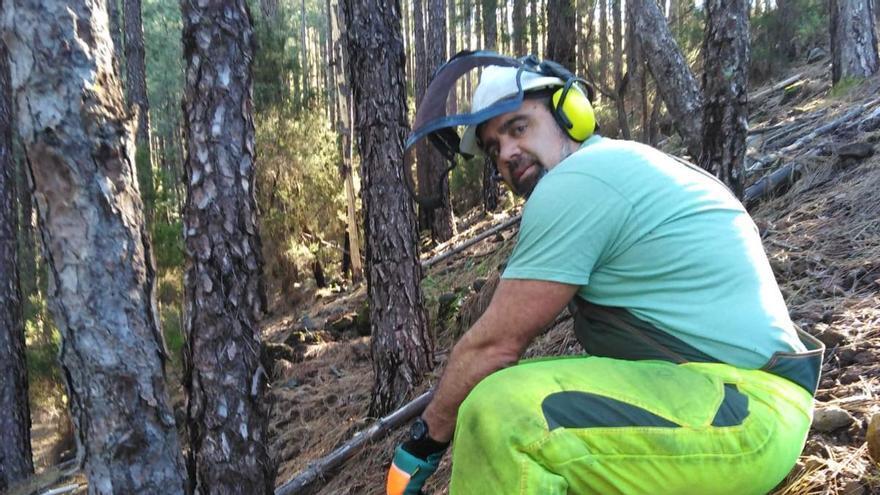
Elesbaan Perera López, born in Tegueste in 1977, is a forest firefighter for the Tenerife Island Council (Cabildo de Tenerife). He specializes in operating chainsaws and believes the public sector needs more professional firefighters to handle major disasters like the huge fire in 2023. He's known as the 'strongman' of the island's mountains.
At first glance, Elesbaan looks imposing, but he quickly shows his kind nature, shaped by his past as a traditional Canarian wrestler, his love for nature, and a life dedicated to helping others. This commitment led him to join a trade union and always look out for his colleagues.
We started by asking about his unusual name: "My father was ahead of his time; they had me very young, at 17, and they liked the name. It's Assyrian, from the Bible, and from what I've found, he was an Ethiopian king."
Elesbaan has been involved in Canarian wrestling since childhood, a family tradition. He proudly shares, "my great-grandfather, Manuel Perera, was the 'pollo' (champion wrestler) of Tegueste." He remembers, "my parents encouraged my brother and me, and we've always done this sport." He wrestled for many years in Tegueste in various divisions, and also in Llano del Moro and El Pinar de El Hierro during the two years he lived on El Hierro. He also enjoys mountain biking. He no longer wrestles "because of my age and to avoid injuries, but I stay in good physical shape." In fact, he adds, "we have a physical trainer at the Cabildo who helps us with exercises."
He calls himself a forest firefighter because 'chainsaw operator' isn't an official job title. In 1999-2000, he studied forest work and natural environment conservation in his hometown. From there, he explains, "I started working on fire campaigns with the company Tragsa for 13 years." This led him to a firefighter role at the Refinery for two years. Then he spent five years at the Cabildo de El Hierro before returning to the Tenerife Cabildo in 2018, where he has been ever since. His work always involves the mountains, combining training, practice, and responding to incidents on various islands, including La Palma.
Forest firefighters are organized into brigades, like Tenerife's Brifor. These teams prevent, extinguish, and monitor forest fires. Elesbaan notes, "our main job in winter is prevention." Chainsaw operators are crucial here, cutting logs, creating firebreaks, and thinning forests. From June to November, as the heat rises, "we switch to more deterrent and surveillance tasks in the mountains," using fire engines, various machinery, and heavy gear.
He has fought major fires, including those in Garafía and Mazo, and the 2007 fire in Chío. However, the fire two summers ago in Tenerife's mountains "affected us all and was a turning point." He believes "administrations must have realized that more staff are needed, and ideally, their own permanent staff."
Perera feels this work "is for professionals, by professionals," because a company might do a job well or poorly, "but without long-term job security for the worker."
He points out that people often take these temporary jobs are students or those looking for four-month summer work. "In my opinion, they must be trained professionals because the people of Tenerife deserve prepared personnel capable of providing the response we need to give."
A chainsaw operator is on the front lines of forest fires. Their main tasks include preventive forest management, creating firebreaks, clearings, and defense lines. Elesbaan explains, "we enter a fire in a coordinated way with a group leader who is always in radio contact with all the different teams and resources. They set the guidelines we follow."
He has faced dangerous situations in the mountains: "You inhale a lot of smoke, and sometimes I've been in a tight spot, though never to the point of wanting to quit because it was too much." He stresses, "I've been lucky to work with people who really prioritize our safety; it's a team effort."
He admits that fire in nature can be captivating: "Some colleagues, especially new ones without experience, are mesmerized by the flames. In some cases, we've had to stop a mission because they froze." He emphasizes, "we help them and even get them out of the area, because the stress and impact are so great that they can't cope."
The Tenerife Cabildo has 15 brigades, each with ten members, two of whom are chainsaw operators. That's 30 in total, which Elesbaan considers "few." He expects "an expansion is coming," referring to a commitment from both the councilor, Blanca Pérez, and the technical service, to increase staff for the next fire season. There will be two more chainsaw operators per team, effectively doubling the current number.
Perera López reminds us that "we are under continuous stress and can lose two or three kilos in a single day." To show why fitness is essential, he gives an example: "in summer, at almost 40 degrees Celsius, on a hillside with all our equipment on, including boots – that's several kilos – plus a machine in your hand weighing between six and 12 kilos; with all that, we are cutting through mountains or felling trees."
This Tegueste native champions the professional forest firefighter and highlights efforts to achieve fair retirement. He explains, "we've been fighting against inequality in this group for 10 to 15 years, because there's no job continuity; there are many temporary contracts here." He states, "there are workers doing the same jobs but getting different salaries. This has created great job insecurity."
One goal is to standardize conditions across Spain. A new law, published on November 9, 2024, aims to do this. Administrations now have one year to implement these regulations. Elesbaan believes "the Cabildo de Tenerife is on board and has done many positive things." This includes changing the retirement reduction coefficient, which "helps colleagues who are eligible to retire. The first ones will do so soon."
A Royal Decree from last September 16 includes this coefficient. It allows for early retirement based on years worked as a forest firefighter. For example, someone with 35 years of service can retire at 59. Elesbaan reflects: "This helps bring justice to a group like ours, which is hard-hit by tough work, fatigue, and exposure to toxic products."
Perera elaborates on his profession: "I believe forest firefighters became more visible to Tenerife society with the 2023 fire. Before, we were seen more as environmental workers who cleared mountains and collected pine needles, rather than fire extinguishers. In fact, administrations hired us as hunting or agricultural laborers linked to forestry or the primary sector."
Analyzing the current situation, Elesbaan says, "traditional forest resource management practices were widely used in agriculture but have been abandoned due to lack of profit. As a result, what's called the 'urban-forest interface zone' – where the forest meets houses – has grown." He dismisses common ideas that forests aren't cleared or pine needles aren't collected, leading to fire fuel: "I disagree, because there's some misinformation. Any citizen can collect pine needles with a permit, but I think this needs to be better organized. We can't compare Tenerife's population 70 years ago with today's." He argues, "before, the bosses or wardens could manage forest use for 20 farmers; right now, if everyone takes whatever they want, endemic species would be in danger."
The forest firefighter adds, "much more staff are needed so we can do prevention work by cutting and clearing. That way, when summer arrives, the job is done, and we don't repeat the 2023 disaster, which could happen again if conditions like extreme dryness, intense heat, and abundant vegetation fuel occur." He believes "lessons have been learned, which is shown by the increase in staff."
Another improvement is the change in shift schedules for the Forest Brigades (Brifor) of the Tenerife Cabildo. Elesbaan, who has a 16-year-old daughter named Andrea, sees this as crucial for work-life balance: "The old schedule was a bit disorganized, with many consecutive mornings and afternoons of seven-and-a-half-hour shifts. Now we have a twelve-hour shift. You work two days and have three days off."
The new Forest Firefighters Law introduces "contingency support in natural and rural environments." This means, Perera explains, that "we have to provide first aid until healthcare professionals arrive."
Asked about recent accidents involving tourists in the island's nature, he believes that "for our role, mastering geography is essential: ravines, currents, wind changes, or topography." He adds, "Tenerife has complicated terrain, and I believe that, besides ignorance and recklessness, there's a lack of direct information for tourists. I think more information points are needed, and trained people should be hired for that task."
To achieve this, proper training is required. He also reiterates the need for more resources, especially human resources, in a "high-risk" job that "must be public." This 'strongman' of the mountain works hard to ensure Tenerife doesn't burn again.