
Tenerife Farmers' Sacrifice Sustains Endangered Livestock Tradition
Tenerife livestock farmers demonstrate immense dedication and sacrifice to preserve traditional farming and endangered species, despite significant financial burdens, relentless work, and a dwindling number of new participants.
"What drives us is our love for livestock farming, because there's little reward, no holidays, no vacations; it's 365 days a year." This is how Mercedes Pérez Marrero, a livestock farmer from La Laguna with 30 years of experience, describes the immense sacrifice involved in an activity that farmers in Tenerife carry out with remarkable dedication.
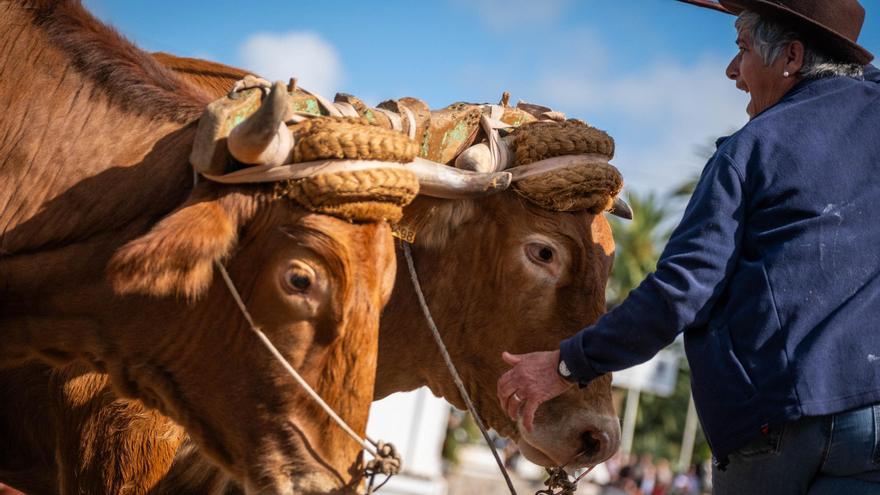
This group gathered on Sunday, January 11th, for the first event of the dragging season: the 38th Tenerife Rural Foundation Livestock Dragging Contest, also known as the Government of the Canary Islands Trophy. Held near the Farmers' Market, the competition saw more than 40 pairs of animals – cows and bulls weighing between 600 and 1,100 kilos – participate.
The goal is for each pair of animals to pull a load, which varies by their weight, along a 70-meter course. They must complete it in under three minutes, with the fastest team winning. However, expert judges also look for other qualities. Ramón Díaz, a livestock farmer with over 20 years in the field, explains that the skill of the person guiding the animals is highly valued. He highlights "the dexterity they have to call them and to get them moving again when they stop." While his brother-in-law competed, Ramón himself focuses on teaching new generations the importance of keeping this tradition alive.
Díaz doesn't rely solely on farming for income; he has another job, and for him, livestock farming is "a very expensive hobby." He owns 16 'vacas bastas,' an indigenous species considered endangered, and spends about 1,400 euros out of his own pocket each month just to feed them. However, by taking part in these competitions, fairs, and pilgrimages, farmers receive some financial compensation, which they use to care for their animals. They stress that these events are crucial for preserving this unique species.
"This yields nothing; besides the money you have to put in, it's a lot of work. You know what they say, the worst of all evils is dealing with animals," states Berto Acosta, a livestock farmer who has spent 25 years organizing events for Saint Anthony the Abbot in Tacoronte. January is definitely the month for animals, with livestock fairs and pilgrimages honoring the saint taking place across the island. In Tacoronte alone, in addition to Sunday's events – organized by the Tenerife Livestock Farmers' Association (Agate) and the City Council – an equestrian show by Chico de la Cruz was held before the competition. The following weekend will feature the popular horse ring race and a livestock fair, complete with an animal blessing.
Despite many young people and children showing interest in farming at the Farmers' Market parking lot, Acosta laments that their numbers are shrinking. "If nothing changes, this activity has no professional future." Those who continue do so almost purely "for the love of it." He explains that many young people try, acquiring animals, but give up once they realize the immense work and cost involved. "With the salaries paid nowadays, who can go without food themselves to give it to them?" he asks.
Professionals in the field primarily complain about rising costs – with forage prices increasing while what they earn for milk or meat doesn't keep pace – delays in receiving aid, and the added difficulties of bureaucracy. "For everything, it's paperwork; it's not like before," complains Mercedes Pérez, who doubts her son will take over her farm, where she cares for a hundred cows and other animals. "I don't know what a vacation is in 30 years," she admits. Although her son attends these contests with her, she believes, "I don't think he'll continue with this; he's interested in other things."