
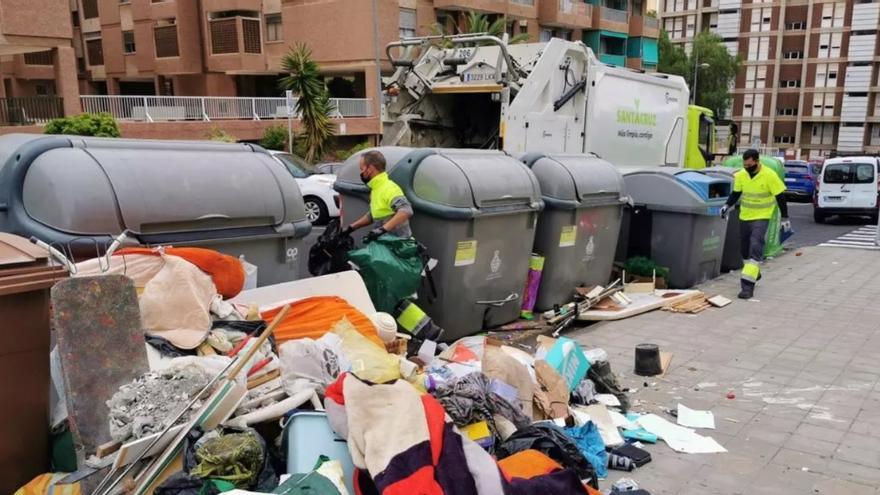
Tenerife Councils Miss Waste Fee Deadline, Delay "Garbage Hike"
Tenerife faces widespread increases in a new waste fee mandated by national law, with many towns delaying implementation or expressing strong opposition despite the January 1, 2026 deadline for full compliance.
Tenerife's new waste fee, dubbed the 'garbage hike,' won't start on time in all towns. This new fee, which aims to meet a national waste law (Law 7/2022 for a circular economy), won't be the same across the island. Increases will vary widely, from 12% to 100%.
The law, published in Spain's official gazette (BOE) in April 2022, brings new European rules into Spanish law. It gave local councils three years to set fees that fully cover the cost of waste services. The crucial date is now January 1, 2026, when the updated fee officially takes effect and can be charged.
Tenerife, like the rest of Spain, faces big increases. What's unique here is that several towns haven't yet brought in the new fee, even though this breaks the law. Councils that have approved it say discounts will help soften the blow. Most councils are uneasy because they know residents won't be happy. For mayors from the PSOE party, it's particularly tricky: supporting their voters means criticizing their own party's policy.
Getting clear information from all towns has been very difficult. Our newspaper sent the same questions to every town hall, but some didn't reply or avoided the tough questions.
Santa Cruz de Tenerife Santa Cruz de Tenerife, the island's capital, approved the changes in October. The city council explained they've set up a system based on a home's official property value and the number of people living there. They estimate an average increase of about 50%, with bills ranging from 70 to 150 euros. Mayor José Manuel Bermúdez (CC), whose party governs with the PP, complained, "This fee is imposed on us by Pedro Sánchez's government."
San Cristóbal de La Laguna San Cristóbal de La Laguna updated its tax rules in April. The council expects an average increase of 24%, meaning residents will pay 115 euros per year, up from 95.4 euros. The exact amount will depend on property value, household size, and any discounts. The ruling coalition (PSOE-CC) supports the fee but expressed frustration that 40% of the 13.7 million euro cost for waste collection goes to the Tenerife Island Council (Cabildo) for waste treatment at the Arico landfill.
Candelaria Mayor Norberto Padilla (CC), who governs with the PSOE, said the initial approval happened in October. He noted that the new bill would be "double the previous one." Padilla complained that local councils don't have "the right tools for a fair and proper application" of the fee. While Candelaria is ready to implement it, he warned that "appeals and claims will need to be considered, as they will affect its future application."
El Rosario El Rosario approved its tax changes in October. The IR-Verdes government highlighted that "national civil servants at the City Council have already warned that the Law requires the fee to cover the service cost, and failing to do so would be a breach of the Law." The new fee per home is 133.27 euros, up from 85.15 euros – a 56.5% increase. The council also complained about the "limited time" given to councils to update their rules and the increased charges from the Cabildo for waste management.
Tegueste Tegueste approved its update in October. The council, led by a PSOE mayor, estimates a 36% increase for homes, from 96 to 130 euros. While supporting the "spirit of the law," they disagree with "how it's being imposed and who has to bear the cost."
El Sauzal El Sauzal approved the fee change in November and is now "following the legal process" to put it in place. The CC-led government considers it "absolutely excessive, especially for businesses," but acknowledges it's "a requirement from European waste management directives." Homes will see an increase of just over 29%, going from 99.9 to 129.09 euros.
La Matanza de Acentejo La Matanza de Acentejo, a PSOE-led council, chose not to respond to inquiries.
La Victoria de Acentejo Despite having a socialist mayor, La Victoria de Acentejo will not implement the new waste fee. The council stated, "We have not changed the tax rules for the waste fee" and added, "We are currently working on an economic and financial study of waste management."
This municipality One unnamed municipality, governed by the local AISU party, is ready to implement the fee. The monthly bill will be 11 euros, an increase of just over 3 euros from the current rate. Annually, this means 132 euros, up by 36 euros, a 38% increase. The council stated, "It is not a municipal decision, and compliance is mandatory."
La Orotava La Orotava is a key municipality as it has firmly decided not to change its fee. The city council, governed solely by CC, plans to put the waste collection service out to tender in 2026. After that, they will "re-evaluate the law and make suitable decisions." They see "many legal loopholes" and an "excessive" increase. They called the regulation "disproportionate and unfair," regretting that "it doesn't adapt to the specific characteristics of different areas."
Puerto de la Cruz The ruling coalition in Puerto de la Cruz (PP-CC-ACP) avoided giving comparative figures with the old fee. However, they stated that an average household would pay 130 euros annually. They criticized the "imposition by the central government."
Los Realejos Los Realejos, led by a PP mayor, approved the changes in March. The standard bi-monthly charge of 13.9 euros remains, but a new line item for Law 7/2022 will be added to bills, costing between 6.52 and 10.04 euros bi-monthly. The council calculates an average bi-monthly bill of 22 euros. Annually, the old generic amount was 83.4 euros, and the new total is 132 euros, an increase of about 58%. The ruling coalition is "categorically against" the change, arguing that "the Government of Spain has misinterpreted a European directive by unilaterally deciding, without consulting city councils, to pass the entire cost of waste treatment onto residents."
San Juan de la Rambla Despite repeated attempts by this newspaper, the ruling coalition in San Juan de la Rambla did not provide the requested data.
Garachico Garachico has not yet finalized the new fee document. The council expects it to be approved this month. They stated, "The intention is to apply it; we doubt it will be by the 1st due to the time the process takes." They don't yet know the new amounts and complained, "It doesn't seem right to us, as in the end, we will pay more for the same thing."
Icod de los Vinos In Icod de los Vinos, the new fee proposal is open for public review until December 23, according to the ruling coalition. They calculated that "although the economic analysis shows an 84.95% deficit between current income and the actual service cost, a slightly greater than 79% increase in tax fees is proposed." For homes with daily collection, currently paying 97 euros per year (in 2025), this would mean a monthly increase of 6.5 euros for 2026. For non-daily collection, currently 68 euros per year (in 2025), it would be a monthly increase of 4.5 euros. So, daily collection would rise from 97 to 178 euros annually. They criticized the fee change, saying, "It seems disproportionate and unfair to the city councils, which must pass this burden onto each resident."
Buenavista del Norte Mayor José Heriberto González (CC), who governs Buenavista del Norte with the PSOE, said they approved the change in April. He explained, "The increase is significant because we had a notable deficit in the service costs, and the decree requires it to be self-sufficient."
El Tanque El Tanque quickly approved its fee change in March. Mayor Esther Morales (PSOE) avoided direct answers to the main questions, simply stating, "It is mandatory; otherwise, administrations will face penalties."
Los Silos Los Silos, a northern town, has a new fee for homes based on the number of registered residents. The council stated that a house with three residents would pay 27.74 euros per quarter, totaling 110.96 euros annually. Mayor Carmen Luz Baso (PSOE, in a pact with USP) supports the measure, believing "awareness only comes when it costs us money." However, she criticized that councils had to approve these rules "without the necessary tools and mechanisms for the law to be properly followed." She also noted a lack of funding from the Cabildo and the Canary Islands Government for containers and other recycling resources.
La Guancha La Guancha referred to a November press release, which stated that the new waste fee "will cause an increase of up to 50% in the bill."
San Miguel de Abona San Miguel de Abona approved its tax changes in October. The annual household fee will rise from 71.4 to 121 euros, a 69% increase. The PSOE-led council stated, "The City Council considers it a necessary and responsible measure."
Arafo Arafo will also apply the new fee. The city council stated that an average household would go from paying 30 euros quarterly to 45 euros, an annual increase from 120 to 180 euros, or 50%. Mayor Juan Ramón Martín (CC) lamented, "This new fee seems to me another example of regulations being imposed on a region without considering its unique characteristics as an outermost region."
Güímar Güímar has also approved the new rules. Mayor Carmen Luisa Castro (PP) stressed, "I want to be very clear: this fee is not a decision by the Güímar City Council, but an imposition by the Government of Spain to comply with European regulations." In Güímar, fees are set in three tiers based on home size. For the most common tier (homes between 51 and 150 square meters), the annual payment will now be 118.22 euros, about 13 euros more, representing a 12% increase.
Fasnia Mayor Luis Javier González (PSOE) reported that Fasnia's new rules have been approved, and the increase will be "approximately double." He commented, "It's not about what politicians think of the new fee, but about complying with the European directive and finding ways to reduce costs and minimize the impact on citizens."
Arico The ruling coalition in Arico (PSOE-PP) did not provide any data.
Granadilla de Abona Granadilla de Abona stated that the fee "has been initially approved and is currently in the publication period." They expect final approval this month. The fee will have a fixed part (65.22 euros) and a variable part of 15.08 euros per resident. So, a home with three registered residents would pay 110.46 euros. The local government (CC-PP-Vox) assured that "the increase will not exceed 30% for homes." They added, "It is not a pleasant measure; it is imposed by the central government, and efforts have been made to harm families as little as possible."
Vilaflor de Chasna Vilaflor de Chasna approved its changes in October. The new fee will depend on household size. For a three-person household, it will rise from 76.6 to 116.05 euros, a 52% increase. The CC-led council, headed by Arturo González, criticized the state-imposed fee as "excessive" and for not considering the "unique characteristics of the Canary Islands."
Santiago del Teide Santiago del Teide, led by a PP mayor, responded, "There is no official information on the matter." Despite repeated attempts, it was unclear if this meant they declined to comment or if a new fee hasn't been established yet.
Tijarafe Mayor Agustina Beltrán (PSOE) of Tijarafe stated that they have a new ordinance, which will take effect next year. She added that since the last fee update was in 2023, the increase "will not be too large."
Adeje Adeje, a southern council, stated, "The Adeje City Council will comply with the new fee regulations throughout next year." They are currently in the process of awarding the waste service contract. The PSOE-led local government highlighted, "We believe that when the new fee is applied, the increase will be lower than in most municipalities on the Islands because here, prices have been adjusted to the real cost of the service year after year for a long time."
Arona Arona has a meeting scheduled today to discuss how to manage the fee increase. The CC-PP-led council expects they won't be ready by January 1, and the delay could be lengthy. After years without updates, the new fee could at least double the previous amount.
Guía de Isora Mayor Emilio Navarro (PP) of Guía de Isora noted that the changes have been approved. However, he has a meeting scheduled with the treasurer today to try and delay its implementation.