
Tenerife Council Launches Youth-Focused Gender Violence Prevention Programme
The Tenerife Island Council has launched a new programme of events for the International Day for the Elimination of Violence against Women, focusing on young people through a congress, a campaign, and family activities to strengthen early prevention of gender-based violence.
The Tenerife Island Council, through its Equality and Diversity department, is launching a comprehensive programme of events for November 25, the International Day for the Elimination of Violence against Women.
This year, the Council is especially focusing on young people – pre-teens, teenagers, and young adults. "We are strengthening early prevention of gender-based violence through three main initiatives," explains Island Director, Patricia León. These are: "the Second Congress on Preventing Gender-Based Violence, the island-wide campaign 'For a future free of gender-based violence,' and the family activity 'What Shall We Play?', held during La Noche en Blanco (White Night) in La Laguna."
These actions align with the Strategic Plan for Preventing Gender-Based Violence 2024-2029, approved by the Island Council. The plan aims to promote positive relationships, sex and relationship education, build equal partnerships, and help identify sexist violence from a young age.
With these three initiatives, "the Tenerife Island Council reaffirms its dedication to preventing gender-based violence from a young age," states Rosa Dávila, President of the Island Council. "The institution is committed to educating, raising awareness, and supporting citizens from childhood to youth, involving professionals, families, and community groups."
On November 26 and 27, the University of La Laguna's Guajara Campus will host the second Congress. This event is designed for professionals from various fields – including equality, gender-based violence, education, youth, culture, and sports – to train, reflect, and coordinate.
The main goal of the congress is to standardise approaches and strategies for preventing gender-based violence among young people. It aims to make it easier for local councils, schools, specialist organisations, and professionals working with young people to cooperate. Key topics will include social and educational support, sex and relationship education, prevention in public areas, promoting equal masculinities, the impact of social media, and support for underage victims.
The programme will feature presentations, debate panels, discussions, and practical experiences. On the morning of November 26, new teaching methods for sex education and preventing online sexist violence will be presented by experts in encounter therapy and cyber-equality. In the afternoon, there will be debates on local experiences and pioneering projects.
On November 27, the Congress will focus on positive masculinities, creating safe public spaces, and legal interventions involving young people.
This Congress is directly inspired by the Island Strategic Plan. This ensures that the content, conclusions, and suggestions from the Congress can be used in the annual work of local technical teams and partner organisations.
"We want to create a space for reflection and dialogue among the different groups that work with young people on our island – pre-teens, teenagers, and young adults – who are a crucial part of the political agenda, looking at young people from a fresh perspective," explains Patricia León. She adds, "We want to empower them to speak up, become role models for their friends in building healthy, violence-free relationships, and, most importantly, to embed gender equality into their daily lives."
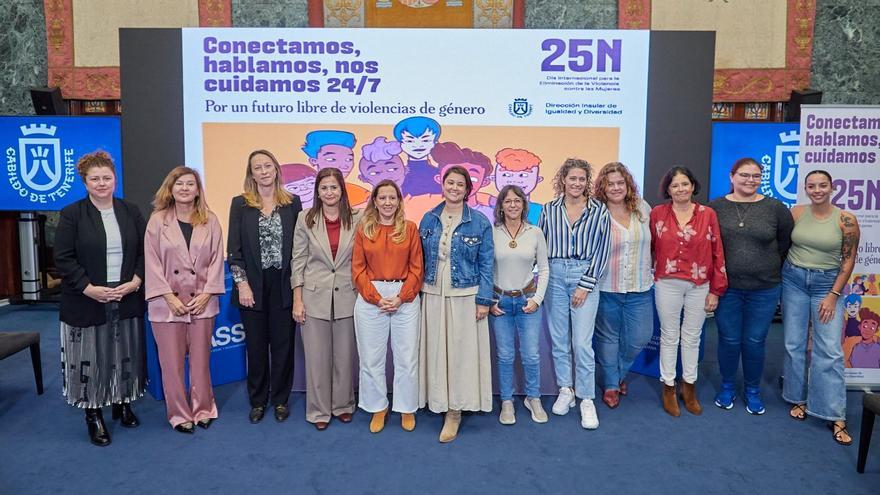
Alongside the Congress, the Island Council has launched a specific campaign for adolescents aged 14 to 18, with the slogan "For a future free of gender-based violence." The campaign focuses on young people who connect, talk, and care for each other, based on findings from the Strategic Plan and recent studies on young people and gender-based violence.
The President of the Island Council recently shared data that highlights a reality requiring immediate action. For example, 25% of young women aged 18 to 30 report physical violence from a former partner, and 20% report sexual violence. Among girls aged 14 to 16, 27% say they have experienced gender-based violence in their relationships. Worryingly, 94% don't report it due to fear, and 64% didn't initially realise they were victims of sexist violence.
Studies also reveal ongoing challenges in understanding terms like "gender-based violence" or "equality." Some boys report feeling challenged or discriminated against when these topics are discussed.
On common ground, young people of all genders share concerns about mental health, social relationships influenced by mobile phones, housing, and emotional well-being.
Within this context, the campaign proposes a message focused on connection, dialogue, and care – essential elements for preventing violence among adolescents.
The campaign features six diverse and natural young people (three girls and three boys), representing the variety of students found in high schools. With direct and accessible visuals, the slogan summarises the Island Council's aspiration: "We connect, we talk, we care for each other 24/7. For a future free of gender-based violence."
The campaign has been promoted through posters in high schools and local councils, on street billboards (MUPIS) in the metropolitan area and various northern and southern municipalities. It has also been displayed on screens on trams and TITSA buses, and disseminated online, targeting social networks and digital platforms popular with young people.
The objective is to create opportunities for young people to reflect and talk, offering positive role models that encourage healthy relationships and challenge behaviours that normalise control, jealousy, or online violence.
To complement the actions for professionals and adolescents, the Island Council has also included a specific initiative for families and younger children. On November 29, during La Noche en Blanco in La Laguna, in collaboration with the Island Centre for Information, Advice, and Documentation for Gender Equality (CIADGE), the activity "What Shall We Play?" will be held, based on the island's guide to non-sexist toys.
The aim is to encourage families to choose games and toys free from gender stereotypes. It offers practical advice so that all children can play, explore, imagine, and learn without limits.
Play is a vital educational tool for children, helping them develop social, thinking, and emotional skills. Through play, children experiment, share, solve problems, and learn values. By promoting non-sexist play, we are also planting the seeds of equality and preventing future violence, fostering relationships built on respect, cooperation, and the freedom to be themselves.
The activity includes workshops and advice for families on non-sexist toys, ideas for stereotype-free play, and activities to help them think about how toy choices shape identities and relationships.
This is an early prevention effort that supports the November 25 initiatives and brings the message of equality to families in an accessible and relatable way.