
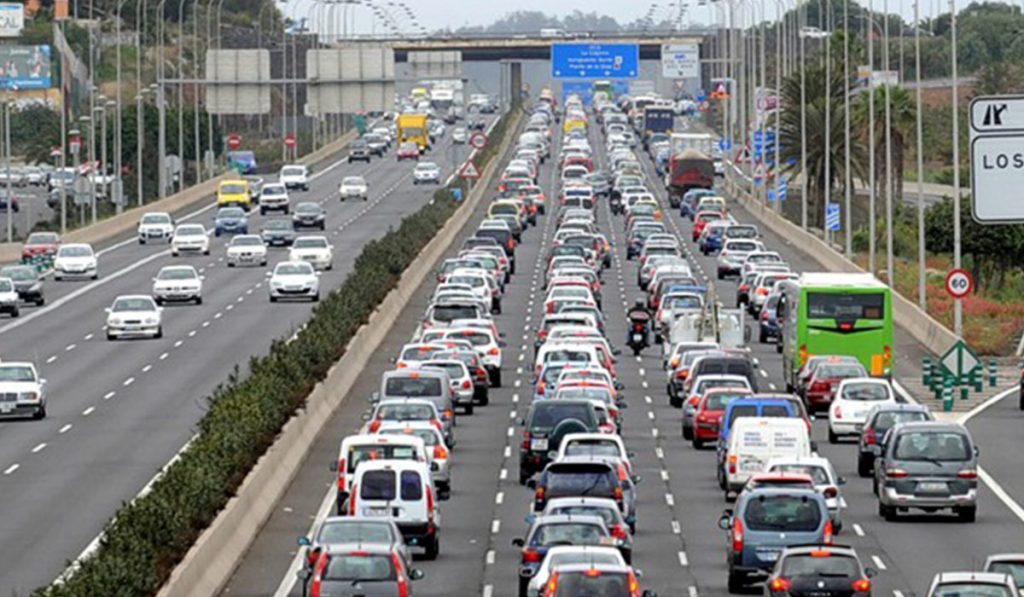
Tenerife Chamber Calls For 'Mobility Emergency'; Cabildo Cites Hurdles
The Tenerife Chamber of Commerce has called for a "mobility emergency" to accelerate road construction and alleviate severe traffic issues, a proposal the Cabildo president is open to studying despite legal complexities and ongoing efforts.
Yesterday, the Chamber of Commerce called for a 'mobility emergency' in Tenerife. They believe this would help speed up paperwork and get road construction projects moving faster.
During a press conference, Santiago Sesé, the Chamber's president, suggested using the same approach as the 'water emergency' declared by the Cabildo (Tenerife's island government), which he said has worked well.
He stressed the need to find solutions to traffic problems. He pointed out that local authorities would be key to making this happen, as it would help cut through the complex red tape involved in such projects.
The Chamber of Commerce president argued that many people face constant stress and exhaustion from traveling on the island's roads. He noted that some companies are even switching to continuous workdays because employees struggle to get to and from work. He also highlighted the environmental damage from traffic jams, lost work time, and people missing work.
Responding to this, Rosa Dávila, the president of the Cabildo de Tenerife, said she was open to 'studying' the idea. However, she pointed out that the island government has already been 'brave' in tackling this long-standing issue. She added that it's up to the regional government to push forward major projects on the TF-1 and TF-5 highways, which are already approved but still need to be put out to tender and awarded. Dávila commented, "We all know that addressing the mobility situation in Tenerife is a great challenge."
Dávila explained that while traffic is Tenerife's biggest problem, with a very high number of vehicles per person – more than in many large cities – it would be 'difficult' to put such a mobility decree into practice. She noted that this would fall under the regional government's responsibility, which already has funds set aside for major projects in its 2026 budget.
She mentioned the progress of the most urgent projects: on the TF-5, the section between Guamasa and Los Rodeos is already in the bidding phase. On the TF-1, work is planned for the section leading to Playa de Las Américas from Oroteanda, and also the section from San Isidro to Oroteanda.
Lope Afonso, the Cabildo's first vice-president, stated that the problem isn't just about 'political will,' but also about legal challenges. He explained that emergency declarations are usually for specific situations involving an unexpected or immediate danger. He added, "It's not that simple. Even if we study it, legally, it's hard to apply an emergency declaration to general traffic issues. It would be different if, for example, a landslide blocked a road or a storm caused a highway closure."
On June 18, the Cabildo de Tenerife's Governing Council initially approved the Sustainable Mobility Plan. This plan involves investing over 5 billion euros between 2025 and 2035. It's described as 'the largest investment in mobility ever made on the island,' with funding from both the Canary Islands and Spanish national governments.
Last week, four accidents and several vehicle breakdowns on the TF-5 highway raised concerns again and intensified the discussion about traffic and how much the island's roads can handle.
Tenerife currently has 830,944 vehicles, including mopeds. Excluding mopeds, the number is 812,327. This works out to 870 vehicles for every thousand residents.
Also, there are 408 vehicles per square kilometer. This 2024 figure is much higher than the average for the entire Canary Islands, which is about 259 vehicles per square kilometer.
Compared to 2023, this is an increase of 9,402 vehicles, or 1.1%. These numbers highlight the scale of the problem.