
Tenerife Campaign Saves Thousands of Disoriented Shearwater Chicks from Light Pollution
Tenerife's 27th annual campaign is successfully rescuing and rehabilitating thousands of vulnerable Atlantic Cory's Shearwater chicks, disoriented by light pollution during their first flights, thanks to extensive collaboration between public resources, volunteers, and citizens.
These birds are over half a meter long, live for more than 30 years, and can fly up to 50,000 kilometers a year. That's 30 times the distance between the Canary Islands and mainland Spain. Their calls sound like a crying baby, and thousands of them come to the Canary Islands' coasts and small islands to breed.
Tenerife is once again working to save the chicks of the Atlantic Cory's Shearwater, a unique seabird species with large populations in the islands. Between mid-October and the end of November, these chicks go through a very vulnerable time. Many survive thanks to rescue efforts organized each year by the Cabildo of Tenerife.
During this period, the shearwater chicks take their first flight. They are over three months old and have grown enough to face their first big challenge: staying away from the coasts for over four years until they return to find a home in a cave or crevice on the islands.
They fly at night to avoid predators and use the moon to navigate. This is where the problem starts. Coastal development in the Canary Islands has filled the once dark environment with lights, as these birds now share space with humans. This disorients them, leading to collisions with windows, falls into ravines, or being hit by vehicles.
The campaign to collect, care for, and release the Cory's Shearwaters in Tenerife is now in its 27th year. Last year, a record 3,446 birds were rescued, with a 94% success rate in their release. This year, as the operation nears its end, over 2,000 chicks have already been rescued.
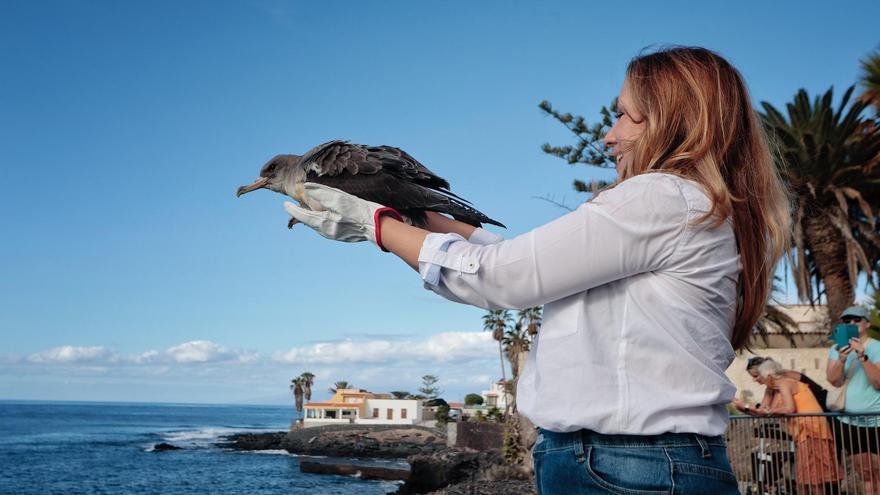
As part of this campaign, the Cabildo held an environmental education event on Monday, November 17th, near La Enramada beach in Adeje. The event included the release of 18 shearwaters that had been cared for at the La Tahonilla Wildlife Recovery Center. Students and teachers from IES Adeje, along with officials from the Cabildo and the Adeje City Council, participated.
During the release, a talk was given about the shearwater's biology and the main threats they face, including habitat loss, predation, plastic pollution in the ocean, and especially light pollution. Light pollution is the main reason for shearwater accidents, particularly on moonless nights when the young birds become disoriented by artificial lights.
The involvement of students from IES Adeje is part of the 'Sea Watchers: Marine Avifauna of Adeje' project. They are working on an innovative initiative, collaborating with La Tahonilla and the Spanish National Research Council (CSIC). The students are analyzing historical rescue data to pinpoint areas with the most light pollution in this part of southern Tenerife.
They have also created an awareness campaign and prepared a report with suggestions for the City Council and the tourism industry to help protect shearwaters and other seabirds.
Rosa Dávila, president of the Cabildo of Tenerife, who attended the shearwater release on Monday, described the campaign as a "resounding success thanks to the extensive collaboration network that unites public resources, security, volunteering, and citizens."
This initiative, supported by the Insular Department of Natural Environment of the Cabildo of Tenerife, has involved many organizations and key individuals, including staff from the Emergency Coordination Center (Cecoes), park rangers, Civil Protection, and the Office of Environmental Participation and Volunteering.
The municipalities of Adeje and Arona have been particularly active in collecting lost shearwater chicks, with the highest rescue numbers: 1,141 in Adeje and 743 in Arona last year.
This success is a testament to the commitment of these municipalities, the cooperation of city councils, local police, the Seprona unit of the Civil Guard, Civil Protection groups and associations, and the Emergency and Security Coordination Center (CECOES).
Volunteer involvement is crucial. This includes contributions from organizations like SEO/BirdLife, the Red Cross, the Oceans Transition Association, Terramare Association, and the Excellence in Tourism and Rumbo Ziday Association.
However, the most important element remains "citizen collaboration," as Dávila highlights. Thanks to the quick actions of local residents who report stranded birds to La Tahonilla staff via the phone number 900 282 228, injured birds can be rescued and released.
The Atlantic Cory's Shearwater is listed as a protected wild species and is considered vulnerable. They migrate from southern Africa to the Canary Islands around February to nest in their preferred caves.
After the female lays her egg, she travels to the West African coast to feed on fish and regain strength. The males stay behind to incubate the egg. The chicks usually hatch in June or July, and it is in October or November that they begin their first flight.
It is during this critical time that campaigns like these, taking place in Tenerife and other islands, play a vital role in saving the birds that become disoriented and fall, confused by the lights of coastal towns and cities.