
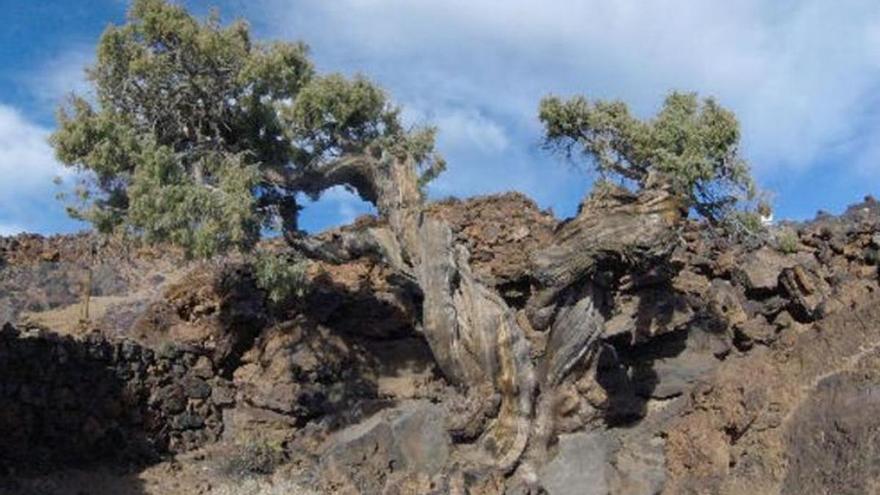
Teide National Park Nears End of 17,000 Cedar Tree Replanting Effort Amid Drought Challenges
A project to replant 17,000 cedars in Teide National Park, aimed at restoring an ancient forest and adapting to climate change, is nearing completion despite severe drought conditions.
The effort to replant 17,000 cedars in Teide National Park is nearing its end, with the final 7,000 trees being planted now. This project, which started recently, is expected to finish by February.
According to José Luis Martín Esquivel, a biologist working in the park, the decision to begin replanting a year and a half ago was based on research. Studies showed that there were once many more cedars on Tenerife's peaks than the roughly thousand that were known to exist. This historical evidence suggests that the area was once a cedar forest.
So far, about 10,000 new cedar saplings have been planted in areas like Siete Cañadas. Martín Esquivel notes that the project is progressing well, despite a significant challenge: drought. He explains that 2023 and 2024 were the driest years on record for Teide National Park, with less than 100 liters of rain per square meter, far below the usual 400 liters. This year is following the same pattern, with only 89 liters of rain so far.
Another key reason for planting cedars now is the decline of the retama bushes, which are suffering and dying. Future climate predictions suggest these bushes may become very rare. Therefore, restoring the ancient cedar forest is also a way to adapt to climate change. It involves replacing one dominant species with another. The cedar, which was also prevalent in the past, is more resilient to harsh weather, so it can fill the gap left by the retama.
Martín Esquivel clarifies that while they refer to a "cedar forest," the trees are actually quite spread out. They are planting about 30 trees per hectare, unlike the pine forests near Las Cañadas, which have over a thousand trees per hectare.
Before this replanting effort began, there were only about 700 native cedars recorded in Teide National Park. This project aims to plant an additional 17,000. In the long term, it could help partially restore the cedar forest that existed before human activity and grazing animals, particularly goats, reduced its numbers. This is why the remaining old cedars are often found in very hard-to-reach places.
In February, the Cabildo of Tenerife, the Endesa Foundation, and the University of Valladolid joined forces to protect the biodiversity of Teide National Park, with a special focus on the cedars.
Besides hiring the company Gesplan to replant these ancient trees in difficult terrain, the project also involves using carbon-14 dating to study new specimens. Based on their growth patterns and trunk thickness, some of these trees might be even older than the "Bárbol" (1,400 years old) and "El Patriarca" (1,100 years old) discovered in 2022 and 2019, respectively. "El Patriarca," a female tree, stands as a symbol of resilience and natural history, having survived centuries of logging, grazing, volcanic activity, and harsh weather. It represents the original ecosystem when cedars were much more common.
José Luis Martín Esquivel explains that scientists believe birds migrating from Northern Europe each winter, starting in October, are responsible for spreading the cedar seeds. This suggests that these birds have a genetic connection to this plant species.
He also points out that the oldest cedars were not only found on cliffs but were also spreading across the park, with younger trees appearing on flatter ground. This expansion, he believes, began after Teide was designated a national park in 1954 and goats were removed. The theory is that goats were a significant presence even before the Spanish Conquest.
Martín Esquivel states that over 1,700 years ago, goats heavily influenced the landscape, forcing cedars to retreat to the cliffs. This, along with studies on how cedars interact with other plant species, leads researchers to conclude that cedars were once much more abundant. This conclusion is also supported by historical records from researchers who visited Tenerife since the 18th century. He adds that this project is helping to recover an endangered species and is nearing completion.
Due to the dry weather, extra efforts were needed to water the newly planted trees using water tanker trucks, which helped them survive. The biologist is hopeful that recent rains from Storm Claudia will ease the water shortage. José Luis Martín Esquivel highlights the cedar's ability to withstand drought and strong winds, noting that the young trees, only about 25 centimeters tall and planted among rocks, are not overly vulnerable.