
Teide National Park Ecosystem Threatened by Climate Change
Rising temperatures in Teide National Park threaten native plant life, prompting conservation efforts like relocating vulnerable species and restoring resilient cedar forests to preserve the iconic landscape.
Climate change is now the biggest threat to nature in Teide National Park. Evidence shows that temperatures are rising beyond what plants like the famous Teide broom can handle.
In 2024, the park had its hottest year on record. The average temperature was over 12 degrees Celsius, which is too hot for many of the park's plants. Scientists believe this trend will drastically change the ecosystem of Las Cañadas del Teide.
Despite these challenges, plants are still blooming, showing how nature can adapt and survive on Tenerife's peaks, sometimes with a little help from scientists.
Climate models predict that by the end of this century, the base of Las Cañadas (between 2,000 and 2,400 meters above sea level) will be very different. Even if we meet the goals of the Paris Agreement, the southwestern part of the park will be hotter and drier than it has been in the last century.
The northeastern part of the park might be better for the Teide broom to survive. But in the worst case, these plants would only be found on the highest peaks, above 2,700 meters. New types of plants that can handle the heat, along with some trees from the surrounding pine forest, would grow in the lower areas.
Some plants are already adapting to the changing climate. The Teide violet, which was seen at 3,320 meters in 1799, now grows even higher, at 3,715 meters.
Botanical studies show that many plants are moving uphill about 3 or 4 meters each year to find cooler temperatures. But the warming is happening so fast that not all plants can keep up.
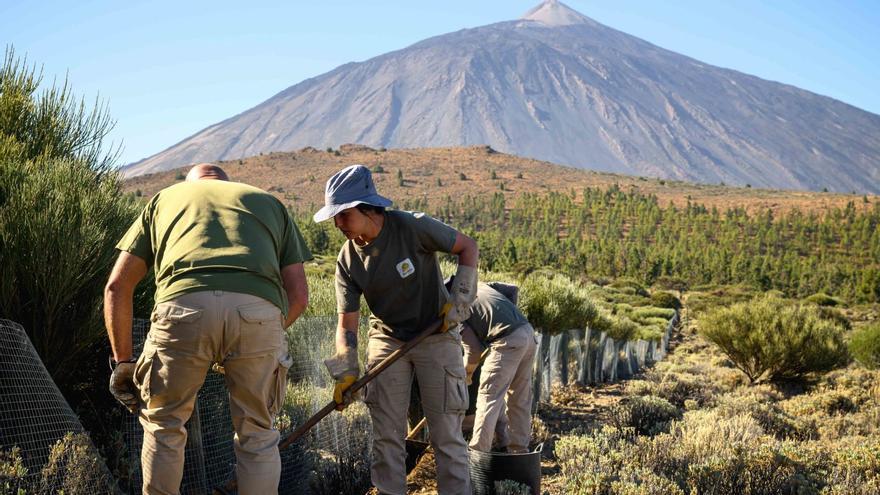
Because of this, park officials are directly helping the most vulnerable plants. For example, the silver thistle, which is only found on Tenerife's peaks, can't move uphill fast enough on its own.
To help it survive, new groups of these plants are being planted on the mid-slopes of the volcano, where the climate is better and it's not as dry. This is to protect one of Teide's most unique plants, known for its silvery flowers and its ability to live in high mountains.
Several other endangered plants, like the Guanche rosebush and the summit rockrose, have already died off in the south of the park, and others are barely surviving. However, new groups of these plants planted in the northeast are doing well, showing that the conservation efforts are working.
Saving the Teide broom depends on protecting the strongest groups of these plants in the northwest part of the park. To help with this, fences will be put up to keep rabbits from eating the young plants.
Although the rabbit population has decreased in the last couple of years because of the dry conditions, they still damage the vegetation.
Most of the Teide brooms that are still around are old, and many can be seen in aerial photos from the 1960s. Protecting large areas could help the last brooms at the base of Las Cañadas survive.
Recent studies have found ancient Canary Island cedars on the cliffs around Las Cañadas. By studying fossil pollen, how the trees interact with birds, and records of how the ancient people used the wood, we know that the Canary Island cedar used to be more common than it is today.
Today, there are only about a thousand of these trees left in the park. Writers from the 16th century mentioned that they grew alongside the Teide brooms, and we've found old stumps among the lava flows of Pico Viejo and Pico Cabras.
The cedar is more resistant to heat and drought and could be important in helping the Teide ecosystem adapt to the new climate. Restoring the cedar forests could make up for the loss of the Teide brooms and help protect this endangered tree.
The plant life on the summit is changing quickly. The white of the Teide brooms, which used to dominate the landscape in the spring, has been replaced by the yellow grasses and the pink flowers of the summit rosalillo, a plant that seems to be doing well in the heat.
Park managers say that with careful management, they can prevent the loss of the most fragile plants and make sure that Teide remains a unique natural place in the world.
In the future, cedars and brooms might grow together, showing how nature can adapt if we act responsibly.
Climate change forces us to make a critical decision: protect Teide today, or lose the unique summit ecosystem that has defined Tenerife's natural identity for over seventy years.