
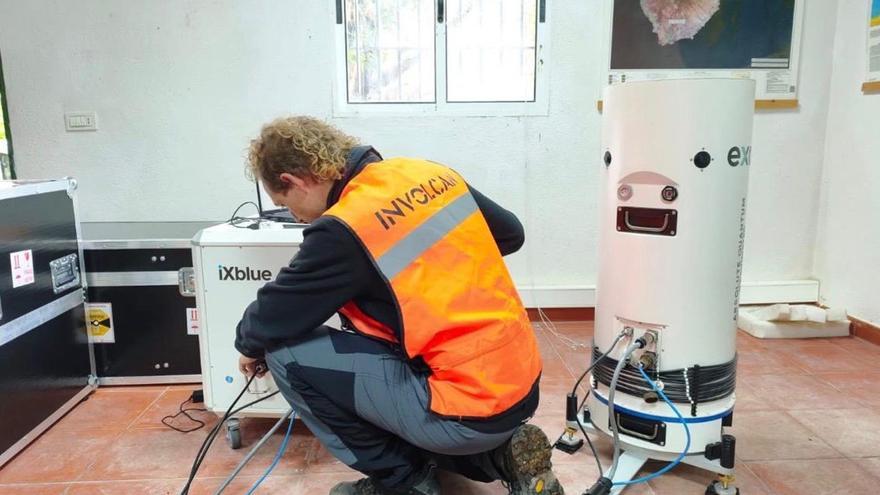
Teide Deploys Quantum Gravimeters for Eruption Prediction
Teide volcano will become the fourth active volcano globally to permanently install three advanced quantum gravimeters, a rare and costly technology, to significantly enhance early warning predictions of magma movement and volcanic activity.
Three advanced quantum gravimeters are set to track magma moving under Teide volcano. These will be the first sensors of their kind to be permanently installed on the volcano, continuously watching for even tiny changes in the ground. Up until now, similar equipment was only used occasionally for specific research projects. Juan José Martínez, the Councillor for Innovation for the Tenerife Island Council, says this will "significantly improve" predictions about what happens around Teide.
These devices are incredibly rare globally; only 21 exist worldwide. Teide will be just the fourth active volcano to use this state-of-the-art technology, joining Etna in Sicily, Kilauea in Hawaii, and La Soufrière in Guadeloupe.
The Canary Islands Volcanological Institute (Involcan) will manage these devices. They are powerful tools for understanding how magma rises before an eruption and how underground hot water systems behave. These highly sensitive gravimeters can detect magma moving deep within the Earth's crust. This means they can provide a much earlier warning of potential volcanic activity compared to other methods, even outperforming standard gravimeters.
Initially, the gravimeters will be placed in three spots on the island: the northwest, south, and northeast. This setup will help "triangulate" and gather comprehensive information about the volcano, according to the councillor. They are also portable, meaning they can be moved to other parts of the Canary Islands if needed. The councillor noted that Involcan works across the entire archipelago and internationally, so these devices could help with prevention, monitoring, or response on any island. Installation is expected to happen quickly, within the first three months of the year.
What makes these gravimeters truly special is their quantum technology. They are incredibly precise instruments that use quantum physics, like matter-wave interferometry, to measure gravity's acceleration with extreme accuracy. Instead of sensing vibrations in larger objects, these devices drop atoms cooled by lasers to pick up tiny changes in the gravitational field.
Martínez admitted that this represents "one of those big technological leaps whose full impact we don't yet fully grasp." He also mentioned plans to start using pre-quantum technologies in other facilities, like the Teide and Anaga supercomputers.
The councillor emphasized that this technology "massively boosts" the calculation and prediction abilities beyond what older systems offer. Because these gravimeters are "much more sensitive" in gathering data, they provide even more valuable information for the complex calculations performed by the supercomputers.
These new instruments cost 1.5 million euros. Involcan secured the funding from the Ministry of Science, Innovation and Universities and the State Research Agency, as part of the Geofiscan project.
The main goal of this project is to buy, set up, and use not only these three gravimeters but also eight borehole seismic stations across the Canary Islands. This will create an advanced early warning system for future volcanic eruptions in the archipelago.
These new installations will work alongside over 300 existing sensors on Tenerife's fiber optic network, which will provide extra data to support the innovative gravimeters.