
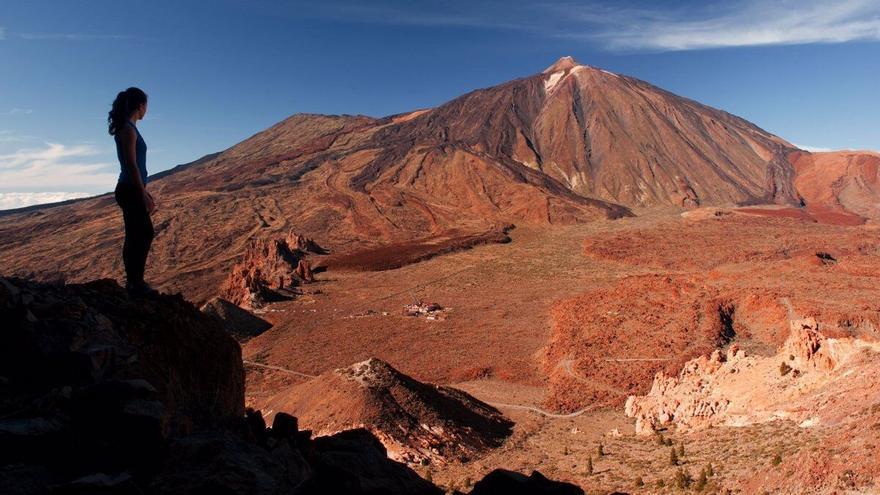
Teide Casts World's Sharpest Pyramid Shadow Over Sea
Mount Teide, Spain's tallest volcano, casts a unique, perfectly triangular shadow over the Atlantic Ocean, a phenomenon highlighted by NASA due to its scientific and visual distinctiveness.
Even the Andes or mighty Kilimanjaro don't have this natural feature. Teide, Spain's tallest volcano and a famous landmark in the Canary Islands, holds a unique world record: it casts the sharpest pyramid-shaped shadow over the sea. NASA has even highlighted this phenomenon for how scientifically and visually remarkable it is.
Every morning and evening, Teide creates a perfectly clear triangular shadow over the Atlantic Ocean. This shadow is visible for several minutes and can stretch tens of kilometers out to sea. NASA has shared this phenomenon on its popular science page, Astronomy Picture of the Day (APOD), explaining why no other mountain on Earth creates a shadow quite like Teide's.
While there are taller mountains than Teide, none create such a clean, geometric shadow. The reason isn't just about how tall it is. In large mountain ranges like the Andes, or on isolated peaks surrounded by uneven land, shadows break up and become blurry as they fall across valleys, flatlands, or other mountains.
But in Tenerife, the volcano stands alone, surrounded by the ocean. The ocean acts like a flat, unbroken screen, making the shadow's triangular shape stand out clearly, with nothing to distort it.
Measurements by the University of La Laguna show the shadow can be between 40 and 60 kilometers long. That's long enough to reach the island of La Gomera at sunrise and almost touch Gran Canaria at sunset.
Teide gets this amazing shadow thanks to three things working together. First, its cone shape and isolated position mean it casts a clean outline without other mountains getting in the way.
Second, the flat ocean horizon acts like a perfect screen. This allows the triangular shadow to stretch out without being cut off by other landforms.
Third, the stable atmosphere in this subtropical region helps. Trade winds here reduce low clouds and stop light from scattering too much, which makes the shadow's edges even sharper.
To see this triangular shadow, you just need to be high up and look away from the sun. At sunrise, the shadow stretches towards La Gomera and is best seen from the Mirador de la Rambleta viewpoint (3,555 meters high).
At sunset, it points towards Gran Canaria and is clearly visible from the path to Pico Viejo or, a bit lower, from the Altavista Refuge.
How long the shadow appears depends on how clear the air is. Haze (known as 'calima') or high humidity make the shadow shorter, while clear skies make it longer. Because of this, researchers informally use it to gauge air quality in the Canary Islands. It also serves as a unique, twice-daily postcard of the island.