
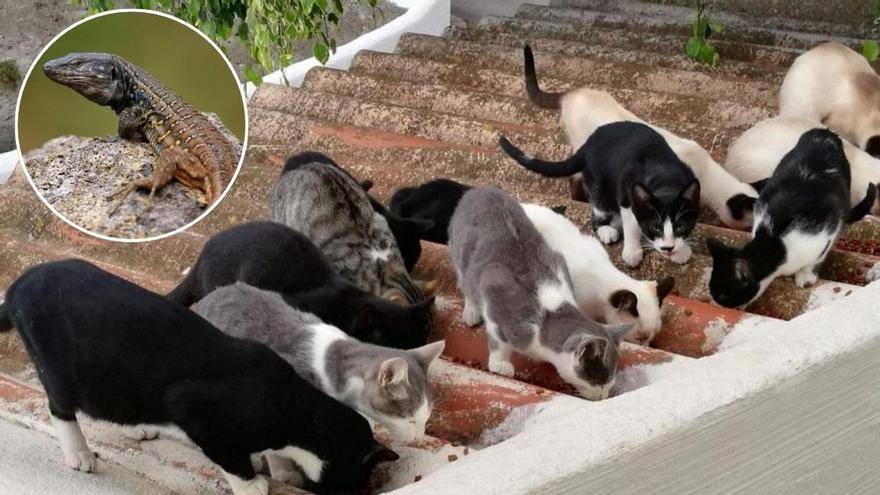
Study Finds Domestic Cats Threaten Biodiversity and Evolution of Tenerife Lizards
A new study reveals that domestic cat colonies in Tenerife are devastating native lizard populations and driving evolutionary changes, prompting researchers to call for urgent policy reforms to protect island biodiversity.
Managing cat colonies on islands is no longer just an animal welfare issue; it has become a major concern for biodiversity. A new study published in the journal Biology Letters shows that domestic cats in Tenerife are significantly affecting the population and physical size of the Tenerife lizard, a native species essential to the island's ecosystem.
The research, conducted by the National Museum of Natural Sciences (MNCN-CSIC), the University of La Laguna, and GOHNIC, highlights how artificial feeding stations for cats disrupt the local environment. After studying over 200 lizards across 22 locations, experts found that areas near these feeders have 120% fewer lizards than areas without them.
The study also reveals that cats are changing the lizards' evolution. Because cats tend to hunt larger lizards, the surviving population is becoming smaller on average. Interestingly, the lizards near feeding stations are actually heavier for their size because they are eating the food meant for the cats. However, this extra food does not make up for the danger posed by the cats or the broader ecological damage caused by concentrating non-native predators in one area.
This issue goes beyond just the Tenerife lizard. These feeding stations also attract rodents, hedgehogs, and birds, which disrupts native food chains. This is particularly dangerous for the Canary Islands, where many unique species evolved in isolation and lack natural defenses against introduced predators.
The researchers warn that domestic cats are one of the greatest threats to island wildlife. They are calling for a change in public policy, arguing that simply feeding cats is not enough. Instead, management strategies must prioritize the protection of native species, acknowledging that human interference in nature has serious consequences that require careful scientific oversight and long-term planning.