
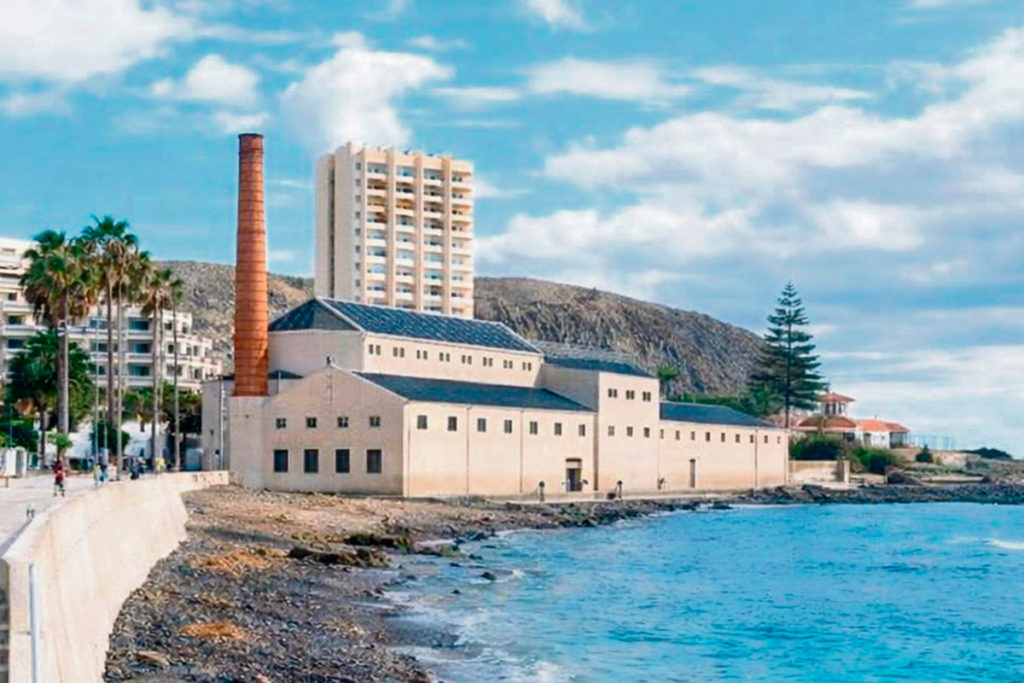
Storm Damage Reveals Industrial Past of Tenerife’s Los Tarajales Promenade
Recent storm damage to the Los Tarajales promenade has resurfaced the history of the site, which evolved from a 20th-century industrial hub into the tourist-focused coastal landscape seen today.
The recent damage caused by Storm Therese to the Los Tarajales promenade in Los Cristianos is a stark reminder of how vulnerable our coastal infrastructure can be. As historian Marcos Brito notes in his 2001 book Arona en el recuerdo, this erosion also highlights the history of a site that, for much of the 20th century, was home to one of the Canary Islands' most ambitious industrial projects—a site now completely transformed into a tourist hub.
The story of this complex, nestled beneath the Montaña de Guaza, began in 1900. At the time, the area had only 77 residents and about forty buildings. The F.E.C. Jacks & Co. distillery opened there in April 1902, featuring advanced machinery like a fifteen-meter-high "Multiplex" system capable of producing thirty hectoliters of alcohol daily. Although a fire in 1904 destroyed much of the equipment and stock, the site’s industrial life continued.
In 1907, engineer and politician Calixto Rodríguez took over the facility, converting it into a pine resin processing plant. This became a major economic driver; by 1912, it employed over 300 workers and generated more than 150,000 pesetas in wages and logistics. After this activity ended around 1918, the site served various purposes, including a military barracks during World War II. Its final chapter began in 1953, when it became a pozzolanic cement plant. This material, used to strengthen maritime construction, was exported internationally—notably to Casablanca—until the factory finally closed in the early 1960s.
Looking back at this industrial past helps us understand how southern Tenerife has changed. Manufacturing, once the backbone of the local economy, was eventually pushed aside by the tourism and urban development we see today. The fact that residential and hotel complexes replaced the factory in the 1970s highlights a major shift in how we manage our coastline—a landscape that, as recent storms have proven, remains in a constant tug-of-war with the sea.