
Spain Jails 15 for International Drug Trafficking, Money Laundering Ring
Spain's National Court has sentenced fifteen individuals, including a group leader and his family, to over 84 years in prison and €13 million in fines for international drug trafficking and laundering millions through a network of companies primarily based in Tenerife.
A complex legal case has just finished in Spain's National Court, revealing a criminal group involved in international drug dealing. This group mainly managed its money and businesses in Tenerife, using a network of companies to hide and move large amounts of illegal cash.
The court's decision, announced this Monday after a trial last October, sentenced fifteen people. They received long prison terms, huge fines, and had their assets seized. The court found that they used a network of businesses to launder money. In total, the court handed down 84 years and five months in prison and fines totaling 13,190,767.67 euros.
Arrests happened between 2011 and 2012 in several places, including La Orotava, Los Realejos, Puerto de la Cruz, Adeje, Málaga, and Madrid. The group's leader and his parents, who ran the Tenerife-based companies, tried to escape to Italy. However, they were caught there and sent back to Spain.
The court confirmed that the group's leader was not only directly involved in major cocaine trafficking but also created and ran a stable business network to launder vast amounts of money. For this, he received a sentence of 21 years and one day in prison, plus fines over eight million euros. The ruling highlighted that even though he often wasn't officially listed as a company director, he was truly in charge. He supplied the money, made investment decisions, and personally guaranteed most of the mortgage loans.
A key part of this network was Ludofin S.L., a company based in Puerto de la Cruz, set up in 2006. Initially, the leader owned 70% of the company, and his partner owned 30%. Later, his mother took over his partner's share. While Ludofin S.L. was officially a catering business, the National Court found its real work involved giving private loans (totaling 328,000 euros) and buying properties and luxury cars. These activities didn't match the company's declared income. The group's leader represented the company in purchases, signed contracts, and personally guaranteed its mortgage loans.
The leader also used Cavallino Import S.L., based in Los Realejos. This company, which started as a shoe shop, was first run by his father, then by his mother. The court found that Cavallino Import S.L. was repeatedly used to buy and sell properties and vehicles. Many of these deals weren't recorded in the company's books and involved cash payments. The leader's father was sentenced to four years and seven months in prison for money laundering; he was officially a director and a 'front man,' even though he didn't have enough income to explain the amount of business he was doing.
The network also included BMax1 Games S.L., also in Puerto de la Cruz. This company had almost no real business or employees. Yet, in a short time, it bought luxury cars, some of which were sold for cash. The leader's mother was the official director, while his father acted as a representative and the true manager.
The leader's close family was also heavily involved. His brother received four years and seven months in prison for money laundering. He was the sole director of Azzurra 2005 S.L., a catering company in La Orotava. Even though this company consistently reported losses, it bought vehicles and dealt in cash. Police seized over 14,000 euros, meant for the leader, from a restaurant warehouse. The leader's sister-in-law, who was the sole owner of Azzurra 2005 S.L., also got four years and seven months in prison. Both were listed as owners of properties and mortgage loans, all paid for with money from the leader.
The leader's partner also played a key role and was sentenced to four years and seven months for money laundering. She was an early partner in Ludofin S.L. and was officially listed as the owner of properties and mortgage loans in Tenerife, even though she was unemployed. The court's judgment noted that she admitted these assets were bought with money from her husband, who sent her monthly payments to cover the costs.
Among the leader's trusted associates was an employee who worked for several companies in the network. He was found guilty of being an accomplice to money laundering and for illegally owning weapons. The court stated he acted as a go-between, handling, storing, and delivering cash from business deals and car sales. He wasn't formally arrested but reported to the police station. Another person, a woman living in Puerto de la Cruz, was sentenced to three years and three months in prison for money laundering. She helped manage and hide funds without being an official director of any company.
While Tenerife was used for managing money and assets, the actual drug trafficking happened elsewhere. One man was sentenced to nine years in prison for his part in bringing cocaine from Argentina into Spain. In one instance, he collected a shipment in Madrid that contained 261.53 grams of cocaine from Argentina.
Two other men were also found guilty. They had traveled to Colombia to smuggle cocaine into Spain by hiding it inside their bodies. One was caught at Madrid-Barajas airport with 667 grams of cocaine. The other, Clemente, was arrested when he arrived to meet him, carrying tickets and bookings to travel on to Italy. Clemente was also convicted of money laundering.
Outside the main family, other friends and relatives also helped the scheme. Two of them were convicted as accomplices to money laundering for their involvement in financial deals and for receiving loans from the leader's companies in Tenerife.
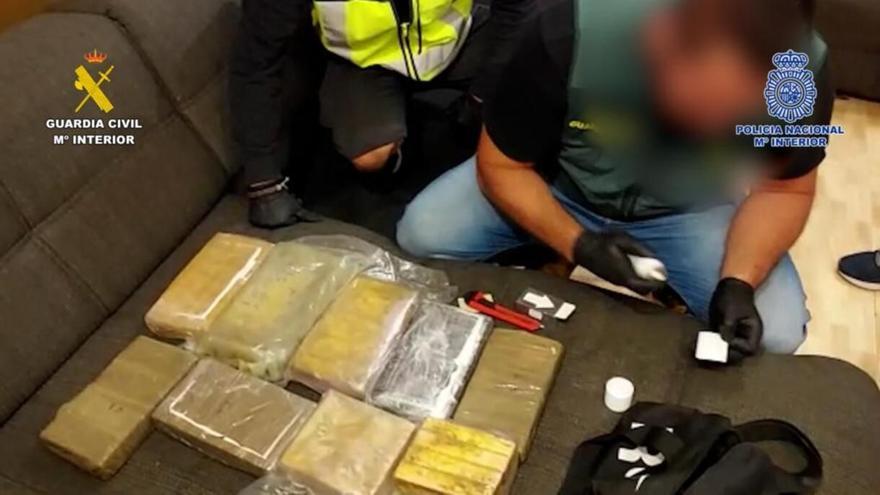
During the operation, police seized 9.7 kilos of cocaine from various locations. Investigators also found conversations about other drug deals that either couldn't be stopped or failed.
Besides the prison sentences and fines, the court ordered the seizure of money, properties, vehicles, and other items. It stressed that the companies examined had very little real business activity to explain the large amounts of money they handled. The National Court concluded that the network of companies in Tenerife was clearly and systematically used to hide, change, and bring drug trafficking profits back into the legal financial system. This case serves as a prime example of organized crime and money laundering.