
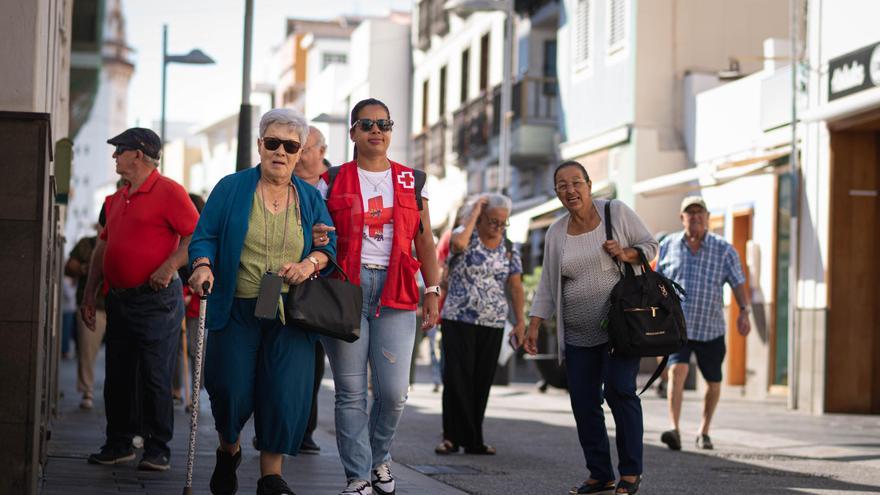
Tenerife is overwhelmed: thousands in need cannot receive social assistance.
On Tenerife, thousands of elderly people and people with disabilities have been waiting for social assistance for years due to a lack of places in public institutions and the high cost of private ones.
The situation in Tenerife is difficult when it comes to helping people who cannot take care of themselves. There are not enough state-run centers, and as a result, seven out of ten people who need constant care cannot get a place in a specialized institution.
New facilities are appearing very slowly, covering only 3% of the need. And the number of people wanting to get help is growing, as the population is aging. Private institutions cannot help either, because there are few places in them, and not everyone can afford them.
Nuhazet González from the UGT trade union says that state aid is "like defending yourself from a hurricane with a newspaper." The numbers speak for themselves. Águeda Fumero, who is responsible for social assistance on the island, admitted that more than 18,000 people are waiting for a place in an institution. She even apologized to the people who need help and their families.
Local authorities are unable to cope with such an influx of people. In just three years, from 2023 to 2025, the queue increased by almost 5,000 people. During this time, it was possible to add a little more than 500 places, but they are all already occupied.
There are plans to open a few hundred more places by the end of the year. There is also a new project where assistants come to the homes of elderly people or people with disabilities. Currently, 500 people are being helped in this way.
Iván Márquez from the Association for Assistance to Dependent People compares the situation to traffic jams: "No matter how many lanes you build, the jams will not disappear as long as there are more and more cars."
He explains that the number of elderly people will increase, especially when the baby boom generation (people born in the 70s) retires.
The forecasts are disappointing. If things continue like this, in just six years, there will be more people over 65 than young people in Tenerife.
It is the elderly who most often need social assistance. Previously, there were significantly more young people, but now the situation has changed.
Emma Colao from the Canary Islands Social Rights Observatory believes that such long waiting lists are a "scandal." She says that neither the local authorities nor the government have been able to respond to the aging population in a timely manner. Thousands of people are not receiving adequate care.
All experts agree that even if documents for receiving assistance are processed quickly, it will not help if there are no places or other care options.
Emma Colao says that the government boasts about reducing the waiting time for processing documents, but this only increases the queue for getting a place in an institution. What is the point of processing documents quickly if there is still no help?
Iván Márquez, who runs several private nursing homes, confirms that there are no places in either state-run or private institutions. His centers also have long waiting lists. In addition, private institutions are mostly focused on the elderly, and there are almost no options for people with disabilities.
There are just over 8,700 places in the state system in Tenerife, and about 3,500 in the private system. But more than 30,000 people are on the waiting list. And only 7% of the island's residents can afford to pay for a private nursing home, where 24-hour care costs from 2,200 to 3,000 euros per month. Most people do not have that kind of money.
Even state aid does not cover these costs, says Emma Colao. Assistance for people who need the most care does not reach even a thousand euros. Funding needs to be increased at least threefold to help everyone who needs it.
Nuhazet González from the UGT trade union knows about the problem firsthand. He cares for his 85-year-old father, who suffers from dementia. He does not have the money for a private institution, and he has been waiting for a place in a state-run one for years.
He receives a little more than 800 euros in assistance, but cannot find a service that would cover this amount. An assistant comes to his father for an hour, but this is not enough.
The government provided Nuhazet with a list of companies that provide various services. But he is on the waiting list at all of them. He can only use part of the money he receives to pay for the assistant's services.
Experts say that this situation leads to loneliness, problems in families, and even to people leaving their relatives in hospitals because they cannot take care of them. There are currently more than 500 elderly people in hospitals in the Canary Islands, some for more than a year.
Águeda Fumero, who is responsible for social assistance in Tenerife, acknowledges the problem. But she says that the local authorities are doing everything possible to solve it. In recent years, millions of euros have been invested in the development of the network of institutions.
But the creation of new places is happening very slowly due to bureaucracy. Of the several hundred places created, some are not yet operational due to various problems. Therefore, the opening of new facilities is not keeping pace with the growing demand.