
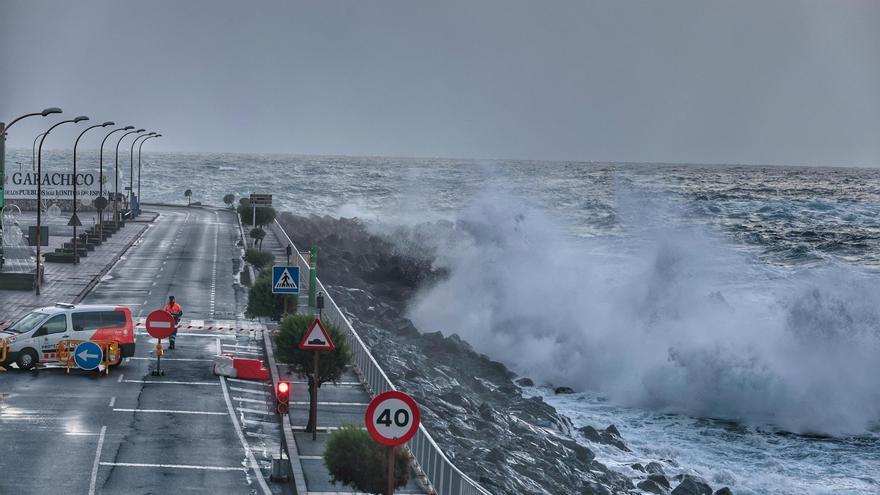
Sea Reclaims Land at Tenerife's Lago Martiánez
Collapsing sea walls behind Puerto de la Cruz's Lago Martiánez highlight the impact of rising sea levels and coastal erosion, fueling debate on whether the sea is "gaining ground" or reclaiming human-altered areas amid climate change.
Behind the famous Lago Martiánez swimming pools in Puerto de la Cruz, the sea is once again taking centre stage. In recent months, several sea walls have collapsed, and another part of the wall is deeply cracked. Locals and experts are watching as the Atlantic Ocean appears to be reclaiming land that was once dry. This situation has sparked a debate that brings together geography, climate change, town planning history, and how we manage our coastlines: Is the sea truly "gaining ground," or is it simply taking back areas that people have altered or damaged?
Lago Martiánez, a key landmark in Puerto de la Cruz, is a tourist complex with a promenade and swimming area right by the sea. The famous artist César Manrique designed these pools, which were built on what used to be tidal pools and a beach in the Llanos de Martiánez area. While the lake was planned as a city project, blending seawater into its artistic design, being so close to the ocean was always a sensitive feature.
For many years, the promenade and its man-made defences stood up to moderate waves. However, bigger waves, rougher seas, and coastal storms – made worse by climate change – have recently tested these structures to their limits.
These local worries are not unique. Along the Canary Islands' coasts, the sea level has risen by about 3.5 mm each year over the past three decades. This information comes from a study published in the Journal of Marine Science and Engineering by researchers at the University of Las Palmas de Gran Canaria. This means that, on average, the sea around the islands was about 10 cm higher between 1993 and 2022.
The same study also shows that the sea is rising even faster in cities like Santa Cruz de Tenerife and Las Palmas. This is because the land there is slowly sinking by about 0.5–0.7 mm each year. These scientific findings match forecasts from the Intergovernmental Panel on Climate Change (IPCC), which expects sea levels to rise by several decimetres before 2050, depending on how much greenhouse gas is emitted.
This problem isn't just happening in the Canary Islands. Across Europe, studies like 'Sea Level Rise in Europe: Impacts and Consequences' warn that rising sea levels combined with coastal erosion can lead to the loss of buildings, land, and natural habitats along vulnerable coastlines.
Coastal erosion – where the sea washes away sand and soil, causing the shoreline to move back – is a natural process. However, human activities have made it much worse. Things like building sea walls and promenades, changing how sand naturally moves, or not having enough sand coming from rivers, all affect how the coast changes.
In Puerto de la Cruz, the sea walls and defences were built not only to protect tourist areas but also to change the natural behaviour of the coast. When these walls are damaged or collapse, the sea can reach previously protected areas, like the one behind the Lago Martiánez promenade, with much greater force.
Experts speaking to local media say the issue isn't just higher sea levels. It's also about the sheer power of waves and high tides, which are hitting coastal structures more often and with more energy than they did decades ago.
Over the past year, local businesses and residents have seen parts of the sea wall, which separates pedestrian areas from technical zones, crumble under the sea's pressure. Cracks are spreading, and local authorities have already marked off some collapsed sections while they wait for permanent repairs.
This situation is causing alarm, not only because of the economic impact – Puerto de la Cruz is a long-standing tourist spot in Tenerife – but also due to fears that these problems will get worse in the years ahead.
The Canary Islands' coast faces rising sea levels and erosion, and this isn't just happening in a few places. A recent study on adapting to sea level rise in the Canary Islands points out that authorities face a difficult challenge. It requires local councils, island governments, the national government, and the European Union to work closely together.
These authorities need to find a balance between protecting city buildings, keeping coastal environments healthy, and ensuring public safety. At the same time, they must plan investments in coastal defences and adaptation strategies, all based on scientific information.
Some experts believe that saying the sea is 'gaining ground' is too simple and doesn't fully explain what's happening. The sea doesn't have its own intentions; instead, it reacts to physical forces. These include the rise in global sea levels, stronger storms, the pressure of waves, and the natural features of the coast. All these factors together can make the sea seem to advance more quickly or aggressively in a specific place like Puerto de la Cruz.
However, there's also an argument based on geography and history: before modern development, coastal areas were always changing, shaped by the sea itself. In many parts of Tenerife, like Playa de Las Teresitas, the coastline was deliberately altered decades ago with added sand and sea walls to boost tourism.
From this viewpoint, the sea could be seen as 'reclaiming' some of its natural space. This is happening because of global climate changes combined with human coastal engineering, which has changed the traditional look of beaches and cliffs.
What's occurring behind the pools in Puerto de la Cruz isn't an isolated event. It's a sign of bigger changes happening along the coasts of the Canary Islands and worldwide. Rising sea levels, coastal erosion made worse by human activity, and a lack of thorough adaptation plans have all come together to challenge structures that once seemed built to last.
Locally, fixing the sea walls and protecting tourist areas are urgent priorities. But at regional and European levels, scientists and those who manage our coasts are calling for serious attention to sea level rise data. They stress the need to include adaptive planning in coastal town development and to recognise that coasts are always changing, not fixed.
Meanwhile, in Puerto de la Cruz, residents, tourists, and authorities will keep asking themselves if the sea is truly gaining ground, or if it's simply doing what it has always done in an island environment.