
Santa Cruz de Tenerife: Two Centuries of Museum Evolution
The Museum of Nature and Archaeology (MUNA) in Santa Cruz de Tenerife, opened in 2002, brings together the Museum of Natural Sciences, the Archaeological Museum, and the Canarian Institute of Bioanthropology, housing extensive collections and conducting significant research.
The first recorded museum in Santa Cruz de Tenerife was a "Cabinet-Museum" opened in 1820. Colonel Juan de Meglioriny y Spínola set it up in his home at 47 Santa Rosalía Street in the El Toscal neighborhood. It housed collections of natural history, anthropology, and ethnography and was a popular stop for important visitors to Tenerife.
In 1839, Sebastián Pérez Yanes took over the Cabinet and opened it to the public as Museo Casilda. Ten years later, he sold it to Fernando Cerdeña, who moved the collection to Argentina. The animals, plants, rocks, and minerals went to the Natural History Museum of Buenos Aires, while the Guanche mummies ended up in the Municipal Museum of Natural Sciences of Necochea. Fortunately, the Autonomous Organization of Museums and Centers of the Cabildo de Tenerife recovered these mummies in 2003. They have been on display at the Museum of Nature and Man (now called the Museum of Nature and Archaeology since 2018) ever since.
In 1874, scholar Anselmo J. Benítez established the Villa Benítez Museum. It showcased his significant collection of minerals, engravings, art, and archaeological items. The Island Council of Tenerife acquired this collection in 1949.
In 1877, Juan Bethencourt Alfonso founded a Scientific Cabinet. It was part of the Secondary Education Institution of Santa Cruz de Tenerife, located in the San Francisco convent. This cabinet was intended for natural science students and also served as a hub for important scientific research. It held collections covering rocks, minerals, paleontology, anthropology, archaeology, prehistory, groundwater, meteorology, botany, zoology, and a vast library.
To stop many private collections in Santa Cruz from being scattered, Bethencourt Alfonso started publishing articles in the Diario de Tenerife in 1899. These efforts led to the creation of the Archaeological and Natural History Museum of Santa Cruz de Tenerife in 1902, run by the City Council. After his death in 1958, his collections were moved to the Island Archaeological Museum, which was then housed in the Cabildo de Tenerife building.
Museum Institutions
The building that now houses the Museum of Nature and Archaeology (MUNA), part of the Autonomous Organization of Museums and Centers of the Cabildo de Tenerife, began its transformation in 1971. After the General and Clinical Hospital of Tenerife (later the University Hospital of the Canary Islands) opened, the Island Council of Tenerife decided to convert the old Hospital de Los Desamparados (later the Civil Hospital) into the Museum of Nature and Man (renamed Museum of Nature and Archaeology in 2018). Architects María Nieves Febles Benítez and Agustín Cabrera Domínguez oversaw its complete renovation. Queen Sofía officially opened the museum on January 9, 2002.
MUNA brings together three main scientific institutions: the Museum of Natural Sciences, the Archaeological Museum, and the Canarian Institute of Bioanthropology. A large team of professionals, including technicians, taxidermists, educators, designers, conservators, and maintenance staff, work here. They organize workshops, exhibitions, lectures, collection drives, and expeditions. They also take part in research projects at local, regional, national, and international levels. Furthermore, they create educational materials tailored for different age groups and school programs, aiming to spark curiosity and encourage learning among students. The museum has been supported by the Friends of the Museum of Nature and Archaeology Association since 1996.
The Museum of Natural Sciences, established in 1951, is an international center. It focuses on preserving, researching, and sharing knowledge about the plants, animals, minerals, and rocks found in the Macaronesian archipelagos (Azores, Madeira, Savage Islands, Cape Verde, and the Canary Islands).
Besides having the best natural history library in the Canary Islands, the museum holds diverse collections. These include microscopic slides, bones, skins, eggs, specimens in liquid, and botanical sheets, covering areas like paleontology, marine biology, botany, entomology, birds, and land vertebrates. The museum's conservators and many scientists protect and study these collections, using them to address issues such as climate change, pollution, and pathogens.
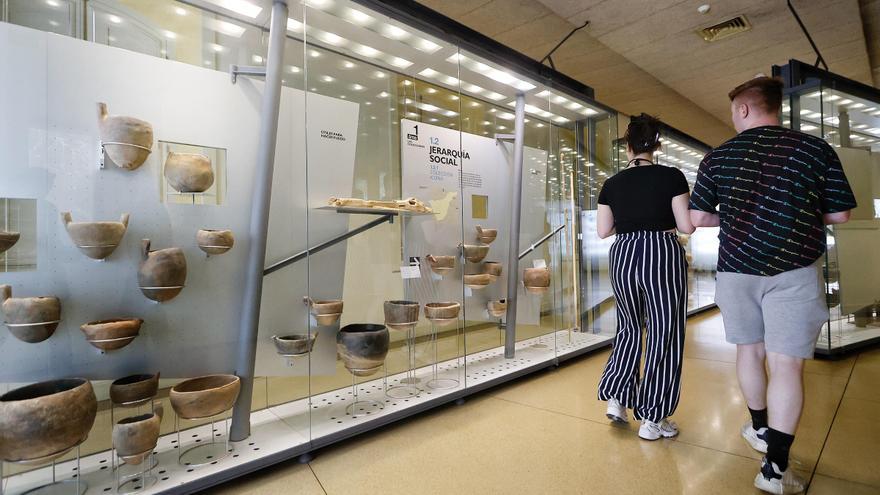
The Archaeological Museum was founded in 1958. It was established with funds from the Municipal Museum, the Provincial Commission for Archaeological Excavations, and the Scientific Cabinet. It also acquired collections from the former Villa Benítez, Vallabriga, and Casa Ossuna Museums, along with donations from private individuals. Luis Diego Cuscoy, the first Director of the Archaeological Museum of Tenerife and Provincial Commissioner, used these resources to bring together archaeological artifacts and human remains from Tenerife's prehistoric past.
The museum houses the largest collection of Guanche mummies and cultural artifacts. It also boasts one of the world's most advanced systems for conserving and displaying mummified human remains. These collections are cataloged and digitized, presented in an informative and engaging manner using innovative, modern designs.
In the 1960s, the museum's collections grew to include materials from the Sahara, African ethnography, and pre-Columbian American archaeology. Twenty years later, it underwent a major renovation. This period saw the arrival of new scientific staff and further expansion of archaeological holdings with the collections of Mazuelas, Massanet, Santiago Melián, Santiago de la Rosa, and Hermógenes Afonso (Hupalupa).
The Canarian Institute of Bioanthropology was founded on December 30, 1993. It specializes in bioanthropological and forensic anthropological studies. Its goals include researching the unique characteristics of the Canarian population from prehistory to today, sharing knowledge about biological and forensic anthropology with institutions and the public, collaborating with other specialized centers on research, academic work, and scientific exchange, and actively helping to protect and study Canarian Heritage.