
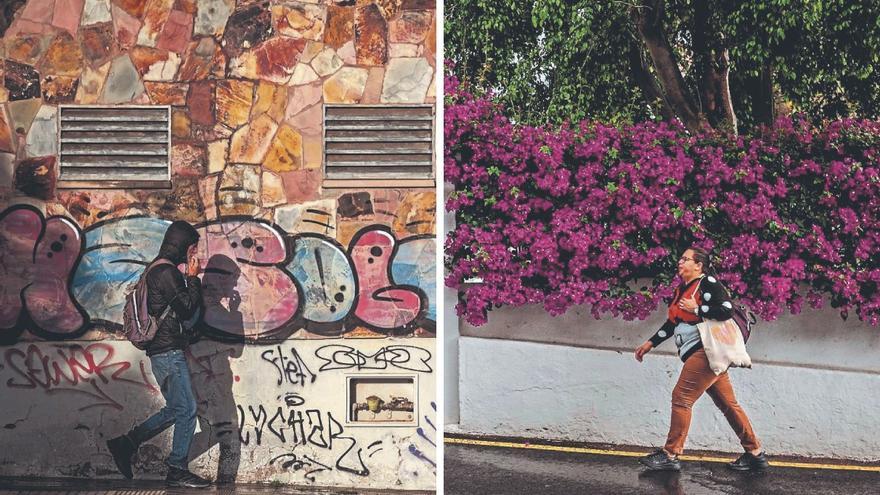
Santa Cruz de Tenerife: Luxury and Poverty Live Side-by-Side
An updated Atlas of Household Income Distribution reveals a stark economic divide in Santa Cruz de Tenerife, where the affluent Las Mimosas (average income €124,345) stands in sharp contrast to Añaza (€22,675), the Canary Islands' poorest neighborhood, a gap evident in daily life.
Luxury homes with private pools stand next to crumbling buildings with old wiring. Grand family chalets with housekeepers contrast with local bars serving traditional coffee. This stark difference, captured in words and pictures, clearly shows a deep economic divide. The gap between rich and poor neighborhoods in the Canary Islands' capitals is more than just numbers. The latest Atlas of Household Income Distribution, updated this year with 2023 data, reveals statistics that are clearly visible in the daily lives of people living in these areas.
This contrast is particularly clear in Santa Cruz de Tenerife. Las Mimosas, the wealthiest area of the capital, has an average annual income of 124,345 euros. Here, narrow, steep streets lead to elegant chalets and green gardens.
Santa Cruz de Tenerife is also home to Añaza, the neighborhood with the lowest annual income in the entire Canary Islands, at 22,675 euros. One of its main features is the stressful rush of traffic during busy times. Añaza is characterized by large graffiti, local cafes, and sewing workshops for young people at risk of social exclusion.
Andrés, 11, dreams of becoming a lawyer like his father, while his mother works part-time as a secretary. He lives just over 500 meters from his school, but he travels this short distance in the back of an SUV. Before he gets out of the white electric car, the driver opens the trunk for him to get his backpack. Las Mimosas' streets are narrow and steep, and many are not served by the Titsa bus network, meaning residents often have to walk to a bus stop. Ignacio, who retired five years ago from a bank ("when we could still do things ourselves, not like now with computers," he grumbles), is waiting for the 902 bus to Barrio Nuevo. His car is in the garage, and he's already had bad news: "The repair will cost over 600 euros... It's old, but it needs to last," he sighs, looking at the grey sky.
Alberto, 14, wants to be a graphic designer. His father is a delivery driver, and his mother is a supermarket cashier. He attends IES María Rosa Alonso in Añaza, two kilometers from his home, and usually walks. He only takes the bus if the weather is bad or he doesn't feel like walking. His family has bought a share of Christmas Lottery ticket number 01333, sold at the school entrance for tomorrow's draw. "Let's hope it wins!" he calls out, disappearing into a group of teenagers. Nearby, Luisa, a waitress at a cafe in Taco, waits for the Titsa 036 bus. She says she "saves a lot" thanks to free public transport. However, she adds that some days you need a lot of patience to "endure the cold and loneliness at a bus stop, especially after dark."
A DHL delivery driver confirms he's at the right address on Emilio Serra Fernández Moratín street. The delivery is for a housekeeper who wishes to remain anonymous. As she closes the gate, she offers a "good morning" with a knowing smile, a silent request that seems to say, "please don't cause any trouble." Las Mimosas doesn't have many everyday service businesses, though it does have aesthetic clinics, architecture studios, and a 24-hour pharmacy. To do something simple like play the Bonoloto lottery, one must find a small tobacconist with an EL DÍA sign at the corner of Olvido and Sueños streets. A man in a large 4x4 parks at a bus stop, enters a 1 x 2 (a type of betting shop), and asks for a EuroMillions ticket. The assistant reminds him about La Primitiva's 61.5 million jackpot, and he's persuaded, buying a ticket and number 53,188 from last Thursday's Lottery.
In a bar on Añaza avenue, an elderly man sips his "leche y leche" (a coffee with milk) and reads a sports newspaper. He loudly declares to no one in particular that "Xabi Alonso is finished after Real Madrid's tough cup win at Talavera." When no one responds, he changes topic, complaining about the neighborhood's needs. "I won't live to see it, but a tram line would be great for us. If they built one in Taco and are thinking of extending it to Las Teresitas and Los Rodeos, someone must think it's really needed here, right?" the former taxi driver muses, but no one takes up his point. Nearby, Feli teaches sewing, pattern making, and design. She initially studied carpentry but switched to design after realizing she "spent all day making bearings." Now, she teaches sewing to young people at risk of social exclusion.
At lunchtime, Yessica and Jony serve customers at two indoor tables in La Tasca de Enfrente, a classic restaurant in Las Mimosas. Open for 52 years, it's a popular spot for both locals and many visitors from Santa Cruz. "Some days are quiet, others we can barely keep up," they say. Together, they have ten years of experience in a job where "you always have to smile." A few streets away, Andrea, Blanca, Loli, and Yurena offer equally warm smiles at the López Echeto sweet shop. Loli is the most experienced, having worked there for 42 years, starting at the shop near the Bullring and also working in the cafe and ice cream parlor. "Many people from the neighborhood come, but our customers also come from other parts of the city," says one of the five women, as the busy shop prepares for numerous Christmas orders. "Busy times are ahead, but we always manage."
In Añaza's commercial area, traffic is a nightmare, and finding parking is nearly impossible. Supermarkets are packed with Christmas Eve and Christmas shoppers. Customers and staff alike take short breaks to grab a bite at a nearby cafe or burger joint. The situation gets worse when the high school lets out, and many students head out for a quick meal. In a quieter spot, Fefi tidies up the facilities of Mujeres de Añaza Emprendedoras (MAE), or 'Entrepreneurial Women of Añaza'.
"We're open from nine in the morning until four in the afternoon," she says with a wide smile, "but I usually stay a bit longer because I like to find everything clean the next day." She's talking about a place where both young and older people learn the basics of modeling.