
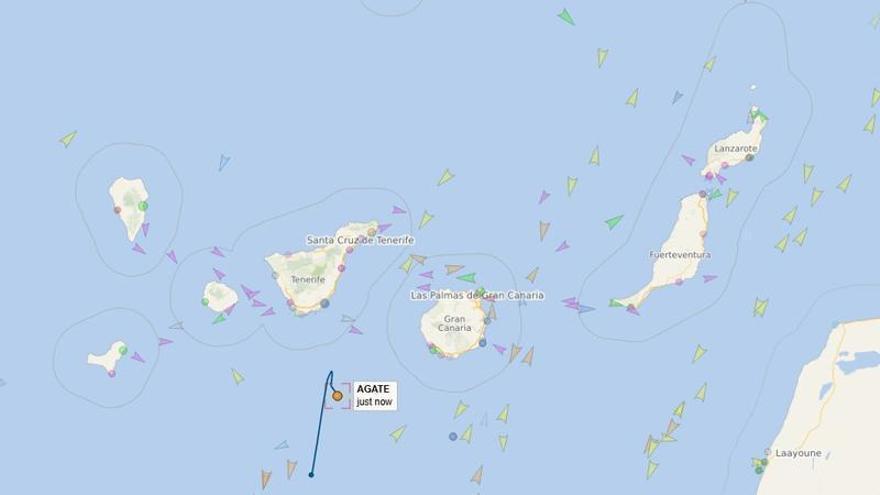
Sanctioned 'Ghost Ship' Loiters Off Canary Islands
A sanctioned "ghost fleet" oil tanker, the Agate, has been drifting unusually for weeks near the Canary Islands, raising maritime security and environmental concerns due to its suspected cargo of Russian fuel.
The Canary Islands saw a mysterious American cargo ship, the Cape Texas, circling its waters at the start of 2025. Now, 2026 begins with another unusual visitor: the oil tanker Agate, part of what's known as the 'ghost fleet.' This isn't a sci-fi reference; it refers to ships like the Agate, which is currently about 290 nautical miles south of Tenerife and is under sanctions from both the European Union and the United Kingdom.
This ship, built in 2005 and flying the flag of Vanuatu, is a tanker designed to carry petroleum products. For over three weeks, maritime tracking data from VesselFinder shows it has been moving very slowly, or barely at all, without any clear destination. This kind of behavior has led international maritime surveillance to label it a 'ghost ship.' Such vessels are part of a network that tries to avoid various trade rules and restrictions at sea by using flags from countries with lax regulations, complex company ownership, or by frequently changing their registration.
The Agate has been drifting southwest of the Canary Islands for weeks, which is unusual for a ship of its kind. Rafael Muñoz, a maritime security expert and co-director of the International Master's in Maritime Security and Protection at Campus CISDE, told the 'Diario de Ucrania' podcast that the ship is carrying 400,000 barrels of Russian fuel. Its original destination was likely a port near Panama. Muñoz believes the ship stopped south of the Canary Islands to avoid being seized by the US Navy in the mid-Atlantic, especially given the situation in Venezuela and recent US actions against other 'dark fleet' vessels.
It's thought the Agate might be carrying Russian naphtha, a type of fuel, intended for Venezuela. Recent global events may have compelled it to stay in international waters, even though it's within Spain's Exclusive Economic Zone. Because of its legal status, this kind of ship typically avoids entering European Union ports unless there's a declared emergency. The Agate's presence near the Canary Islands highlights the islands' important strategic location on shipping routes connecting Africa, America, and Europe.
International records show the Agate is restricted because it's suspected of being involved in trading oil and gas that are under sanctions. This kind of activity has increased in recent years due to global conflicts and economic penalties imposed by Western countries. There are estimated to be around a thousand such ships sailing worldwide.
Measuring nearly 180 meters long and capable of carrying hundreds of thousands of barrels of fuel, ships like the Agate pose potential environmental and maritime security risks, especially when they operate outside normal regulatory oversight.
The Agate's presence near the Canary Islands once again shows how exposed the islands are to the routes used by this 'ghost fleet.' This network operates in a grey area between legal and illegal, exploiting the complex rules of international shipping.
As of now, the Agate has not asked for help or permission to enter any port, nor is it reported to be in an emergency. Its future actions could vary: it might continue its journey, be stopped by international authorities, or simply leave the Atlantic waters near the Canary Islands to find a new route or stay in a different area.